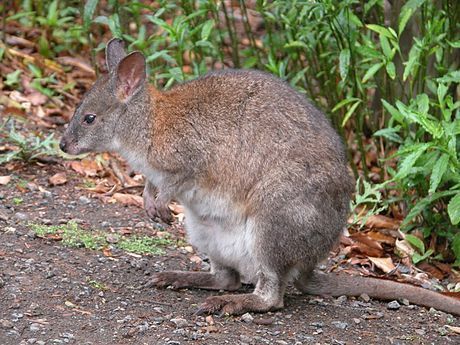
Long-nosed Potoroo

Long-nosed Potoroo

Potorous tridactylus

Silhouette: Rachel T Mason · PhyloPic

LCNTNear ThreatenedVUENCR Endemic
Daily sighting probability ~20% · Possible
at Springbrook National Park

In 3 days ~50% in a week ~80%

36 Verified sightings at Springbrook National Park From 2019 to 2026
59 In all 3 parks
August Best month
🌙 Nocturnal When it's spotted

About the Long-nosed Potoroo

The long-nosed potoroo (Potorous tridactylus) is a small, hopping mammal native to forests and shrubland of southeastern Australia and Tasmania. A member of the potoroo and bettong family (Potoroidae), it lives alone and digs at night for fungi, roots, or small insects. It is also a marsupial (like kangaroos) and carries its young in a pouch. The long-nosed potoroo is threatened by habitat loss and introduced species such as cats or foxes.

At first glance, the long-nosed potoroo with its pointed nose and grey-brown fur looks very much like a bandicoot — that is, until it hops away with its front feet tucked into its chest, revealing its close relationship with the kangaroo family. The long-nosed potoroo exhibits many morphological specializations such as an elongated pointed rostral region (nose), erect ears, large eyes, claws for digging, and long robust hind legs. It is only a small marsupial, with a body length between 34 and 38 cm (13–15 in), and a semi-prehensile tail length of 15 to 24 cm (5.9–9.4 in).

As it is rarely seen in the wild, better indicators of its presence are the runways it makes through the undergrowth and the hollow diggings it leaves behind when feeding on underground roots and fungi. Wikipedia →

Global Distribution

Parks Where Found

# Park Country Daily sighting probability
1 Maria Island National Park 🇦🇺 Australia
~30%
2 Springbrook National Park 🇦🇺 Australia
~20%
3 Great Otway National Park 🇦🇺 Australia
~10%

Zoos & Centres Where Found

# Zoo / Centre Country
1 Pairi Daiza 🇧🇪 Belgium In captivity
2 Prague Zoo 🇨🇿 Czechia In captivity
3 Healesville Sanctuary 🇦🇺 Australia In captivity
4 Taronga Zoo 🇦🇺 Australia In captivity
5 Wilhelma 🇩🇪 Germany In captivity
6 Cleland Wildlife Park 🇦🇺 Australia In captivity
7 Melbourne Zoo 🇦🇺 Australia In captivity
8 Lone Pine Koala Sanctuary 🇦🇺 Australia In captivity
9 Sydney Zoo 🇦🇺 Australia In captivity
10 Bonorong Wildlife Sanctuary 🇦🇺 Australia In captivity
11 Sea Life Sydney Aquarium 🇦🇺 Australia In captivity
12 Wild Life Sydney 🇦🇺 Australia In captivity
13 Birdworld Kuranda 🇦🇺 Australia In captivity
14 Kuranda Koala Gardens 🇦🇺 Australia In captivity
15 Rákosův pavilon 🇨🇿 Czechia In captivity
16 Velemlokárium 🇨🇿 Czechia In captivity
17 Warrawong Wildlife Sanctuary 🇦🇺 Australia In captivity
18 Wildlife HQ Zoo 🇦🇺 Australia In captivity
19 Wing's Wildlife Park 🇦🇺 Australia In captivity

Before you go

What are the chances of seeing a Long-nosed Potoroo in Springbrook National Park?

Possible

About 20% of wildlife watchers report a Long-nosed Potoroo sighting in Springbrook National Park on a given day, based on 36 verified sightings from GBIF citizen-science data from 2019 to 2026. It is the 9th most-seen of the 22 mammals we can rate there. Over three days the chance rises to about 50%, and over a week to about 80%, if each day is a fresh chance.

When is the best time to see a Long-nosed Potoroo in Springbrook National Park?

August

In that month about 40% of wildlife watchers report a Long-nosed Potoroo in Springbrook National Park on a given day, against under 5% in March to May, the lowest months. That is one of Springbrook National Park's driest months, with about 45 mm of rain against 210 mm in February.

What time of day is best to see a Long-nosed Potoroo?

Between 8 and 11 pm

Across all the parks we cover, that three-hour window holds the most Long-nosed Potoroo sightings with a recorded time, and about 7 in 10 of them come between 6 pm and 6 am: it is mostly seen at night.

Is Springbrook National Park the best place to see a Long-nosed Potoroo?

2nd of 3

Of the 3 parks where we can rate Long-nosed Potoroo sightings, Springbrook National Park ranks 2nd at about 20%. The best odds are in Maria Island National Park (Australia, about 30%).

Which relatives of the Long-nosed Potoroo live in Springbrook National Park?

Same order: Diprotodontia

The closest relatives of the Long-nosed Potoroo that you can see in Springbrook National Park (order Diprotodontia, Kangaroos, Possums, Wombats, and Allies) are Red-legged Pademelon (about 70%), Koala (about 60%) and Red-necked Pademelon (about 50%), with each one's daily chance of a sighting.

Where does the Long-nosed Potoroo sighting chance come from?

GBIF citizen-science records

It is estimated from how often the Long-nosed Potoroo is recorded against all the mammals logged in Springbrook National Park (36 verified sightings from 2019 to 2026), calibrated against known sighting rates. Figures are rounded to the nearest 10% because citizen-science data supports honest approximations, not decimals, and months with records from fewer than five people show "—". How it works.

← Back to Springbrook National Park