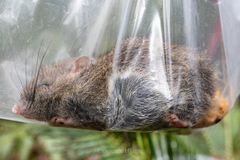
Bush Rat

Bush Rat

Rattus fuscipes

Silhouette: Rachel T Mason · PhyloPic

LCLeast ConcernNTVUENCR Endemic
Daily sighting probability ~10% · With luck
at Springbrook National Park

In 3 days ~20% in a week ~40%

5 Verified sightings at Springbrook National Park From 2019 to 2026
54 In all 5 parks
July Best month
☀️🌙 Day & Night When it's spotted

About the Bush Rat

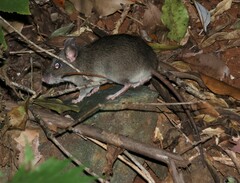
The bush rat or Australian bush rat (Rattus fuscipes) is a small Australian nocturnal animal. It is an omnivore and one of the most common indigenous species of rat on the continent, found in many heathland areas of Victoria and New South Wales.

The description of the species by G. R. Waterhouse was published in the second part of the series Zoology of the Voyage of H.M.S. Beagle, edited by Charles Darwin. The species was assigned to the genus Mus, a once broader classification, and later placed with the genus Rattus. The collection of the type specimen was made when HMS Beagle was anchored at King George Sound, a port at the southwest of the continent. The capture was noted by Darwin as "caught in a trap baited with cheese, amongst the bushes...". The type locality has been determined as Little Grove, Western Australia, six kilometres (3.7 mi) south of Mount Melville in the city of Albany. The population is regarded as the fuscipes species group, as the species has received various treatments of subspecies.

Four subspecies are recognised, each occurring in different regions or habitat, these are R. f. assimilis, common in the coastal region of the south and east of... Wikipedia →

Global Distribution

Parks Where Found

# Park Country Daily sighting probability
1 Lamington National Park 🇦🇺 Australia
~20%
2 Booderee National Park 🇦🇺 Australia
~10%
3 Great Otway National Park 🇦🇺 Australia
~10%
4 Springbrook National Park 🇦🇺 Australia
~10%
5 Blue Mountains National Park 🇦🇺 Australia
~10%

Cities Where Found

# City Country Daily sighting probability
1 Sydney 🇦🇺 Australia
<5%

Before you go

What are the chances of seeing a Bush Rat in Springbrook National Park?

With luck

About 10% of wildlife watchers report a Bush Rat sighting in Springbrook National Park on a given day, based on 5 verified sightings from GBIF citizen-science data from 2019 to 2026. It is the 20th most-seen of the 22 mammals we can rate there. Over three days the chance rises to about 20%, and over a week to about 40%, if each day is a fresh chance.

When is the best time to see a Bush Rat in Springbrook National Park?

July

In that month about 20% of wildlife watchers report a Bush Rat in Springbrook National Park on a given day, against under 5% in February–June and August–November, the lowest months. That is one of Springbrook National Park's driest months, with about 50 mm of rain against 210 mm in February.

What time of day is best to see a Bush Rat?

Between 8 and 11 pm

Across all the parks we cover, that three-hour window holds the most Bush Rat sightings with a recorded time, and about 6 in 10 of them come between 6 pm and 6 am: it is seen both by day and at night.

Where does the Bush Rat sighting chance come from?

GBIF citizen-science records

It is estimated from how often the Bush Rat is recorded against all the mammals logged in Springbrook National Park (5 verified sightings from 2019 to 2026), calibrated against known sighting rates. Figures are rounded to the nearest 10% because citizen-science data supports honest approximations, not decimals, and months with records from fewer than five people show "—". How it works.

← Back to Springbrook National Park