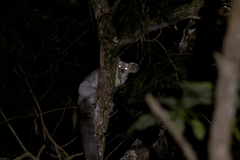
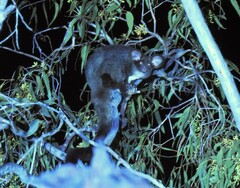
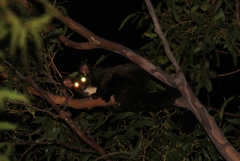
Greater Glider

Greater Glider

Petauroides volans

Silhouette: Rachel T Mason · PhyloPic

LCNTVUENEndangeredCR Endemic
Daily sighting probability ~10% · With luck
at Springbrook National Park

In 3 days ~20% in a week ~30%

26 Verified sightings at Springbrook National Park From 2019 to 2026
78 In all 3 parks
September Best month
🌙 Nocturnal When it's spotted

About the Greater Glider

The southern greater glider (Petauroides volans), also known as the southern and central greater glider, is a species of large gliding marsupial native to the forests of southeastern Australia. It is an endangered species per the IUCN Red List classification, and since 5 July 2022 has also been listed as endangered under the EPBC Act in Australia. The main threats to its survival are climate change and logging.

This was the first described species of Petauroides, and long thought to be the only species, with Petauroides armillatus and Petauroides minor being thought to comprise a distinct subspecies of it, P. volans minor; together, they were referred to as the greater glider. However, in 2012 and 2015, several field guides written by Colin Groves and/or Stephen Jackson listed the greater glider as being split into three species, confirmed by a 2020 analysis which found significant genetic and morphological differences between the three species. The American Society of Mammalogists now considers the two subspecies to be distinct from P. volans.

The Australian Government's Species Profile and Threats Database (SPRAT) refers to the animal as the greater glider (southern... Wikipedia →

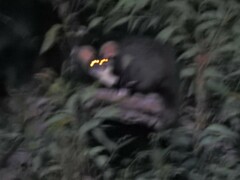
Global Distribution

Parks Where Found

# Park Country Daily sighting probability
1 Blue Mountains National Park 🇦🇺 Australia
~10%
2 Lamington National Park 🇦🇺 Australia
~10%
3 Springbrook National Park 🇦🇺 Australia
~10%

Zoos & Centres Where Found

# Zoo / Centre Country
1 Taronga Western Plains Zoo 🇦🇺 Australia In captivity

Before you go

What are the chances of seeing a Greater Glider in Springbrook National Park?

With luck

About 10% of wildlife watchers report a Greater Glider sighting in Springbrook National Park on a given day, based on 26 verified sightings from GBIF citizen-science data from 2019 to 2026. It is the 22nd most-seen of the 22 mammals we can rate there. Over three days the chance rises to about 20%, and over a week to about 30%, if each day is a fresh chance.

When is the best time to see a Greater Glider in Springbrook National Park?

June and September–December

In those months about 10% of wildlife watchers report a Greater Glider in Springbrook National Park on a given day, against under 5% in January–May and July–August, the lowest months.

What time of day is best to see a Greater Glider?

Between 6 and 9 pm

Across all the parks we cover, that three-hour window holds the most Greater Glider sightings with a recorded time, and about 8 in 10 of them come between 6 pm and 6 am: it is mostly seen at night.

Is Springbrook National Park the best place to see a Greater Glider?

Among the best

Of the 3 parks where we can rate Greater Glider sightings, Springbrook National Park ranks 3rd at about 10%, level with the leaders once rounded. The best odds are in Blue Mountains National Park (Australia, about 10%) and Lamington National Park (Australia, about 10%).

Where does the Greater Glider sighting chance come from?

GBIF citizen-science records

It is estimated from how often the Greater Glider is recorded against all the mammals logged in Springbrook National Park (26 verified sightings from 2019 to 2026), calibrated against known sighting rates. Figures are rounded to the nearest 10% because citizen-science data supports honest approximations, not decimals, and months with records from fewer than five people show "—". How it works.

← Back to Springbrook National Park