Little Cuckoo

Little Cuckoo

Piaya minuta

Silhouette: Nicolas Huet le Jeune and Jean-Gabriel Prêtre (vectorized by T. Michael Keesey) · PhyloPic

LCLeast ConcernNTVUENCR
Daily sighting probability <5% · Rare
at Tambopata National Reserve

In 3 days ~10%

57 Verified sightings at Tambopata National Reserve From 2019 to 2026
573 In all 10 parks
May Best month
☀️ Diurnal When it's spotted

About the Little Cuckoo

The little cuckoo (Coccycua minuta) is a species of bird in the cuckoo family (Cuculidae) from South America and Panama. It was formerly placed in the genus Piaya, but was moved to the reinstated genus Coccycua following the discovery that its closest living relatives are a couple species traditionally placed in Coccyzus or Micrococcyx, rather than the other members of Piaya.

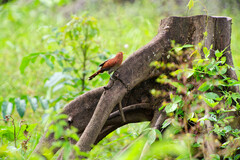
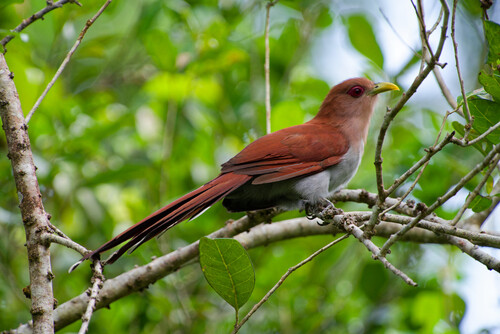
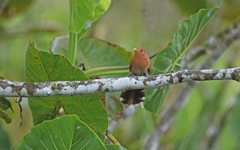
This species is about 27 centimetres (11 in) long and weighs 40 grams (1.4 oz). The adult is mainly chestnut brown, with a greyish lower belly, browner tail and white tips to the tail feathers. The bill is yellow, short, and decurved; the iris of the eyes is red. Immature birds are dark brown with a black bill and no white tail tips. It is smaller and the throat is darker than in the squirrel cuckoo.

The little cuckoo makes harsh chek and kak calls. This small cuckoo occurs from Panama and Trinidad south through Colombia to Bolivia, Peru and Brazil; in Ecuador, it has been recorded as high up as 1,900 metres (6,200 ft) ASL. The little cuckoo is found in mangrove swamps, and scrubby woodland near water. It is generally believed to be an all-year resident, but... Wikipedia →

Sounds

Call0:19

French Guiana · 2024

© Tristan Guillebot de Nerville · XC1139131 · CC BY-NC-SA 4.0

Song0:13

Brazil · 2024

© JAYRSON ARAUJO DE OLIVEIRA · XC949490 · CC BY-NC-SA 4.0

Recording0:15

Colombia · 2021

© David Monroy Rengifo · XC639825 · CC BY-NC-SA 4.0

Global Distribution

Parks Where Found

# Park Country Daily sighting probability
1 Caroni Swamp 🇹🇹 Trinidad and Tobago
~10%
2 Parque Estadual Encontro das Águas 🇧🇷 Brazil
~10%
3 Yasuní National Park 🇪🇨 Ecuador
~10%
4 Manu National Park 🇵🇪 Peru
<5%
5 Cuyabeno Wildlife Reserve 🇪🇨 Ecuador
<5%
6 Tambopata National Reserve 🇵🇪 Peru
<5%
7 Darién National Park 🇵🇦 Panama
<5%
8 Sierra de la Macarena National Park 🇨🇴 Colombia
<5%
9 Amacayacu National Natural Park 🇨🇴 Colombia
<5%
10 Chapada dos Guimarães National Park 🇧🇷 Brazil
<5%

Cities Where Found

# City Country Daily sighting probability
1 Panama City 🇵🇦 Panama
<5%

Before you go

What are the chances of seeing a Little Cuckoo in Tambopata National Reserve?

Rare

Under 5% of wildlife watchers report a Little Cuckoo sighting in Tambopata National Reserve on a given day, based on 57 verified sightings from GBIF citizen-science data from 2019 to 2026. It is the 375th most-seen of the 550 birds we can rate there. Over three days the chance rises to about 10%, if each day is a fresh chance.

When is the best time to see a Little Cuckoo in Tambopata National Reserve?

May

In that month about 10% of wildlife watchers report a Little Cuckoo in Tambopata National Reserve on a given day, against under 5% in June to April, the lowest months.

What time of day is best to see a Little Cuckoo?

Between 8 and 11 am

Across all the parks we cover, that three-hour window holds the most Little Cuckoo sightings with a recorded time, and about 9 in 10 of them come between 6 am and 6 pm: it is a daytime animal.

Is Tambopata National Reserve the best place to see a Little Cuckoo?

6th of 10

Of the 10 parks where we can rate Little Cuckoo sightings, Tambopata National Reserve ranks 6th at under 5%. The best odds are in Caroni Swamp (Trinidad and Tobago, about 10%), Parque Estadual Encontro das Águas (Brazil, about 10%) and Yasuní National Park (Ecuador, about 10%).

Where does the Little Cuckoo sighting chance come from?

GBIF citizen-science records

It is estimated from how often the Little Cuckoo is recorded against all the birds logged in Tambopata National Reserve (57 verified sightings from 2019 to 2026), calibrated against known sighting rates. Figures are rounded to the nearest 10% because citizen-science data supports honest approximations, not decimals, and months with records from fewer than five people show "—". How it works.

← Back to Tambopata National Reserve