Pheasant Cuckoo

Pheasant Cuckoo

Dromococcyx phasianellus

Silhouette: Nicolas Huet le Jeune and Jean-Gabriel Prêtre (vectorized by T. Michael Keesey) · PhyloPic

LCLeast ConcernNTVUENCR
Daily sighting probability <5% · Rare
at Tambopata National Reserve

In 3 days <5% in a week ~10%

22 Verified sightings at Tambopata National Reserve From 2019 to 2026
633 In all 14 parks
May Best month
☀️ Diurnal When it's spotted

About the Pheasant Cuckoo

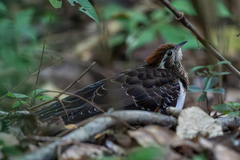
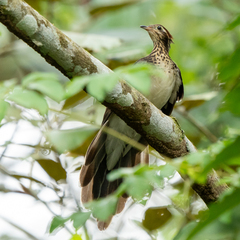
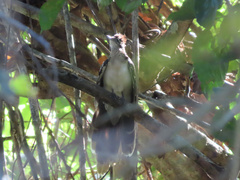
The pheasant cuckoo (Dromococcyx phasianellus) is a species of neotropical cuckoo in the subfamily Neomorphinae of the family Cuculidae. It is native to Central and South America where it occurs in lowland tropical forest.

The pheasant cuckoo is a large cuckoo with a short crest tipped with rusty brown. The bird's upper parts are dark sooty-brown and the underparts are pale buff with small black streaks on the breast. The feathers of the large tail are of varying lengths, with the central ones being the longest. The call consists of two short whistles, the second being of higher pitch, followed by a trill "whee! whee! wheerr-rr". It can be sung from low, medium, or high perches or from the ground.

The breeding season in Mexico appears to be March through August when the males sing. In Oaxaca breeding is from April to June while in Panama calling most frequent from mid-April to July, i.e. from the onset of wet season. There is little information about territorial behaviour. Males respond to singing males with counter-singing or by a strutting display involving head and crest raised, breast feathers puffed out and wings partially extended... Wikipedia →

Sounds

Song0:15

Brazil · 2026

© JAYRSON ARAUJO DE OLIVEIRA · XC1162241 · CC BY-NC-SA 4.0

Aberrant0:34

Brazil · 2025

© Miguel Angelo Biz · XC999529 · CC BY-NC-SA 4.0

Call0:33

Panama · 2009

© Ken Allaire · XC60746 · CC BY-NC-ND 2.5

Global Distribution

Parks Where Found

# Park Country Daily sighting probability
1 Biotopo Cerro Cahuí 🇬🇹 Guatemala
~10%
2 Tikal National Park 🇬🇹 Guatemala
~10%
3 Chapada dos Guimarães National Park 🇧🇷 Brazil
~10%
4 Calakmul Biosphere Reserve 🇲🇽 Mexico
~10%
5 Chagres National Park 🇵🇦 Panama
<5%
6 Cañón del Sumidero National Park 🇲🇽 Mexico
<5%
7 Soberanía National Park 🇵🇦 Panama
<5%
8 Cusuco National Park 🇭🇳 Honduras
<5%
9 Pico Bonito National Park 🇭🇳 Honduras
<5%
10 Tambopata National Reserve 🇵🇪 Peru
<5%
11 Manu National Park 🇵🇪 Peru
<5%
12 Yasuní National Park 🇪🇨 Ecuador
<5%
13 Sian Ka'an Biosphere Reserve 🇲🇽 Mexico
<5%
14 Parque Natural Metropolitano 🇵🇦 Panama
<5%

Cities Where Found

# City Country Daily sighting probability
1 Campo Grande 🇧🇷 Brazil
<5%
2 Panama City 🇵🇦 Panama
<5%

Before you go

What are the chances of seeing a Pheasant Cuckoo in Tambopata National Reserve?

Rare

Under 5% of wildlife watchers report a Pheasant Cuckoo sighting in Tambopata National Reserve on a given day, based on 22 verified sightings from GBIF citizen-science data from 2019 to 2026. It is the 451st most-seen of the 550 birds we can rate there. Over three days the chance rises to under 5%, and over a week to about 10%, if each day is a fresh chance.

When is the best time to see a Pheasant Cuckoo in Tambopata National Reserve?

Any time of year

In every month with enough records, under 5% of wildlife watchers report a Pheasant Cuckoo in Tambopata National Reserve on a given day, so our monthly data shows no clear season.

What time of day is best to see a Pheasant Cuckoo?

Between 9 am and noon

Across all the parks we cover, that three-hour window holds the most Pheasant Cuckoo sightings with a recorded time, and about 9 in 10 of them come between 6 am and 6 pm: it is a daytime animal.

Where does the Pheasant Cuckoo sighting chance come from?

GBIF citizen-science records

It is estimated from how often the Pheasant Cuckoo is recorded against all the birds logged in Tambopata National Reserve (22 verified sightings from 2019 to 2026), calibrated against known sighting rates. Figures are rounded to the nearest 10% because citizen-science data supports honest approximations, not decimals, and months with records from fewer than five people show "—". How it works.

← Back to Tambopata National Reserve