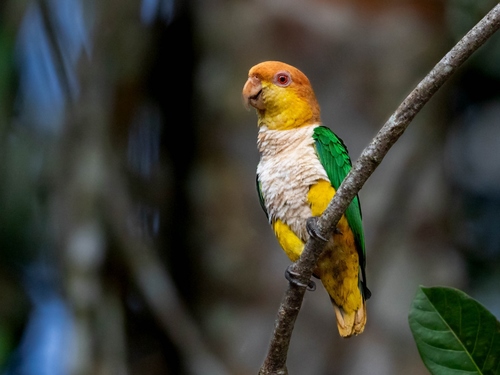
Red-shouldered Macaw

Red-shouldered Macaw

Diopsittaca nobilis

Silhouette: Sheatherius · PhyloPic

LCLeast ConcernNTVUENCR
Daily sighting probability <5% · Rare
at Tambopata National Reserve

In 3 days <5%

11 Verified sightings at Tambopata National Reserve From 2019 to 2026
841 In all 5 parks
January Best month
☀️ Diurnal When it's spotted

About the Red-shouldered Macaw

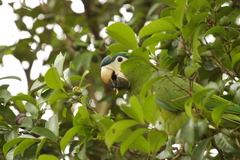
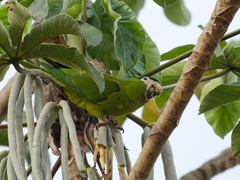
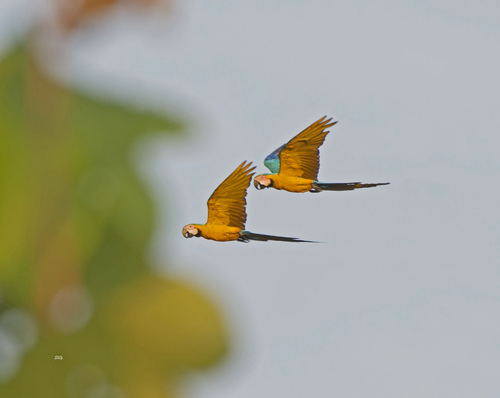
The red-shouldered macaw (Diopsittaca nobilis) is a small green South American parrot, a member of a large group of Neotropical parrots called macaws. The species is named for the red coverts on its wings. It is the smallest macaw, being 30 cm (12 in) in length – similar in size to the Aratinga parakeets. It is native to the tropical lowlands, savannahs, and swamplands of Brazil, the Guianas, Bolivia, Venezuela, and far south-eastern Peru. There are three subspecies: The noble macaw (Diopsittaca nobilis cumanensis), Hahn's macaw (Diopsittaca nobilis nobilis), and the long-winged macaw (Diopsittaca nobilis longipennis). The long-winged macaw is a poorly distinct third subspecies that has longer wings, but is otherwise similar to the noble macaw. The Hahn's subspecies is named for German zoologist Carl-Wilhelm Hahn, who in 1834 began compiling Ornithologischer Atlas oder naturgetreue Abbildung und Beschreibung der aussereuropäischen Vögel (Engl: Ornithological Atlas or natural depiction and description of birds from outside Europe).

Red-shouldered macaws are frequently bred in captivity for the pet trade, where they are sometimes described as mini-macaws. Though wild populations of red-shouldered macaws have declined locally due to habitat loss, they are listed as Least Concern by IUCN. They are listed on Appendix II of CITES, and trade is restricted. Wikipedia →

Sounds

Call0:37

Brazil · 2026

© JAYRSON ARAUJO DE OLIVEIRA · XC1164967 · CC BY-NC-SA 4.0

Flight call0:24

Guyana · 2025

© Richard E. Webster · XC1031776 · CC BY-NC-SA 4.0

Alarm call0:21

Brazil · 2025

© Fabrício Grigolin · XC1023352 · CC BY-NC-SA 4.0

Global Distribution

Parks Where Found

# Park Country Daily sighting probability
1 Emas National Park 🇧🇷 Brazil
~50%
2 Chapada dos Guimarães National Park 🇧🇷 Brazil
~20%
3 Tijuca National Park 🇧🇷 Brazil
~20%
4 Parque Estadual Encontro das Águas 🇧🇷 Brazil
<5%
5 Tambopata National Reserve 🇵🇪 Peru
<5%

Cities Where Found

# City Country Daily sighting probability
1 Maceió 🇧🇷 Brazil
~50%
2 João Pessoa 🇧🇷 Brazil
~50%
3 São Paulo 🇧🇷 Brazil
~30%
4 São Luís 🇧🇷 Brazil
~30%
5 Campo Grande 🇧🇷 Brazil
~20%
6 Campinas 🇧🇷 Brazil
~20%
7 Rio de Janeiro 🇧🇷 Brazil
~10%
8 Recife 🇧🇷 Brazil
~10%
9 Goiânia 🇧🇷 Brazil
~10%
10 Niterói 🇧🇷 Brazil
<5%

Zoos & Centres Where Found

# Zoo / Centre Country
1 Parque das Aves 🇧🇷 Brazil In captivity
2 Givskud Zoo 🇩🇰 Denmark In captivity
3 Beijing Zoo 🇨🇳 China In captivity
4 Lisbon Zoo 🇵🇹 Portugal In captivity
5 Zoológico Dois Irmãos 🇧🇷 Brazil In captivity
6 Bioparque Municipal Vesty Pakos 🇧🇴 Bolivia In captivity
7 Ueno Zoo 🇯🇵 Japan In captivity
8 Bird Paradise 🇸🇬 Singapore In captivity
9 Parc zoologique de Fréjus 🇫🇷 France In captivity
10 Rainforest Wild Asia 🇸🇬 Singapore In captivity
11 Rio de Janeiro Zoological Garden 🇧🇷 Brazil In captivity
12 Paphos Zoo 🇨🇾 Cyprus In captivity
13 Loro Parque 🇪🇸 Spain In captivity
14 Ueno Zoological Gardens (West Garden) 🇯🇵 Japan In captivity
15 Zoológico Municipal de Guarulhos 🇧🇷 Brazil In captivity
16 Gilcrease Nature Sanctuary 🇺🇸 United States In captivity
17 Bali Bird Park 🇮🇩 Indonesia In captivity
18 Castellar Zoo 🇪🇸 Spain In captivity
19 Zoológico do Município de São Bernardo do Campo 🇧🇷 Brazil In captivity
20 Birdworld Kuranda 🇦🇺 Australia In captivity
21 Bloedel Conservatory 🇨🇦 Canada In captivity
22 Kuranda Koala Gardens 🇦🇺 Australia In captivity
23 Bird Park 🇷🇺 Russia In captivity
24 Zoológico La Era de las aves 🇪🇸 Spain In captivity

Before you go

What are the chances of seeing a Red-shouldered Macaw in Tambopata National Reserve?

Rare

Under 5% of wildlife watchers report a Red-shouldered Macaw sighting in Tambopata National Reserve on a given day, based on 11 verified sightings from GBIF citizen-science data from 2019 to 2026. It is the 505th most-seen of the 550 birds we can rate there. Over three days the chance rises to under 5%, if each day is a fresh chance.

When is the best time to see a Red-shouldered Macaw in Tambopata National Reserve?

Any time of year

In every month with enough records, under 5% of wildlife watchers report a Red-shouldered Macaw in Tambopata National Reserve on a given day, so our monthly data shows no clear season.

What time of day is best to see a Red-shouldered Macaw?

Between 3 and 6 pm

Across all the parks we cover, that three-hour window holds the most Red-shouldered Macaw sightings with a recorded time, and about 9 in 10 of them come between 6 am and 6 pm: it is a daytime animal.

Which relatives of the Red-shouldered Macaw live in Tambopata National Reserve?

Same family: Psittacidae

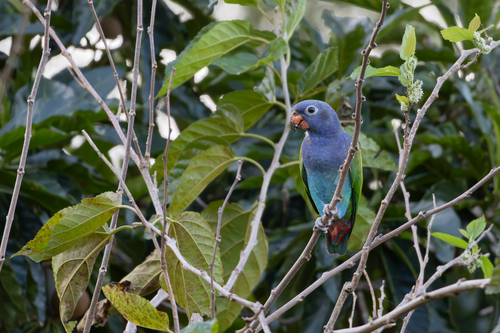
The closest relatives of the Red-shouldered Macaw that you can see in Tambopata National Reserve (family Psittacidae, New World and African Parrots) are Blue-headed Parrot (about 40%), Mealy Parrot (about 40%) and Cobalt-winged Parakeet (about 40%), with each one's daily chance of a sighting.

Where does the Red-shouldered Macaw sighting chance come from?

GBIF citizen-science records

It is estimated from how often the Red-shouldered Macaw is recorded against all the birds logged in Tambopata National Reserve (11 verified sightings from 2019 to 2026), calibrated against known sighting rates. Figures are rounded to the nearest 10% because citizen-science data supports honest approximations, not decimals, and months with records from fewer than five people show "—". How it works.

← Back to Tambopata National Reserve