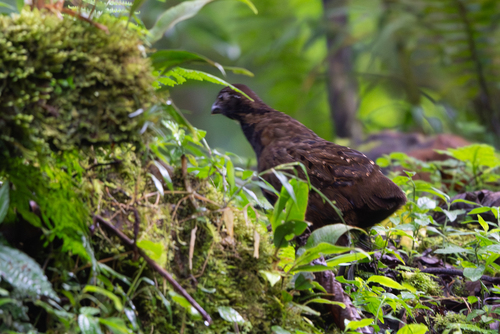
Black Guan

Black Guan

Chamaepetes unicolor

Silhouette: Natalia Ladino · PhyloPic

LCLeast ConcernNTVUENCR
Daily sighting probability ~10% · With luck
at Tapantí-Macizo de la Muerte National Park

In 3 days ~30% in a week ~60%

1,240 Verified sightings at Tapantí-Macizo de la Muerte National Park From 2019 to 2026
10,576 In all 12 parks
December Best month
☀️ Diurnal When it's spotted

About the Black Guan

The black guan (Chamaepetes unicolor) is a species of bird in the chachalaca, guan, and curassow family Cracidae. It is found in Costa Rica and Panama. The black guan shares the genus Chamaepetes with the sickle-winged guan (C. goudotii) of western South America and may form a superspecies with it.

The black guan is 62 to 69 cm (2.03 to 2.26 ft) long and weighs about 1,135 g (2.502 lb). Adults have all black plumage with contrasting bright blue facial skin around a red eye. Their legs and feet are pinkish-red. Juveniles are similar but less glossy and their underparts browner and their facial skin is blackish or dark brown.

The black guan is found from the Cordillera de Guanacaste in northern Costa Rica to western Coclé Province in Panama. It inhabits cloudforest in the Talamancan montane forest ecozone. It prefers steep terrain in the temperate, subtropical, and tropical zones, usually between about 1,000 and 2,250 m (3,280 and 7,380 ft) of elevation, but in some areas as low as 800 m (2,600 ft) and in others as high as 3,000 m (9,800 ft).

The black guan is thought to be mainly... Wikipedia →

Sounds

Wing whirring0:09

Costa Rica · 2010

© Peter Boesman · XC274424 · CC BY-NC-ND 4.0

Call0:33

Costa Rica · 2013

© Paul Driver · XC137743 · CC BY-NC-SA 3.0

Wing snap0:05

Panama · 2009

© Andrew Spencer · XC31699 · CC BY-NC-ND 2.5

Global Distribution

Parks Where Found

# Park Country Daily sighting probability
1 Monteverde Cloud Forest Reserve 🇨🇷 Costa Rica
~30%
2 Los Quetzales National Park 🇨🇷 Costa Rica
~30%
3 Poás Volcano National Park 🇨🇷 Costa Rica
~30%
4 Tapantí-Macizo de la Muerte National Park 🇨🇷 Costa Rica
~10%
5 Chirripó National Park 🇨🇷 Costa Rica
~10%
6 Volcán Barú National Park 🇵🇦 Panama
~10%
7 Braulio Carrillo National Park 🇨🇷 Costa Rica
~10%
8 La Amistad International Park (Panama) 🇵🇦 Panama
<5%
9 Irazú Volcano National Park 🇨🇷 Costa Rica
<5%
10 Arenal Volcano National Park 🇨🇷 Costa Rica
<5%
11 Rincón de la Vieja National Park 🇨🇷 Costa Rica
<5%
12 Tenorio Volcano National Park 🇨🇷 Costa Rica
<5%

Zoos & Centres Where Found

# Zoo / Centre Country
1 La Paz Waterfall Gardens 🇨🇷 Costa Rica In captivity
2 El Nispero Zoo 🇵🇦 Panama In captivity

Before you go

What are the chances of seeing a Black Guan in Tapantí-Macizo de la Muerte National Park?

With luck

About 10% of wildlife watchers report a Black Guan sighting in Tapantí-Macizo de la Muerte National Park on a given day, based on 1,240 verified sightings from GBIF citizen-science data from 2019 to 2026. It is the 78th most-seen of the 467 birds we can rate there. Over three days the chance rises to about 30%, and over a week to about 60%, if each day is a fresh chance.

When is the best time to see a Black Guan in Tapantí-Macizo de la Muerte National Park?

February and December

In those months about 20% of wildlife watchers report a Black Guan in Tapantí-Macizo de la Muerte National Park on a given day, against about 10% in January and March–November, the lowest months.

What time of day is best to see a Black Guan?

Between 10 am and 1 pm

Across all the parks we cover, that three-hour window holds the most Black Guan sightings with a recorded time, and about 9 in 10 of them come between 6 am and 6 pm: it is a daytime animal.

Which relatives of the Black Guan live in Tapantí-Macizo de la Muerte National Park?

Same family: Cracidae

The closest relatives of the Black Guan that you can see in Tapantí-Macizo de la Muerte National Park (family Cracidae, Guans, Chachalacas, and Curassows) are Great Curassow (about 10%), Crested Guan (about 10%) and Gray-headed Chachalaca (about 10%), with each one's daily chance of a sighting.

Where does the Black Guan sighting chance come from?

GBIF citizen-science records

It is estimated from how often the Black Guan is recorded against all the birds logged in Tapantí-Macizo de la Muerte National Park (1,240 verified sightings from 2019 to 2026), calibrated against known sighting rates. Figures are rounded to the nearest 10% because citizen-science data supports honest approximations, not decimals, and months with records from fewer than five people show "—". How it works.

← Back to Tapantí-Macizo de la Muerte National Park