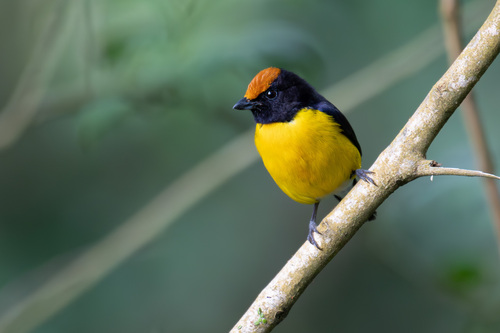
Golden-browed Chlorophonia

Golden-browed Chlorophonia

Chlorophonia callophrys

Silhouette: Sheatherius · PhyloPic

LCLeast ConcernNTVUENCR
Daily sighting probability ~30% · Possible
at Tapantí-Macizo de la Muerte National Park

In 3 days ~70% in a week ~90%

3,158 Verified sightings at Tapantí-Macizo de la Muerte National Park From 2019 to 2026
15,094 In all 12 parks
March Best month
☀️ Diurnal When it's spotted

About the Golden-browed Chlorophonia

The golden-browed chlorophonia (Chlorophonia callophrys) is a species of bird in the family Fringillidae, the finches and euphonias. It is found in Costa Rica and Panama. The golden-browed chlorophonia was originally described by Jean Cabanis in 1861 with the binomial Triglyphidia callophrys. Cabanis stated that the genus Triglyphidia "probably means 'with three small notches' ".

The golden-browed chlorophonia and the blue-crowned chlorophonia (Chlorophonia occipitalis) were for a time treated as conspecific and now form a superspecies. The genus Chlorophonia was long placed in the family Thraupidae, the "true" tanagers. Multiple studies in the late twentieth and early twenty-first centuries resulted in its being reassigned to its present place in the family Fringillidae.

The golden-browed chlorophonia is monotypic. The blue-crowned chlorophonia is a chunky, short-tailed, stubby-billed bird. It is about 13 cm (5.1 in) long and weighs about 24 g (0.85 oz). The species is sexually dimorphic. Adult males have pale violet-blue crown and nape, under the crown a golden-yellow forehead and wide supercilium, and a turquoise eye-ring. The rest... Wikipedia →

Sounds

Call0:32

Panama · 2015

© Peter Boesman · XC271154 · CC BY-NC-ND 4.0

Song0:25

Costa Rica · 2024

© Paul Driver · XC955618 · CC BY-NC-SA 4.0

Call0:15

Costa Rica · 2022

© Jerome Fischer · XC714790 · CC BY-NC-SA 4.0

Global Distribution

Parks Where Found

# Park Country Daily sighting probability
1 Los Quetzales National Park 🇨🇷 Costa Rica
~40%
2 Monteverde Cloud Forest Reserve 🇨🇷 Costa Rica
~40%
3 Tapantí-Macizo de la Muerte National Park 🇨🇷 Costa Rica
~30%
4 Volcán Barú National Park 🇵🇦 Panama
~30%
5 Braulio Carrillo National Park 🇨🇷 Costa Rica
~10%
6 La Amistad International Park (Panama) 🇵🇦 Panama
~10%
7 Poás Volcano National Park 🇨🇷 Costa Rica
~10%
8 Irazú Volcano National Park 🇨🇷 Costa Rica
~10%
9 Chirripó National Park 🇨🇷 Costa Rica
~10%
10 Arenal Volcano National Park 🇨🇷 Costa Rica
<5%
11 Tenorio Volcano National Park 🇨🇷 Costa Rica
<5%
12 Rincón de la Vieja National Park 🇨🇷 Costa Rica
<5%

Cities Where Found

# City Country Daily sighting probability
1 San José 🇨🇷 Costa Rica
<5%

Before you go

What are the chances of seeing a Golden-browed Chlorophonia in Tapantí-Macizo de la Muerte National Park?

Possible

About 30% of wildlife watchers report a Golden-browed Chlorophonia sighting in Tapantí-Macizo de la Muerte National Park on a given day, based on 3,158 verified sightings from GBIF citizen-science data from 2019 to 2026. It is the 22nd most-seen of the 467 birds we can rate there. Over three days the chance rises to about 70%, and over a week to about 90%, if each day is a fresh chance.

When is the best time to see a Golden-browed Chlorophonia in Tapantí-Macizo de la Muerte National Park?

January to May

In those months about 40% of wildlife watchers report a Golden-browed Chlorophonia in Tapantí-Macizo de la Muerte National Park on a given day, against about 20% in June to November, the lowest months.

What time of day is best to see a Golden-browed Chlorophonia?

Between 9 am and noon

Across all the parks we cover, that three-hour window holds the most Golden-browed Chlorophonia sightings with a recorded time, and about 9 in 10 of them come between 6 am and 6 pm: it is a daytime animal.

Is Tapantí-Macizo de la Muerte National Park the best place to see a Golden-browed Chlorophonia?

3rd of 12

Of the 12 parks where we can rate Golden-browed Chlorophonia sightings, Tapantí-Macizo de la Muerte National Park ranks 3rd at about 30%. The best odds are in Los Quetzales National Park (Costa Rica, about 40%) and Monteverde Cloud Forest Reserve (Costa Rica, about 40%).

Which relatives of the Golden-browed Chlorophonia live in Tapantí-Macizo de la Muerte National Park?

Same family: Fringillidae

The closest relatives of the Golden-browed Chlorophonia that you can see in Tapantí-Macizo de la Muerte National Park (family Fringillidae, Finches, Euphonias, and Allies) are Tawny-capped Euphonia (about 20%), Yellow-bellied Siskin (about 10%) and Yellow-throated Euphonia (about 10%), with each one's daily chance of a sighting.

Where does the Golden-browed Chlorophonia sighting chance come from?

GBIF citizen-science records

It is estimated from how often the Golden-browed Chlorophonia is recorded against all the birds logged in Tapantí-Macizo de la Muerte National Park (3,158 verified sightings from 2019 to 2026), calibrated against known sighting rates. Figures are rounded to the nearest 10% because citizen-science data supports honest approximations, not decimals, and months with records from fewer than five people show "—". How it works.

← Back to Tapantí-Macizo de la Muerte National Park