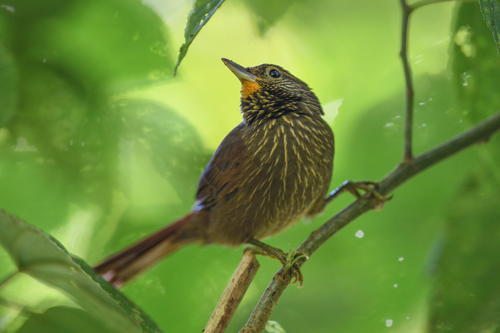
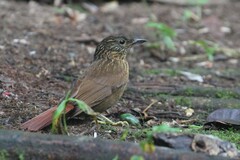
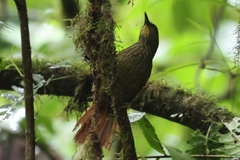
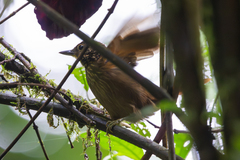
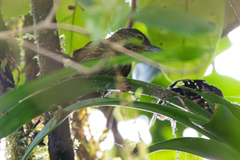

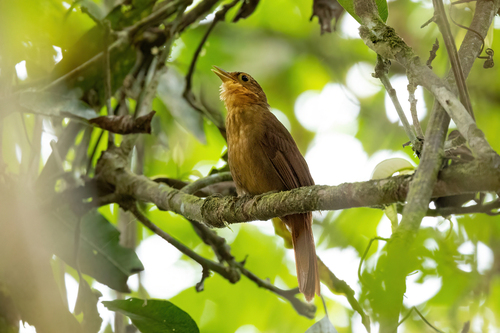
Lineated Foliage-gleaner

Lineated Foliage-gleaner

Syndactyla subalaris

Silhouette: Sheatherius · PhyloPic

LCLeast ConcernNTVUENCR
Daily sighting probability <5% · Rare
at Tapantí-Macizo de la Muerte National Park

In 3 days <5% in a week ~10%

122 Verified sightings at Tapantí-Macizo de la Muerte National Park From 2019 to 2026
2,304 In all 11 parks
August Best month
☀️ Diurnal When it's spotted

About the Lineated Foliage-gleaner

The lineated foliage-gleaner (Syndactyla subalaris) is a species of bird in the Furnariinae subfamily of the ovenbird family Furnariidae. It is found in Colombia, Costa Rica, Ecuador, Panama, Peru, and Venezuela. The lineated foliage-gleaner's taxonomy is unsettled. The International Ornithological Committee and BirdLife International's Handbook of the Birds of the World recognize these six subspecies:

Their apparent differences from mentalis are within its range of variabilty. The lineated and rufous-necked foliage-gleaner (S. ruficollis) are sister species. This article follows the six-subspecies model. The lineated foliage-gleaner is 17 to 19 cm (6.7 to 7.5 in) long and weighs 26... Wikipedia →

Sounds

Call0:16

Ecuador · 2025

© Manuel Sánchez-Nivicela · XC1161977 · CC BY-NC-ND 4.0

Uncertain0:18

Ecuador · 2026

© Daan van der Hoeven · XC1105457 · CC BY-NC-SA 4.0

Alarm call0:21

Ecuador · 2024

© Matthew L. Brady · XC977306 · CC BY-NC-SA 4.0

Global Distribution

Parks Where Found

# Park Country Daily sighting probability
1 Volcán Barú National Park 🇵🇦 Panama
~10%
2 Monteverde Cloud Forest Reserve 🇨🇷 Costa Rica
~10%
3 Farallones de Cali National Natural Park 🇨🇴 Colombia
~10%
4 La Amistad International Park (Panama) 🇵🇦 Panama
<5%
5 Darién National Park 🇵🇦 Panama
<5%
6 Los Quetzales National Park 🇨🇷 Costa Rica
<5%
7 Chirripó National Park 🇨🇷 Costa Rica
<5%
8 Braulio Carrillo National Park 🇨🇷 Costa Rica
<5%
9 Tapantí-Macizo de la Muerte National Park 🇨🇷 Costa Rica
<5%
10 Los Nevados National Natural Park 🇨🇴 Colombia
<5%
11 Arenal Volcano National Park 🇨🇷 Costa Rica
<5%

Before you go

What are the chances of seeing a Lineated Foliage-gleaner in Tapantí-Macizo de la Muerte National Park?

Rare

Under 5% of wildlife watchers report a Lineated Foliage-gleaner sighting in Tapantí-Macizo de la Muerte National Park on a given day, based on 122 verified sightings from GBIF citizen-science data from 2019 to 2026. It is the 298th most-seen of the 467 birds we can rate there. Over three days the chance rises to under 5%, and over a week to about 10%, if each day is a fresh chance.

When is the best time to see a Lineated Foliage-gleaner in Tapantí-Macizo de la Muerte National Park?

August

In that month about 10% of wildlife watchers report a Lineated Foliage-gleaner in Tapantí-Macizo de la Muerte National Park on a given day, against under 5% in September to July, the lowest months.

What time of day is best to see a Lineated Foliage-gleaner?

Between 9 am and noon

Across all the parks we cover, that three-hour window holds the most Lineated Foliage-gleaner sightings with a recorded time, and about 9 in 10 of them come between 6 am and 6 pm: it is a daytime animal.

Which relatives of the Lineated Foliage-gleaner live in Tapantí-Macizo de la Muerte National Park?

Same family: Furnariidae

The closest relatives of the Lineated Foliage-gleaner that you can see in Tapantí-Macizo de la Muerte National Park (family Furnariidae, Ovenbirds and Woodcreepers) are Ruddy Treerunner (about 20%), Spot-crowned Woodcreeper (about 20%) and Spotted Woodcreeper (about 10%), with each one's daily chance of a sighting.

Where does the Lineated Foliage-gleaner sighting chance come from?

GBIF citizen-science records

It is estimated from how often the Lineated Foliage-gleaner is recorded against all the birds logged in Tapantí-Macizo de la Muerte National Park (122 verified sightings from 2019 to 2026), calibrated against known sighting rates. Figures are rounded to the nearest 10% because citizen-science data supports honest approximations, not decimals, and months with records from fewer than five people show "—". How it works.

← Back to Tapantí-Macizo de la Muerte National Park