Violet-capped Woodnymph

Violet-capped Woodnymph

Thalurania glaucopis

Silhouette: Andy Wilson · PhyloPic

LCLeast ConcernNTVUENCR
Daily sighting probability ~30% · Possible
at Tijuca National Park

In 3 days ~70% in a week ~90%

1,002 Verified sightings at Tijuca National Park From 2019 to 2026
4,466 In all 7 parks
December Best month
☀️ Diurnal When it's spotted

About the Violet-capped Woodnymph

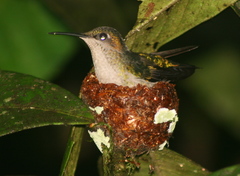
The violet-capped woodnymph (Thalurania glaucopis) is a species of hummingbird in the "emeralds", tribe Trochilini of subfamily Trochilinae. It is found in Argentina, Brazil, Paraguay, and Uruguay. The violet-capped woodnymph was formally described in 1788 by the German naturalist Johann Friedrich Gmelin in his revised and expanded edition of Carl Linnaeus's Systema Naturae. He placed it with all the other hummingbirds in the genus Trochilus and coined the binomial name Trochilus glaucopis. Gmelin based his description on "L'oiseau-mouche à queue fourchue du Brésil" that had been described and illustrated in 1760 by the French zoologist Mathurin Jacques Brisson from a preserved specimen that had been sent to Paris from Brazil. The violet-capped woodnymph is now placed with three other woodnymphs in the genus Thalurania that was introduced in 1848 by the English ornithologist John Gould. The genus name combines the Ancient Greek thalos meaning "child" with ouranos meaning "heaven". The specific epithet glaucopis is from the Ancient Greek glaukos meaning "blue-grey" or "glaucous" with ōps meaning "face". The species is treated as monotypic: no subspecies... Wikipedia →

Sounds

Call0:24

Argentina · 2026

© Marcos E. Sosa · XC1135486 · CC BY-NC-SA 4.0

Uncertain0:25

Brazil · 2022

© Marcelo da Rocha · XC735990 · CC BY-NC-SA 4.0

Song0:11

Brazil · 2019

© Fernando Igor de Godoy · XC705635 · CC BY-NC-SA 4.0

Global Distribution

Parks Where Found

# Park Country Daily sighting probability
1 Serra dos Órgãos National Park 🇧🇷 Brazil
~70%
2 Itatiaia National Park 🇧🇷 Brazil
~60%
3 Tijuca National Park 🇧🇷 Brazil
~30%
4 Iguazú National Park 🇦🇷 Argentina
~20%
5 Iguaçu National Park 🇧🇷 Brazil
~20%
6 Chapada Diamantina National Park 🇧🇷 Brazil
~20%
7 Serra da Canastra National Park 🇧🇷 Brazil
<5%

Cities Where Found

# City Country Daily sighting probability
1 Rio de Janeiro 🇧🇷 Brazil
~20%
2 Santos 🇧🇷 Brazil
~10%
3 Curitiba 🇧🇷 Brazil
<5%
4 São Paulo 🇧🇷 Brazil
<5%
5 Niterói 🇧🇷 Brazil
<5%
6 Porto Alegre 🇧🇷 Brazil
<5%
7 Belo Horizonte 🇧🇷 Brazil
<5%

Zoos & Centres Where Found

# Zoo / Centre Country
1 Parque das Aves 🇧🇷 Brazil In captivity

Before you go

What are the chances of seeing a Violet-capped Woodnymph in Tijuca National Park?

Possible

About 30% of wildlife watchers report a Violet-capped Woodnymph sighting in Tijuca National Park on a given day, based on 1,002 verified sightings from GBIF citizen-science data from 2019 to 2026. It is the 24th most-seen of the 214 birds we can rate there. Over three days the chance rises to about 70%, and over a week to about 90%, if each day is a fresh chance.

When is the best time to see a Violet-capped Woodnymph in Tijuca National Park?

December

In that month about 50% of wildlife watchers report a Violet-capped Woodnymph in Tijuca National Park on a given day, against about 20% in January, the lowest month.

What time of day is best to see a Violet-capped Woodnymph?

Between 2 and 5 pm

Across all the parks we cover, that three-hour window holds the most Violet-capped Woodnymph sightings with a recorded time, and about 9 in 10 of them come between 6 am and 6 pm: it is a daytime animal.

Where does the Violet-capped Woodnymph sighting chance come from?

GBIF citizen-science records

It is estimated from how often the Violet-capped Woodnymph is recorded against all the birds logged in Tijuca National Park (1,002 verified sightings from 2019 to 2026), calibrated against known sighting rates. Figures are rounded to the nearest 10% because citizen-science data supports honest approximations, not decimals, and months with records from fewer than five people show "—". How it works.

← Back to Tijuca National Park