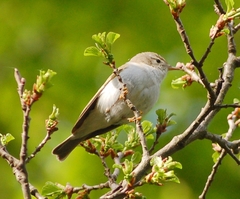
Western Bonelli's Warbler

Western Bonelli's Warbler

Phylloscopus bonelli

Silhouette: Jiekun He · PhyloPic

LCLeast ConcernNTVUENCR
Daily sighting probability ~10% · With luck
at Triglav National Park

In 3 days ~20% in a week ~40%

44 Verified sightings at Triglav National Park From 2019 to 2026
1,995 In all 16 parks
June Best month
☀️ Diurnal When it's spotted

About the Western Bonelli's Warbler

The western Bonelli's warbler (Phylloscopus bonelli) is a warbler in the leaf warbler genus Phylloscopus. It was formerly regarded as the western subspecies of a wider "Bonelli's warbler" species, but as a result of modern taxonomic developments, they are now usually considered to be two species:

Western Bonelli's warbler, Phylloscopus bonelli, which breeds in southwest Europe and north Africa Eastern Bonelli's warbler, Phylloscopus orientalis, which breeds in southeast Europe and Asia Minor The breeding ranges of the two species do not overlap; while their appearance and songs are very similar, the calls are completely different (see below). They also show marked difference in mtDNA sequence.

The species is migratory, wintering in sub-Saharan Africa. It is a rare vagrant in Northern Europe. The genus name Phylloscopus is from Ancient Greek phullon, "leaf", and skopos, "seeker" (from skopeo, "to watch"). The English name and the specific bonelli are for the Italian ornithologist Franco Andrea Bonelli.

Western Bonelli's warbler is a small passerine bird, found in forest and woodland. Four to six eggs are laid in a nest on the ground. The eggs are white with reddish... Wikipedia →

Sounds

Song0:40

France · 2026

© Tony Rinaud · XC1178456 · CC BY-NC-SA 4.0

Call0:56

Senegal · 2026

© Peter Boesman · XC1081335 · CC BY-NC-ND 4.0

Subsong0:09

France · 2023

© Cyrille Frey · XC818375 · CC BY-NC-SA 4.0

Global Distribution

Parks Where Found

# Park Country Daily sighting probability
1 Ecrins National Park 🇫🇷 France
~30%
2 Mercantour National Park 🇫🇷 France
~30%
3 Sierra de Guadarrama National Park 🇪🇸 Spain
~20%
4 Cévennes National Park 🇫🇷 France
~20%
5 Picos de Europa National Park 🇪🇸 Spain
~10%
6 Ordesa y Monte Perdido National Park 🇪🇸 Spain
~10%
7 Sierra Nevada National Park 🇪🇸 Spain
~10%
8 Aigüestortes National Park 🇪🇸 Spain
~10%
9 Hohe Tauern National Park 🇦🇹 Austria
~10%
10 Pyrénées National Park 🇫🇷 France
~10%
11 Triglav National Park 🇸🇮 Slovenia
~10%
12 Vanoise National Park 🇫🇷 France
<5%
13 Niokolo-Koba National Park 🇸🇳 Senegal
<5%
14 Doñana National Park 🇪🇸 Spain
<5%
15 Monfragüe National Park 🇪🇸 Spain
<5%
16 Camargue 🇫🇷 France
<5%

Cities Where Found

# City Country Daily sighting probability
1 Marrakesh 🇲🇦 Morocco
~10%
2 Barcelona 🇪🇸 Spain
<5%
3 Turin 🇮🇹 Italy
<5%
4 Madrid 🇪🇸 Spain
<5%
5 Valencia 🇪🇸 Spain
<5%
6 Milan 🇮🇹 Italy
<5%
7 Lisbon 🇵🇹 Portugal
<5%

Before you go

What are the chances of seeing a Western Bonelli's Warbler in Triglav National Park?

With luck

About 10% of wildlife watchers report a Western Bonelli's Warbler sighting in Triglav National Park on a given day, based on 44 verified sightings from GBIF citizen-science data from 2019 to 2026. It is the 66th most-seen of the 105 birds we can rate there. Over three days the chance rises to about 20%, and over a week to about 40%, if each day is a fresh chance.

When is the best time to see a Western Bonelli's Warbler in Triglav National Park?

April to July

In those months about 10% of wildlife watchers report a Western Bonelli's Warbler in Triglav National Park on a given day, against under 5% in August to March, the lowest months.

What time of day is best to see a Western Bonelli's Warbler?

Between 9 am and noon

Across all the parks we cover, that three-hour window holds the most Western Bonelli's Warbler sightings with a recorded time, and about 9 in 10 of them come between 6 am and 6 pm: it is a daytime animal.

Where does the Western Bonelli's Warbler sighting chance come from?

GBIF citizen-science records

It is estimated from how often the Western Bonelli's Warbler is recorded against all the birds logged in Triglav National Park (44 verified sightings from 2019 to 2026), calibrated against known sighting rates. Figures are rounded to the nearest 10% because citizen-science data supports honest approximations, not decimals, and months with records from fewer than five people show "—". How it works.

← Back to Triglav National Park