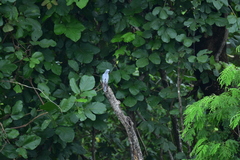
Large Cuckoo-shrike

Large Cuckoo-shrike

Coracina macei

Silhouette: PhyloPic

LCLeast ConcernNTVUENCR
Daily sighting probability <5% · Rare
at Udawalawe National Park

In 3 days <5% in a week ~10%

7 Verified sightings at Udawalawe National Park From 2019 to 2026
7,870 In all 14 parks
March Best month
☀️ Diurnal When it's spotted

About the Large Cuckoo-shrike

The Indian cuckooshrike (Coracina macei) is a species of bird in the cuckooshrike family Campephagidae that is found on the Indian subcontinent. Formerly under the English name "large cuckooshrike" this species included many subspecies and had a large range that included Southeast Asia.

The Indian cuckooshrike formerly included additional subspecies (under the English name "large cuckooshrike"): Oriental cuckooshrike now includes 5 former subspecies of the large cuckooshrike. Malayan cuckooshrike was formerly a subspecies of the large cuckooshrike. Adult males have a broad and well-marked eye stripe which is pale in females. The throat and breast are grey in males and the abdomen and flanks are finely barred. Females have the throat and breast also with barring which extends further down and lacks the prominent whitish vent of the male. They are mostly insectivorous but also feed on figs and forest fruits and usually fly in small groups with a bounding flight just above the forest canopy. The Indian population has a loud call... Wikipedia →

Sounds

Flight call0:14

Thailand · 2024

© Greg Irving · XC953622 · CC BY-NC-SA 4.0

Call0:11

Malaysia · 2014

© Peter Boesman · XC290624 · CC BY-NC-ND 4.0

Uncertain0:21

Taiwan · 2024

© 蔡明剛 · XC882140 · CC BY-NC-SA 4.0

Global Distribution

Parks Where Found

# Park Country Daily sighting probability
1 Kanha National Park 🇮🇳 India
~50%
2 Bandhavgarh National Park 🇮🇳 India
~30%
3 Satpura National Park 🇮🇳 India
~30%
4 Nagarhole National Park 🇮🇳 India
~10%
5 Ranthambore National Park 🇮🇳 India
~10%
6 Periyar National Park 🇮🇳 India
~10%
7 Bandipur National Park 🇮🇳 India
~10%
8 Gir National Park 🇮🇳 India
~10%
9 Wilpattu National Park 🇱🇰 Sri Lanka
~10%
10 Minneriya National Park 🇱🇰 Sri Lanka
<5%
11 Yala National Park 🇱🇰 Sri Lanka
<5%
12 Mudumalai National Park 🇮🇳 India
<5%
13 Udawalawe National Park 🇱🇰 Sri Lanka
<5%
14 Sinharaja Forest Reserve 🇱🇰 Sri Lanka
<5%

Cities Where Found

# City Country Daily sighting probability
1 Thrissur 🇮🇳 India
~10%
2 Ranchi 🇮🇳 India
~10%
3 Jabalpur 🇮🇳 India
~10%
4 Kozhikode 🇮🇳 India
<5%
5 Gwalior 🇮🇳 India
<5%
6 Indore 🇮🇳 India
<5%
7 Vadodara 🇮🇳 India
<5%
8 Jaipur 🇮🇳 India
<5%
9 Nagpur 🇮🇳 India
<5%
10 Bhopal 🇮🇳 India
<5%

Before you go

What are the chances of seeing a Large Cuckoo-shrike in Udawalawe National Park?

Rare

Under 5% of wildlife watchers report a Large Cuckoo-shrike sighting in Udawalawe National Park on a given day, based on 7 verified sightings from GBIF citizen-science data from 2019 to 2026. It is the 155th most-seen of the 166 birds we can rate there. Over three days the chance rises to under 5%, and over a week to about 10%, if each day is a fresh chance.

When is the best time to see a Large Cuckoo-shrike in Udawalawe National Park?

March

In that month about 10% of wildlife watchers report a Large Cuckoo-shrike in Udawalawe National Park on a given day, against under 5% in April to February, the lowest months.

What time of day is best to see a Large Cuckoo-shrike?

Between 7 and 10 am

Across all the parks we cover, that three-hour window holds the most Large Cuckoo-shrike sightings with a recorded time, and about 9 in 10 of them come between 6 am and 6 pm: it is a daytime animal.

Is Udawalawe National Park the best place to see a Large Cuckoo-shrike?

13th of 14

Of the 14 parks where we can rate Large Cuckoo-shrike sightings, Udawalawe National Park ranks 13th at under 5%. The best odds are in Kanha National Park (India, about 50%), Bandhavgarh National Park (India, about 30%) and Satpura National Park (India, about 30%).

Where does the Large Cuckoo-shrike sighting chance come from?

GBIF citizen-science records

It is estimated from how often the Large Cuckoo-shrike is recorded against all the birds logged in Udawalawe National Park (7 verified sightings from 2019 to 2026), calibrated against known sighting rates. Figures are rounded to the nearest 10% because citizen-science data supports honest approximations, not decimals, and months with records from fewer than five people show "—". How it works.

← Back to Udawalawe National Park