Beaked Gecko

Beaked Gecko

Rhynchoedura ornata

Silhouette: Jose Carlos Arenas-Monroy · PhyloPic

LCLeast ConcernNTVUENCR Endemic
Daily sighting probability ~20% · Possible
at Uluru-Kata Tjuta National Park

In 3 days ~60% in a week ~90%

12 Verified sightings at Uluru-Kata Tjuta National Park From 2019 to 2026
12 In 1 park
January Best month
☀️ Diurnal When it's spotted

About the Beaked Gecko

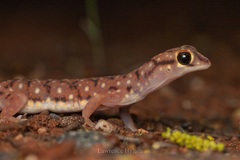
The western beaked gecko (Rhynchoedura ornata) is a species of gecko found throughout the interior of Australia. The species was first described by Albert Günther in 1867. It is placed in the Rhynchoedura genus, which are found throughout Australasia. This group shares characteristics with several species of Diplodactylus, the conspicillatus group, Glen Storr has suggested that these could be transferred to this genus.

Many of the characters of this species are found in Diplodactylus stenodactylus, their appearance, habitat and distribution, and Diplodactylus pulcher has a similar snout and vertebrae. Synonyms for this species include Diplodactylus paraornatus and Rhynchoedura ormsbyi published by Wells & Wellington.

Research into the phylogenetic relationships of Diplodactylus has identified two clades, and the resurrection of Lucasium has been proposed. Rhynchoedura was found to be distinct from D. byrnei, D. steindachneri and the stenodactylus group, but may be considered as a sister group to these.

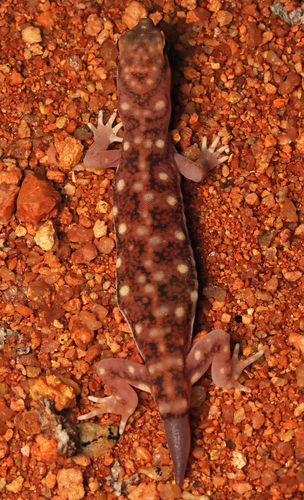
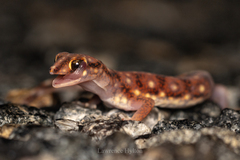
It is a small nocturnal gecko up to 95 millimetres, snout vent length to 50 mm, with a long slender tail. The snout is narrow and beak-like, its characteristic... Wikipedia →
Global Distribution

Parks Where Found

# Park Country Daily sighting probability
1 Uluru-Kata Tjuta National Park 🇦🇺 Australia
~20%

More parks will be added in future updates.

Before you go

What are the chances of seeing a Beaked Gecko in Uluru-Kata Tjuta National Park?

Possible

About 20% of wildlife watchers report a Beaked Gecko sighting in Uluru-Kata Tjuta National Park on a given day, based on 12 verified sightings from GBIF citizen-science data from 2019 to 2026. It is the 9th most-seen of the 25 reptiles we can rate there. Over three days the chance rises to about 60%, and over a week to about 90%, if each day is a fresh chance.

When is the best time to see a Beaked Gecko in Uluru-Kata Tjuta National Park?

January and October

In those months about 40% of wildlife watchers report a Beaked Gecko in Uluru-Kata Tjuta National Park on a given day, against under 5% in February, May–June and November–December, the lowest months. Those are among Uluru-Kata Tjuta National Park's wettest months, with about 40 mm of rain a month against almost none in July.

What time of day is best to see a Beaked Gecko?

Between noon and 3 pm

Across all the parks we cover, that three-hour window holds the most Beaked Gecko sightings with a recorded time, and about 8 in 10 of them come between 6 am and 6 pm: it is a daytime animal.

Where else can you see a Beaked Gecko?

Only Uluru-Kata Tjuta National Park, in our data

Uluru-Kata Tjuta National Park is the only park on Wallace's Line with enough records to rate Beaked Gecko sightings: about 20% of wildlife watchers there report one on a given day.

Where does the Beaked Gecko sighting chance come from?

GBIF citizen-science records

It is estimated from how often the Beaked Gecko is recorded against all the reptiles logged in Uluru-Kata Tjuta National Park (12 verified sightings from 2019 to 2026), calibrated against known sighting rates. Figures are rounded to the nearest 10% because citizen-science data supports honest approximations, not decimals, and months with records from fewer than five people show "—". How it works.

← Back to Uluru-Kata Tjuta National Park