Thorny Devil

Thorny Devil

Moloch horridus

Silhouette: Michael Scroggie · PhyloPic

LCLeast ConcernNTVUENCR Endemic
Daily sighting probability ~40% · Likely
at Uluru-Kata Tjuta National Park

In 3 days ~80% in a week >90%

26 Verified sightings at Uluru-Kata Tjuta National Park From 2019 to 2026
26 In 1 park
March Best month
🌅 Crepuscular When it's spotted

About the Thorny Devil

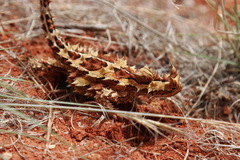
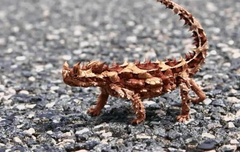
The thorny devil (Moloch horridus), also known commonly as the mountain devil, thorny lizard, thorny dragon, and moloch, is a species of lizard in the family Agamidae. The species is endemic to Australia. It is the sole species in the genus Moloch. It grows up to 21 cm (8.3 in) in total length (including tail), with females generally larger than males.

The thorny devil was first described by the biologist John Edward Gray in 1841. While it is the only species contained in the genus Moloch, many taxonomists suspect another species might remain to be found in the wild. The thorny devil is only distantly related to the morphologically similar North American horned lizards of the genus Phrynosoma. This similarity is usually thought of as an example of convergent evolution.

The names given to this lizard reflect its appearance: the two large horned scales on its head complete the illusion of a dragon or devil. The name Moloch was used for a deity of the ancient Near East, usually depicted as a hideous beast. The thorny devil also has other nicknames people have given it such as the "devil lizard", "horned lizard", and the "thorny toad".

The thorny devil grows... Wikipedia →

Global Distribution

Parks Where Found

# Park Country Daily sighting probability
1 Uluru-Kata Tjuta National Park 🇦🇺 Australia
~40%

More parks will be added in future updates.

Zoos & Centres Where Found

# Zoo / Centre Country
1 Alice Springs Desert Park 🇦🇺 Australia In captivity
2 Cleland Wildlife Park 🇦🇺 Australia In captivity

Before you go

What are the chances of seeing a Thorny Devil in Uluru-Kata Tjuta National Park?

Likely

About 40% of wildlife watchers report a Thorny Devil sighting in Uluru-Kata Tjuta National Park on a given day, based on 26 verified sightings from GBIF citizen-science data from 2019 to 2026. It is the 5th most-seen of the 25 reptiles we can rate there. Over three days the chance rises to about 80%, and over a week to over 90%, if each day is a fresh chance.

When is the best time to see a Thorny Devil in Uluru-Kata Tjuta National Park?

March and April

In those months about 60% of wildlife watchers report a Thorny Devil in Uluru-Kata Tjuta National Park on a given day, against under 5% in June–July and November, the lowest months.

What time of day is best to see a Thorny Devil?

Between 8 and 11 am

Across all the parks we cover, that three-hour window holds the most Thorny Devil sightings with a recorded time, and about 6 in 10 of them come between 6 am and 6 pm: it is most active around dawn and dusk.

Where else can you see a Thorny Devil?

Only Uluru-Kata Tjuta National Park, in our data

Uluru-Kata Tjuta National Park is the only park on Wallace's Line with enough records to rate Thorny Devil sightings: about 40% of wildlife watchers there report one on a given day.

Where does the Thorny Devil sighting chance come from?

GBIF citizen-science records

It is estimated from how often the Thorny Devil is recorded against all the reptiles logged in Uluru-Kata Tjuta National Park (26 verified sightings from 2019 to 2026), calibrated against known sighting rates. Figures are rounded to the nearest 10% because citizen-science data supports honest approximations, not decimals, and months with records from fewer than five people show "—". How it works.

← Back to Uluru-Kata Tjuta National Park