Black-headed Scaly Foot

Black-headed Scaly Foot

Pygopus nigriceps

Silhouette: SeismicShrimp · PhyloPic

LCLeast ConcernNTVUENCR Endemic
Daily sighting probability ~20% · Possible
at Uluru-Kata Tjuta National Park

In 3 days ~50% in a week ~80%

8 Verified sightings at Uluru-Kata Tjuta National Park From 2019 to 2026
14 In all 2 parks
March Best month
☀️ Diurnal When it's spotted

About the Black-headed Scaly Foot

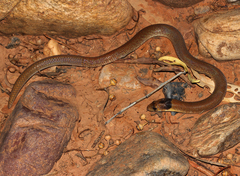
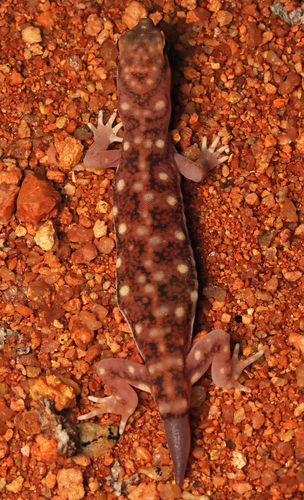
The hooded scaly-foot (Pygopus nigriceps), also known as western scaly-foot, black-headed scaly-foot or western hooded scaly-foot, is an endemic Australian legless lizard of the family Pygopodidae. Adult hooded scaly-foots range from 45 to 55 cm long, with an average snout to vent length of 22.7 cm. Females are generally larger than males. Hooded scaly-foots show no trace of forelimbs, whilst the hind limbs are reduced to scaly flaps. These hind limbs are small and paddle-shaped, with modified scales which do not aid in movement.

The scales of the hooded scaly-foot are smooth and weakly glossed. Usually, it has 120 or more ventral scales, which are in a paired series, much larger than the adjacent body scales. Body colour varies from brown to reddish-brown, with desert specimens usually a more orangish colour and other individuals a duller brown. It is white below. The species has little to no body pattern, with oblique dark lines converging mid-dorsally.

These scaly-foots are characterised by black bands across the head and neck which may look like a hood. This hood comprises a band across the eyes onto the lips, a dark smudge on the nostrils, and a broad band across... Wikipedia →
Global Distribution

Parks Where Found

# Park Country Daily sighting probability
1 Uluru-Kata Tjuta National Park 🇦🇺 Australia
~20%
2 Ningaloo Marine Park 🇦🇺 Australia
~10%

Closest Relatives at Uluru-Kata Tjuta National Park

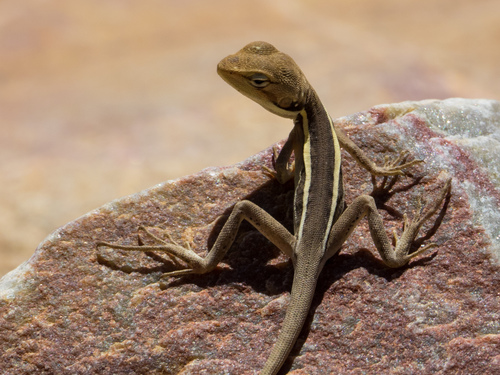
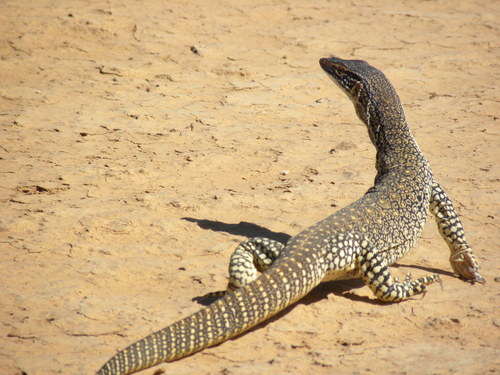
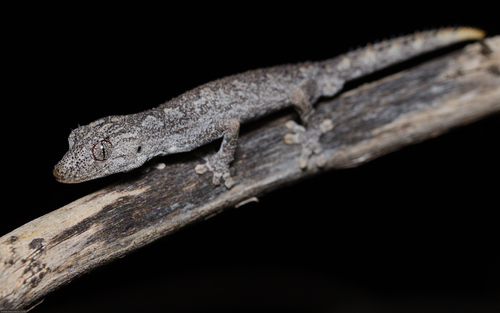
No species of the same family or order lives in Uluru-Kata Tjuta National Park, so these are its closest relatives here: other reptiles.

Before you go

What are the chances of seeing a Black-headed Scaly Foot in Uluru-Kata Tjuta National Park?

Possible

About 20% of wildlife watchers report a Black-headed Scaly Foot sighting in Uluru-Kata Tjuta National Park on a given day, based on 8 verified sightings from GBIF citizen-science data from 2019 to 2026. It is the 12th most-seen of the 25 reptiles we can rate there. Over three days the chance rises to about 50%, and over a week to about 80%, if each day is a fresh chance.

When is the best time to see a Black-headed Scaly Foot in Uluru-Kata Tjuta National Park?

March

In that month about 40% of wildlife watchers report a Black-headed Scaly Foot in Uluru-Kata Tjuta National Park on a given day, against under 5% in April, June–August and November–January, the lowest months.

What time of day is best to see a Black-headed Scaly Foot?

Between 11 am and 2 pm

Across all the parks we cover, that three-hour window holds the most Black-headed Scaly Foot sightings with a recorded time, and about 9 in 10 of them come between 6 am and 6 pm: it is a daytime animal.

Is Uluru-Kata Tjuta National Park the best place to see a Black-headed Scaly Foot?

Yes

Of the 2 parks where we can rate Black-headed Scaly Foot sightings, Uluru-Kata Tjuta National Park has the highest daily chance: about 20%. Next come Ningaloo Marine Park (Australia, about 10%).

Where does the Black-headed Scaly Foot sighting chance come from?

GBIF citizen-science records

It is estimated from how often the Black-headed Scaly Foot is recorded against all the reptiles logged in Uluru-Kata Tjuta National Park (8 verified sightings from 2019 to 2026), calibrated against known sighting rates. Figures are rounded to the nearest 10% because citizen-science data supports honest approximations, not decimals, and months with records from fewer than five people show "—". How it works.

← Back to Uluru-Kata Tjuta National Park