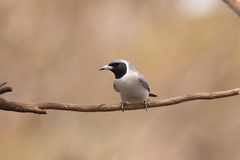
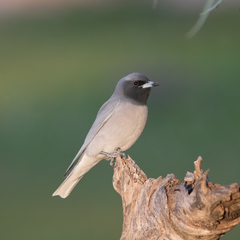
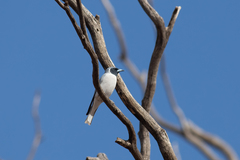
Masked Woodswallow

Masked Woodswallow

Artamus personatus

Silhouette: Sheatherius · PhyloPic

LCLeast ConcernNTVUENCR
Daily sighting probability ~10% · With luck
at Uluru-Kata Tjuta National Park

In 3 days ~30% in a week ~60%

57 Verified sightings at Uluru-Kata Tjuta National Park From 2019 to 2026
647 In all 6 parks
October Best month
☀️ Diurnal When it's spotted

About the Masked Woodswallow

Masked woodswallow (Artamus personatus) is a species of bird in the family Artamidae. A.personatus is a common, gregarious and highly nomadic species, appearing in large flocks usually with white-browed woodswallow (Artamus superciliosus). Among the few passerines that have powder down through their plumage. Listed as least concern on the IUCN Red List.

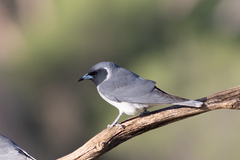
Ranging from 18–20 centimetres (7.1–7.9 in) in length with a wingspan of 32–34 centimetres (13–13 in), weighing approximately 37 grams (1.3 oz), the masked woodswallow is similar in size to the white-browed woodswallow. Sexes differ markedly in colour and also in immature plumage. This difference between sexes is unique only to the masked woodswallow and white-browed woodswallow. Adult males have a sharply defined black face mask with a pale edge. This mask covers the lores, ear coverts, chin and throat. Upperparts are dark blue grey with a prominent white tip on the tail. The underbody is pale grey, fading to greyish white on under tail coverts. Legs and feet are grey to grey black or black. Adult females are similar to adult males but slightly browner and mask is indistinct. Juveniles are... Wikipedia →

Sounds

Call0:37

Australia · 2025

© Peter Boesman · XC1066386 · CC BY-NC-ND 4.0

Imitation1:17

Australia · 2020

© Marc Anderson · XC600344 · CC BY-NC-ND 4.0

Recording0:18

Australia · 2019

© deborod · iNaturalist · CC BY-NC 4.0

Global Distribution

Parks Where Found

# Park Country Daily sighting probability
1 Hattah-Kulkyne National Park 🇦🇺 Australia
~30%
2 Uluru-Kata Tjuta National Park 🇦🇺 Australia
~10%
3 Grampians National Park 🇦🇺 Australia
<5%
4 Royal National Park 🇦🇺 Australia
<5%
5 Blue Mountains National Park 🇦🇺 Australia
<5%
6 Lamington National Park 🇦🇺 Australia
<5%

Cities Where Found

# City Country Daily sighting probability
1 Sydney 🇦🇺 Australia
<5%
2 Melbourne 🇦🇺 Australia
<5%

Zoos & Centres Where Found

# Zoo / Centre Country
1 Alice Springs Desert Park 🇦🇺 Australia In captivity
2 Featherdale Sydney Wildlife Park 🇦🇺 Australia In captivity

Before you go

What are the chances of seeing a Masked Woodswallow in Uluru-Kata Tjuta National Park?

With luck

About 10% of wildlife watchers report a Masked Woodswallow sighting in Uluru-Kata Tjuta National Park on a given day, based on 57 verified sightings from GBIF citizen-science data from 2019 to 2026. It is the 41st most-seen of the 84 birds we can rate there. Over three days the chance rises to about 30%, and over a week to about 60%, if each day is a fresh chance.

When is the best time to see a Masked Woodswallow in Uluru-Kata Tjuta National Park?

October

In that month about 30% of wildlife watchers report a Masked Woodswallow in Uluru-Kata Tjuta National Park on a given day, against under 5% in April and June–July, the lowest months.

What time of day is best to see a Masked Woodswallow?

Between 7 and 10 am

Across all the parks we cover, that three-hour window holds the most Masked Woodswallow sightings with a recorded time, and about 9 in 10 of them come between 6 am and 6 pm: it is a daytime animal.

Is Uluru-Kata Tjuta National Park the best place to see a Masked Woodswallow?

2nd of 6

Of the 6 parks where we can rate Masked Woodswallow sightings, Uluru-Kata Tjuta National Park ranks 2nd at about 10%. The best odds are in Hattah-Kulkyne National Park (Australia, about 30%).

Which relatives of the Masked Woodswallow live in Uluru-Kata Tjuta National Park?

Same genus: Artamus

The closest relatives of the Masked Woodswallow that you can see in Uluru-Kata Tjuta National Park (genus Artamus, Woodswallows) are Little Woodswallow (about 40%) and Black-faced Woodswallow (about 40%), with each one's daily chance of a sighting.

Where does the Masked Woodswallow sighting chance come from?

GBIF citizen-science records

It is estimated from how often the Masked Woodswallow is recorded against all the birds logged in Uluru-Kata Tjuta National Park (57 verified sightings from 2019 to 2026), calibrated against known sighting rates. Figures are rounded to the nearest 10% because citizen-science data supports honest approximations, not decimals, and months with records from fewer than five people show "—". How it works.

← Back to Uluru-Kata Tjuta National Park