Narina Trogon

Narina Trogon

Apaloderma narina

Silhouette: Keith Murdock (photo), John E. McCormack, Michael G. Harvey, Brant C. Faircloth, Nicholas G. Crawford, Travis C. Glenn, Robb T. Brumfield & T. Michael Keesey · PhyloPic

LCLeast ConcernNTVUENCR
Daily sighting probability ~10% · With luck
at uMkhuze Game Reserve

In 3 days ~30% in a week ~50%

49 Verified sightings at uMkhuze Game Reserve From 2019 to 2026
1,633 In all 26 parks
September Best month
☀️ Diurnal When it's spotted

About the Narina Trogon

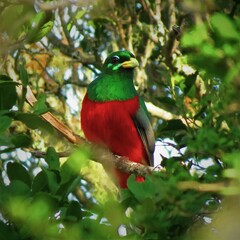
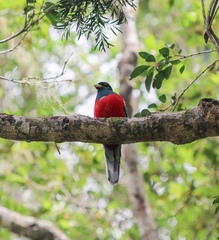
The Narina trogon (Apaloderma narina) is a largely green and red, medium-sized (32–34 cm long) bird in the family Trogonidae. It is native to forests and woodlands of the Afrotropics. Though it is the most widespread and diverse in habitat choice of the three Apaloderma species, its numbers are locally depleted due to deforestation. Some populations are sedentary while others undertake regular movements.

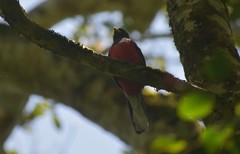
It is sexually dimorphic, with males more brightly coloured. Both sexes have vivid, gingery green upperpart plumage. The tail feathers have a metallic blue-green gloss. The outer three rectices on each side are tipped and fringed white, giving the undertail of perched birds a characteristic white appearance (compare bar-tailed trogon). The wing coverts are a grizzled grey, and remiges mostly colourless grey.

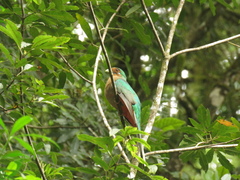
The male especially, has bright red underside plumage and bare, green gape and eye flanges. The female has brown face and chest plumage, blue skin orbiting the eyes and duller red plumage below. Immature birds resemble females but have distinct white tips to the tertials (inner wing), and less distinct gape and eye flanges.

The name is derived from the Khoi word... Wikipedia →

Sounds

Song0:22

Zambia · 2023

© Dries Van de Loock · XC854351 · CC BY-NC-ND 4.0

Call0:10

South Africa · 2020

© Niall Perrins · XC607366 · CC BY-NC-SA 4.0

Uncertain0:09

Gabon · 2021

© BurBenj · XC669143 · CC BY-NC-SA 4.0

Global Distribution

Parks Where Found

# Park Country Daily sighting probability
1 Arusha National Park 🇹🇿 Tanzania
~20%
2 iSimangaliso Wetland Park 🇿🇦 South Africa
~20%
3 Kibale National Park 🇺🇬 Uganda
~20%
4 Semuliki National Park 🇺🇬 Uganda
~10%
5 Garden Route National Park 🇿🇦 South Africa
~10%
6 uMkhuze Game Reserve 🇿🇦 South Africa
~10%
7 Gorongosa National Park 🇲🇿 Mozambique
~10%
8 Bwindi Impenetrable National Park 🇺🇬 Uganda
~10%
9 Nyungwe National Park 🇷🇼 Rwanda
~10%
10 Liwonde National Park 🇲🇼 Malawi
~10%
11 Mana Pools National Park 🇿🇼 Zimbabwe
<5%
12 Kafue National Park 🇿🇲 Zambia
<5%
13 Hluhluwe-Imfolozi Park 🇿🇦 South Africa
<5%
14 Masai Mara National Reserve 🇰🇪 Kenya
<5%
15 Mikumi National Park 🇹🇿 Tanzania
<5%
16 Aberdare National Park 🇰🇪 Kenya
<5%
17 Lower Zambezi National Park 🇿🇲 Zambia
<5%
18 Akagera National Park 🇷🇼 Rwanda
<5%
19 Lake Mburo National Park 🇺🇬 Uganda
<5%
20 Nairobi National Park 🇰🇪 Kenya
<5%
21 Lake Nakuru National Park 🇰🇪 Kenya
<5%
22 Lake Manyara National Park 🇹🇿 Tanzania
<5%
23 Virunga National Park 🇨🇩 Democratic Republic of the Congo
<5%
24 Ngorongoro Conservation Area 🇹🇿 Tanzania
<5%
25 Table Mountain National Park 🇿🇦 South Africa
<5%
26 Kruger National Park 🇿🇦 South Africa
<5%

Cities Where Found

# City Country Daily sighting probability
1 Nairobi 🇰🇪 Kenya
<5%

Closest Relatives at uMkhuze Game Reserve

No species of the same family or order lives in uMkhuze Game Reserve, so these are its closest relatives here: other birds.

Before you go

What are the chances of seeing a Narina Trogon in uMkhuze Game Reserve?

With luck

About 10% of wildlife watchers report a Narina Trogon sighting in uMkhuze Game Reserve on a given day, based on 49 verified sightings from GBIF citizen-science data from 2019 to 2026. It is the 170th most-seen of the 283 birds we can rate there. Over three days the chance rises to about 30%, and over a week to about 50%, if each day is a fresh chance.

When is the best time to see a Narina Trogon in uMkhuze Game Reserve?

September

In that month about 20% of wildlife watchers report a Narina Trogon in uMkhuze Game Reserve on a given day, against under 5% in February and June, the lowest months. That is one of uMkhuze Game Reserve's driest months, with about 30 mm of rain against 120 mm in February.

What time of day is best to see a Narina Trogon?

Between 6 and 9 am

Across all the parks we cover, that three-hour window holds the most Narina Trogon sightings with a recorded time, and about 9 in 10 of them come between 6 am and 6 pm: it is a daytime animal.

Is uMkhuze Game Reserve the best place to see a Narina Trogon?

6th of 26

Of the 26 parks where we can rate Narina Trogon sightings, uMkhuze Game Reserve ranks 6th at about 10%. The best odds are in Arusha National Park (Tanzania, about 20%), iSimangaliso Wetland Park (South Africa, about 20%) and Kibale National Park (Uganda, about 20%).

Where does the Narina Trogon sighting chance come from?

GBIF citizen-science records

It is estimated from how often the Narina Trogon is recorded against all the birds logged in uMkhuze Game Reserve (49 verified sightings from 2019 to 2026), calibrated against known sighting rates. Figures are rounded to the nearest 10% because citizen-science data supports honest approximations, not decimals, and months with records from fewer than five people show "—". How it works.

← Back to uMkhuze Game Reserve