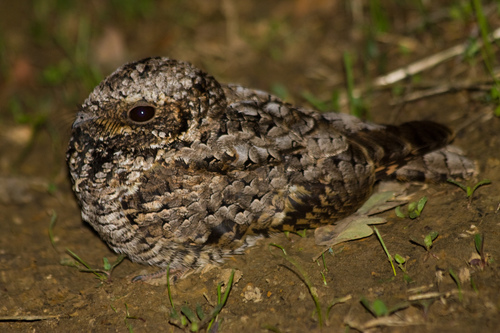
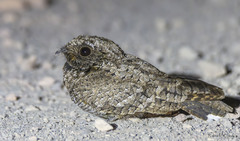
Common Poorwill

Common Poorwill

Phalaenoptilus nuttallii

Silhouette: Sheatherius · PhyloPic

LCLeast ConcernNTVUENCR
Daily sighting probability <5% · Rare
at Yosemite National Park

In 3 days <5%

22 Verified sightings at Yosemite National Park From 2019 to 2026
931 In all 13 parks
September Best month
☀️🌙 Day & Night When it's spotted

About the Common Poorwill

The common poorwill (Phalaenoptilus nuttallii) is a nocturnal bird of the family Caprimulgidae, the nightjars. It is found from British Columbia and southeastern Alberta, through the western United States to northern Mexico. The bird's habitat is dry, open areas with grasses or shrubs, and even stony desert slopes with very little vegetation.

Many northern birds migrate to winter within the breeding range in central and western Mexico, though some remain further north. The common poorwill is the only bird known to go into torpor for extended periods (weeks to months). This happens on the southern edge of its range in the United States, where it spends much of the winter inactive, concealed in piles of rocks. Such an extended period of torpor is close to a state of hibernation and is not known among other birds.

The common poorwill was illustrated and formally described in 1844 by the ornithologist John James Audubon from a male specimen collected on the eastern bank of the Missouri River between Fort Pierre and mouth of the Cheyenne River in South Dakota. Audubon coined the binomial name Caprimulgus nuttallii, choosing the specific epithet to honour a friend, the ornithologist... Wikipedia →
Sounds

Call0:27

United States · 2023

© Gregory Askew · XC820861 · CC BY-NC-SA 4.0

Song1:04

United States · 2022

© Scott Olmstead · XC729928 · CC BY-NC-SA 4.0

Dawn song0:30

United States · 2020

© Sue Riffe · XC609198 · CC BY-NC-SA 4.0

Global Distribution

Parks Where Found

# Park Country Daily sighting probability
1 Guadalupe Mountains National Park 🇺🇸 United States
~10%
2 Big Bend National Park 🇺🇸 United States
~10%
3 Death Valley National Park 🇺🇸 United States
<5%
4 Saguaro National Park 🇺🇸 United States
<5%
5 Cumbres de Monterrey National Park 🇲🇽 Mexico
<5%
6 Joshua Tree National Park 🇺🇸 United States
<5%
7 Badlands National Park 🇺🇸 United States
<5%
8 El Vizcaíno Biosphere Reserve 🇲🇽 Mexico
<5%
9 Zion National Park 🇺🇸 United States
<5%
10 Grand Canyon National Park 🇺🇸 United States
<5%
11 Yosemite National Park 🇺🇸 United States
<5%
12 Channel Islands National Park 🇺🇸 United States
<5%
13 Rocky Mountain National Park 🇺🇸 United States
<5%

Cities Where Found

# City Country Daily sighting probability
1 San Diego 🇺🇸 United States
<5%
2 Las Vegas 🇺🇸 United States
<5%
3 Los Angeles 🇺🇸 United States
<5%
4 Denver 🇺🇸 United States
<5%
5 Mesa 🇺🇸 United States
<5%
6 Portland 🇺🇸 United States
<5%
7 Salt Lake City 🇺🇸 United States
<5%
8 Seattle 🇺🇸 United States
<5%
9 Phoenix 🇺🇸 United States
<5%
10 San Francisco 🇺🇸 United States
<5%

Before you go

What are the chances of seeing a Common Poorwill in Yosemite National Park?

Rare

Under 5% of wildlife watchers report a Common Poorwill sighting in Yosemite National Park on a given day, based on 22 verified sightings from GBIF citizen-science data from 2019 to 2026. It is the 151st most-seen of the 169 birds we can rate there. Over three days the chance rises to under 5%, if each day is a fresh chance.

When is the best time to see a Common Poorwill in Yosemite National Park?

Any time of year

In every month with enough records, under 5% of wildlife watchers report a Common Poorwill in Yosemite National Park on a given day, so our monthly data shows no clear season.

What time of day is best to see a Common Poorwill?

Between 8 and 11 pm

Across all the parks we cover, that three-hour window holds the most Common Poorwill sightings with a recorded time, and about 7 in 10 of them come between 6 pm and 6 am: it is seen both by day and at night.

Where does the Common Poorwill sighting chance come from?

GBIF citizen-science records

It is estimated from how often the Common Poorwill is recorded against all the birds logged in Yosemite National Park (22 verified sightings from 2019 to 2026), calibrated against known sighting rates. Figures are rounded to the nearest 10% because citizen-science data supports honest approximations, not decimals, and months with records from fewer than five people show "—". How it works.

← Back to Yosemite National Park