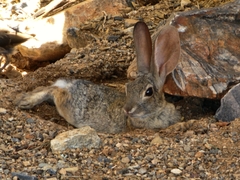
Desert Cottontail

Desert Cottontail

Sylvilagus audubonii

Silhouette: PhyloPic

LCLeast ConcernNTVUENCR
Daily sighting probability ~10% · With luck
at Zion National Park

In 3 days ~30% in a week ~60%

14 Verified sightings at Zion National Park From 2019 to 2026
1,012 In all 9 parks
August Best month
🌅 Crepuscular When it's spotted

About the Desert Cottontail

The desert cottontail (Sylvilagus audubonii), also known as Audubon's cottontail, is a New World cottontail rabbit, and a member of the family Leporidae. Unlike the European rabbit (Oryctolagus cuniculus), they do not form social burrow systems, but compared with some other leporids, they are extremely tolerant of other individuals in their vicinity.

Cottontails give birth to their kits in burrows vacated by other mammals. They sometimes cool off, or take refuge in scratched out shallow created depressions of their own making, using their front paws like a back hoe. They are not usually active in the middle of the day, but can be observed foraging in the early morning, and early evening. Cottontails are rarely found out of their burrows looking for food on windy days, because the wind interferes with their ability to hear approaching predators, their primary defense mechanism.

The lifespan of a cottontail that reaches adulthood averages less than two years, depending on the location. Unfortunately for the cottontail, almost every local carnivore larger or faster than the lagomorph is its predator. Some predators, like snakes for example, are familiar with the area inhabited... Wikipedia →

Global Distribution

Parks Where Found

# Park Country Daily sighting probability
1 Joshua Tree National Park 🇺🇸 United States
~50%
2 Badlands National Park 🇺🇸 United States
~50%
3 Saguaro National Park 🇺🇸 United States
~40%
4 Death Valley National Park 🇺🇸 United States
~40%
5 Big Bend National Park 🇺🇸 United States
~30%
6 Channel Islands National Park 🇺🇸 United States
~20%
7 Grand Canyon National Park 🇺🇸 United States
~20%
8 El Vizcaíno Biosphere Reserve 🇲🇽 Mexico
~10%
9 Zion National Park 🇺🇸 United States
~10%

Cities Where Found

# City Country Daily sighting probability
1 Mesa 🇺🇸 United States
~60%
2 Phoenix 🇺🇸 United States
~40%
3 Las Vegas 🇺🇸 United States
~40%
4 San Diego 🇺🇸 United States
~30%
5 Los Angeles 🇺🇸 United States
~30%
6 Tijuana 🇲🇽 México
~20%
7 Sacramento 🇺🇸 United States
~20%
8 Denver 🇺🇸 United States
~10%
9 Torreón 🇲🇽 México
~10%
10 San Francisco 🇺🇸 United States
<5%

Zoos & Centres Where Found

# Zoo / Centre Country
1 Réserve africaine de Sigean 🇫🇷 France In captivity
2 Chapultepec Zoo 🇲🇽 Mexico In captivity
3 Reid Park Zoo 🇺🇸 United States In captivity
4 Dallas World Aquarium 🇺🇸 United States In captivity

Before you go

What are the chances of seeing a Desert Cottontail in Zion National Park?

With luck

About 10% of wildlife watchers report a Desert Cottontail sighting in Zion National Park on a given day, based on 14 verified sightings from GBIF citizen-science data from 2019 to 2026. It is the 7th most-seen of the 19 mammals we can rate there. Over three days the chance rises to about 30%, and over a week to about 60%, if each day is a fresh chance.

When is the best time to see a Desert Cottontail in Zion National Park?

July to September

In those months about 20% of wildlife watchers report a Desert Cottontail in Zion National Park on a given day, against under 5% in November to March, the lowest months.

What time of day is best to see a Desert Cottontail?

Between 5 and 8 pm

Across all the parks we cover, that three-hour window holds the most Desert Cottontail sightings with a recorded time, and about 6 in 10 of them come between 6 am and 6 pm: it is most active around dawn and dusk.

Where does the Desert Cottontail sighting chance come from?

GBIF citizen-science records

It is estimated from how often the Desert Cottontail is recorded against all the mammals logged in Zion National Park (14 verified sightings from 2019 to 2026), calibrated against known sighting rates. Figures are rounded to the nearest 10% because citizen-science data supports honest approximations, not decimals, and months with records from fewer than five people show "—". How it works.

← Back to Zion National Park