Razorbill

Razorbill

Alca torda

Silhouette: PhyloPic

LCLeast ConcernNTVUENCR
Daily sighting probability <5% · Rare
at Acadia National Park

In 3 days ~10% in a week ~20%

400 Verified sightings at Acadia National Park From 2019 to 2026
861 In all 9 parks
December Best month
☀️ Diurnal When it's spotted

About the Razorbill

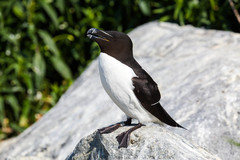
The razorbill (Alca torda) is a North Atlantic colonial seabird and the only extant member of the genus Alca of the family Alcidae, the auks. It is the closest living relative of the extinct great auk (Pinguinus impennis). Historically, it has also been known as "auk", "razor-billed auk" and "lesser auk".

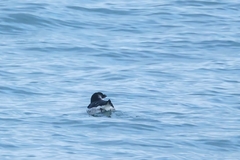
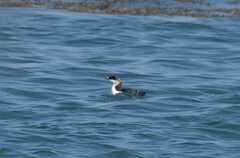
Razorbills are primarily black with a white underside. The male and female are identical in plumage; however, males are generally larger than females. This agile bird, which is capable of both flight and diving, has a predominantly aquatic lifestyle and only comes to land in order to breed. It is monogamous, choosing one partner for life. Females lay one egg per year. Razorbills nest along coastal cliffs in enclosed or slightly exposed crevices. The parents spend equal amounts of time incubating, and once the chick has hatched, they take turns foraging for their young.

Presently, this species faces major threats, including the destruction of breeding sites, oil spills, and deterioration of food quality. As a result, razorbills have on occasion been seen outside of their normal range as they search for alternative food sources. The IUCN records the population of the species as fluctuating. It decreased from 2015 to 2021, and appears to be increasing or stable at the present. It is estimated that the current global razorbill population lies between 838,000 and 1,600,000 mature individuals. In 1918, the razorbill was protected in the United States by the Migratory Bird Treaty Act. Wikipedia →

Sounds

Call0:44

United States · 2025

© Scott Olmstead · XC1079595 · CC BY-NC-SA 4.0

Begging call0:07

Sweden · 2020

© Lars Edenius · XC613944 · CC BY-NC-SA 4.0

Alarm call0:35

Iceland · 2018

© Stanislas Wroza · XC432751 · CC BY-NC-SA 4.0

Global Distribution

Parks Where Found

# Park Country Daily sighting probability
1 Vatnajokull National Park 🇮🇸 Iceland
~10%
2 Wadden Sea National Park 🇩🇪 Germany
<5%
3 Cape Breton Highlands National Park 🇨🇦 Canada
<5%
4 Acadia National Park 🇺🇸 United States
<5%
5 Snowdonia National Park 🇬🇧 United Kingdom
<5%
6 Gros Morne National Park 🇨🇦 Canada
<5%
7 Svalbard 🇳🇴 Norway
<5%
8 Doñana National Park 🇪🇸 Spain
<5%
9 Camargue 🇫🇷 France
<5%

Cities Where Found

# City Country Daily sighting probability
1 Dublin 🇮🇪 Ireland
~10%
2 Toronto 🇨🇦 Canada
<5%
3 Rotterdam [The Hague] 🇳🇱 Netherlands
<5%
4 Barcelona 🇪🇸 Spain
<5%
5 New York City 🇺🇸 United States
<5%
6 Boston 🇺🇸 United States
<5%
7 Porto 🇵🇹 Portugal
<5%
8 Lisbon 🇵🇹 Portugal
<5%
9 Montreal 🇨🇦 Canada
<5%

Zoos & Centres Where Found

# Zoo / Centre Country
1 Copenhagen Zoo 🇩🇰 Denmark In captivity
2 Lisbon Oceanarium 🇵🇹 Portugal In captivity
3 Odense Zoo 🇩🇰 Denmark In captivity
4 L'Oceanogràfic 🇪🇸 Spain In captivity
5 National Aquarium 🇺🇸 United States In captivity
6 Montreal Biodome 🇨🇦 Canada In captivity

Before you go

What are the chances of seeing a Razorbill in Acadia National Park?

Rare

Under 5% of wildlife watchers report a Razorbill sighting in Acadia National Park on a given day, based on 400 verified sightings from GBIF citizen-science data from 2019 to 2026. It is the 107th most-seen of the 243 birds we can rate there. Over three days the chance rises to about 10%, and over a week to about 20%, if each day is a fresh chance.

When is the best time to see a Razorbill in Acadia National Park?

November to February

In those months about 10% of wildlife watchers report a Razorbill in Acadia National Park on a given day, against under 5% in March to October, the lowest months.

What time of day is best to see a Razorbill?

Between 10 am and 1 pm

Across all the parks we cover, that three-hour window holds the most Razorbill sightings with a recorded time, and about 9 in 10 of them come between 6 am and 6 pm: it is a daytime animal.

Where does the Razorbill sighting chance come from?

GBIF citizen-science records

It is estimated from how often the Razorbill is recorded against all the birds logged in Acadia National Park (400 verified sightings from 2019 to 2026), calibrated against known sighting rates. Figures are rounded to the nearest 10% because citizen-science data supports honest approximations, not decimals, and months with records from fewer than five people show "—". How it works.

← Back to Acadia National Park