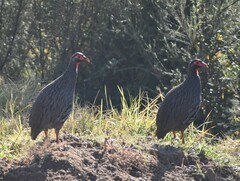
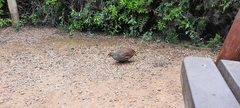
Red-necked Francolin

Red-necked Francolin

Pternistis afer

Silhouette: Amanda Kuhlman · PhyloPic

LCLeast ConcernNTVUENCR
Daily sighting probability ~70% · Very likely
at Akagera National Park

In 3 days >90%

559 Verified sightings at Akagera National Park From 2019 to 2026
7,037 In all 22 parks
April Best month
☀️ Diurnal When it's spotted

About the Red-necked Francolin

The red-necked spurfowl or red-necked francolin (Pternistis afer), is a gamebird in the pheasant family Phasianidae that is a resident species in southern Africa. The red-necked spurfowl was described in 1776 by the German zoologist Philipp Ludwig Statius Müller and given the binomial name Tetrao afer. The type locality was later designated as Benguela in western Angola. The specific epithet afer is the Latin word for "African". The species is now placed in the genus Pternistis that was introduced by the German naturalist Johann Georg Wagler in 1832. A molecular phylogenetic study published in 2019 found that the red-necked spurfowl is sister to the grey-breasted spurfowl.

Although many subspecies have been described only four are now recognised: Wikipedia →

Sounds

Call0:06

Uganda · 2025

© Bernard BOUSQUET · XC1057442 · CC BY-NC-SA 4.0

Song0:21

Zambia · 2023

© Marc Anderson · XC892140 · CC BY-NC-ND 4.0

Alarm call0:13

South Africa · 2019

© Tim Cockcroft · XC501363 · CC BY-NC-SA 4.0

Global Distribution

Parks Where Found

# Park Country Daily sighting probability
1 Ruaha National Park 🇹🇿 Tanzania
~80%
2 Tarangire National Park 🇹🇿 Tanzania
~70%
3 Akagera National Park 🇷🇼 Rwanda
~70%
4 Queen Elizabeth National Park 🇺🇬 Uganda
~60%
5 Lake Mburo National Park 🇺🇬 Uganda
~50%
6 Kafue National Park 🇿🇲 Zambia
~50%
7 Masai Mara National Reserve 🇰🇪 Kenya
~40%
8 Gorongosa National Park 🇲🇿 Mozambique
~40%
9 Mikumi National Park 🇹🇿 Tanzania
~30%
10 Addo Elephant National Park 🇿🇦 South Africa
~30%
11 South Luangwa National Park 🇿🇲 Zambia
~20%
12 Odzala-Kokoua National Park 🇨🇬 Republic of the Congo
~20%
13 Liwonde National Park 🇲🇼 Malawi
~20%
14 Garden Route National Park 🇿🇦 South Africa
~20%
15 Serengeti National Park 🇹🇿 Tanzania
~20%
16 Virunga National Park 🇨🇩 Democratic Republic of the Congo
~10%
17 Ngorongoro Conservation Area 🇹🇿 Tanzania
<5%
18 Lake Manyara National Park 🇹🇿 Tanzania
<5%
19 Lower Zambezi National Park 🇿🇲 Zambia
<5%
20 Arusha National Park 🇹🇿 Tanzania
<5%
21 Kruger National Park 🇿🇦 South Africa
<5%
22 Bwindi Impenetrable National Park 🇺🇬 Uganda
<5%

Cities Where Found

# City Country Daily sighting probability
1 Lubango 🇦🇴 Angola
~10%
2 Kigali 🇷🇼 Rwanda
<5%

Before you go

What are the chances of seeing a Red-necked Francolin in Akagera National Park?

Very likely

About 70% of wildlife watchers report a Red-necked Francolin sighting in Akagera National Park on a given day, based on 559 verified sightings from GBIF citizen-science data from 2019 to 2026. It is the 6th most-seen of the 320 birds we can rate there. Over three days the chance rises to over 90%, if each day is a fresh chance.

When is the best time to see a Red-necked Francolin in Akagera National Park?

February–May, July and December

In those months about 70% of wildlife watchers report a Red-necked Francolin in Akagera National Park on a given day, against about 40% in August, the lowest month.

What time of day is best to see a Red-necked Francolin?

Between 1 and 4 pm

Across all the parks we cover, that three-hour window holds the most Red-necked Francolin sightings with a recorded time, and about 9 in 10 of them come between 6 am and 6 pm: it is a daytime animal.

Is Akagera National Park the best place to see a Red-necked Francolin?

3rd of 22

Of the 22 parks where we can rate Red-necked Francolin sightings, Akagera National Park ranks 3rd at about 70%. The best odds are in Ruaha National Park (Tanzania, about 80%) and Tarangire National Park (Tanzania, about 70%). All parks ranked.

Where does the Red-necked Francolin sighting chance come from?

GBIF citizen-science records

It is estimated from how often the Red-necked Francolin is recorded against all the birds logged in Akagera National Park (559 verified sightings from 2019 to 2026), calibrated against known sighting rates. Figures are rounded to the nearest 10% because citizen-science data supports honest approximations, not decimals, and months with records from fewer than five people show "—". How it works.

← Back to Akagera National Park