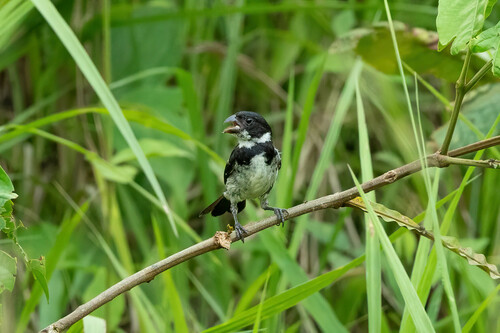
Orange-headed Tanager

Orange-headed Tanager

Thlypopsis sordida

Silhouette: Sheatherius · PhyloPic

LCLeast ConcernNTVUENCR
Daily sighting probability ~10% · With luck
at Amacayacu National Natural Park

In 3 days ~20% in a week ~50%

53 Verified sightings at Amacayacu National Natural Park From 2019 to 2026
554 In all 9 parks
February Best month
☀️ Diurnal When it's spotted

About the Orange-headed Tanager

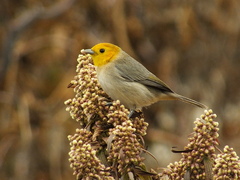
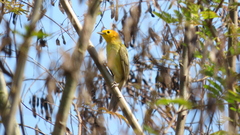
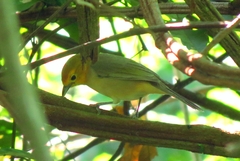
The orange-headed tanager (Thlypopsis sordida) is a species of bird in the family Thraupidae. Native to South America, it is found in Argentina, Bolivia, Brazil, Colombia, Ecuador, Paraguay, Peru, and Venezuela, where it inhabits successional vegetation, cerrado, riparian forest, shrub, brush, and open woodland. Males of the species have sandy-gray upperparts, cinnamon to buff underparts, white on the center of the lower breast, belly, and tail, and rufous-orange and yellow heads. Females are similar but duller.

The orange-headed tanager is omnivorous, feeding on insects, spiders, fruit, and seeds. It forages in an active manner, gleaning prey while hopping or, more infrequently, catching it in flight. Nesting has been recorded in December, and clutches contain two bluish-white eggs with brown markings. The species is listed as being of least concern by the International Union for Conservation of Nature (IUCN) on the IUCN Red List due to its large range and stable population.

The orange-headed tanager was originally described in 1837 as Nemosia sordida by the French ornithologists Frédéric de Lafresnaye and Alcide d'Orbigny on the basis of specimens from... Wikipedia →

Sounds

Song0:37

Brazil · 2022

© JAYRSON ARAUJO DE OLIVEIRA · XC753633 · CC BY-NC-SA 4.0

Call0:57

Brazil · 2019

© Arthur Gomes · XC513011 · CC BY-NC-SA 4.0

Canto1:10

Brazil · 2015

© Caio Brito · XC428084 · CC BY-NC-SA 4.0

Global Distribution

Parks Where Found

# Park Country Daily sighting probability
1 Iberá National Park 🇦🇷 Argentina
~10%
2 Amacayacu National Natural Park 🇨🇴 Colombia
~10%
3 Parque Estadual Encontro das Águas 🇧🇷 Brazil
<5%
4 Amboró National Park 🇧🇴 Bolivia
<5%
5 Yasuní National Park 🇪🇨 Ecuador
<5%
6 Itatiaia National Park 🇧🇷 Brazil
<5%
7 Chapada Diamantina National Park 🇧🇷 Brazil
<5%
8 Manu National Park 🇵🇪 Peru
<5%
9 Tijuca National Park 🇧🇷 Brazil
<5%

Cities Where Found

# City Country Daily sighting probability
1 João Pessoa 🇧🇷 Brazil
~10%
2 Recife 🇧🇷 Brazil
~10%
3 Salvador 🇧🇷 Brazil
~10%
4 São Paulo 🇧🇷 Brazil
~10%
5 Campinas 🇧🇷 Brazil
~10%
6 Asuncion 🇵🇾 Paraguay
<5%
7 Santos 🇧🇷 Brazil
<5%
8 Belo Horizonte 🇧🇷 Brazil
<5%
9 Niterói 🇧🇷 Brazil
<5%
10 Rio de Janeiro 🇧🇷 Brazil
<5%

Before you go

What are the chances of seeing an Orange-headed Tanager in Amacayacu National Natural Park?

With luck

About 10% of wildlife watchers report an Orange-headed Tanager sighting in Amacayacu National Natural Park on a given day, based on 53 verified sightings from GBIF citizen-science data from 2019 to 2026. It is the 184th most-seen of the 436 birds we can rate there. Over three days the chance rises to about 20%, and over a week to about 50%, if each day is a fresh chance.

When is the best time to see an Orange-headed Tanager in Amacayacu National Natural Park?

February

In that month about 20% of wildlife watchers report an Orange-headed Tanager in Amacayacu National Natural Park on a given day, against under 5% in January and September, the lowest months.

What time of day is best to see an Orange-headed Tanager?

Between 8 and 11 am

Across all the parks we cover, that three-hour window holds the most Orange-headed Tanager sightings with a recorded time, and about 9 in 10 of them come between 6 am and 6 pm: it is a daytime animal.

Is Amacayacu National Natural Park the best place to see an Orange-headed Tanager?

Among the best

Of the 9 parks where we can rate Orange-headed Tanager sightings, Amacayacu National Natural Park ranks 2nd at about 10%, level with the leaders once rounded. The best odds are in Iberá National Park (Argentina, about 10%).

Which relatives of the Orange-headed Tanager live in Amacayacu National Natural Park?

Same family: Thraupidae

The closest relatives of the Orange-headed Tanager that you can see in Amacayacu National Natural Park (family Thraupidae, Tanagers and Allies) are Silver-beaked Tanager (about 50%), Blue-gray Tanager (about 30%) and Palm Tanager (about 30%), with each one's daily chance of a sighting.

Where does the Orange-headed Tanager sighting chance come from?

GBIF citizen-science records

It is estimated from how often the Orange-headed Tanager is recorded against all the birds logged in Amacayacu National Natural Park (53 verified sightings from 2019 to 2026), calibrated against known sighting rates. Figures are rounded to the nearest 10% because citizen-science data supports honest approximations, not decimals, and months with records from fewer than five people show "—". How it works.

← Back to Amacayacu National Natural Park