
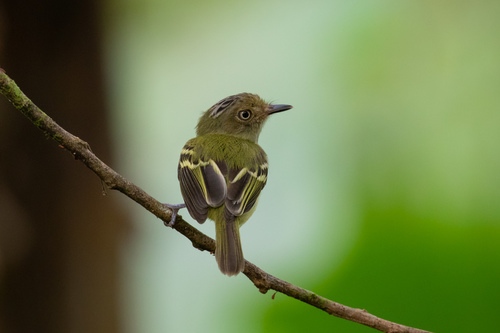
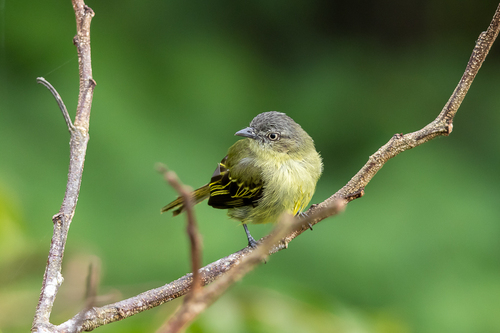
Sulphury Flycatcher

Sulphury Flycatcher

Tyrannopsis sulphurea

Silhouette: Emily Willoughby · PhyloPic

LCLeast ConcernNTVUENCR
Daily sighting probability ~10% · With luck
at Amacayacu National Natural Park

In 3 days ~20% in a week ~30%

39 Verified sightings at Amacayacu National Natural Park From 2019 to 2026
445 In all 7 parks
August Best month
☀️ Diurnal When it's spotted

About the Sulphury Flycatcher

The sulphury flycatcher (Tyrannopsis sulphurea) is a passerine bird of the family Tyrannidae, the tyrant flycatchers. It is found on Trinidad and in every mainland South American country except Argentina, Chile, Paraguay, and Uruguay.

The sulphury flycatcher was originally described as Muscicapa sulphurea, erroneously classifying it as an Old World flycatcher. Robert Ridgway erected genus Tyrannopsis for it in 1905. The sulphury flycatcher is the only member of its genus and has no subspecies.

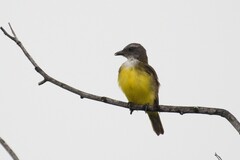
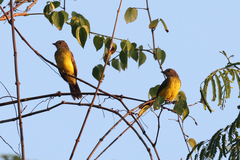
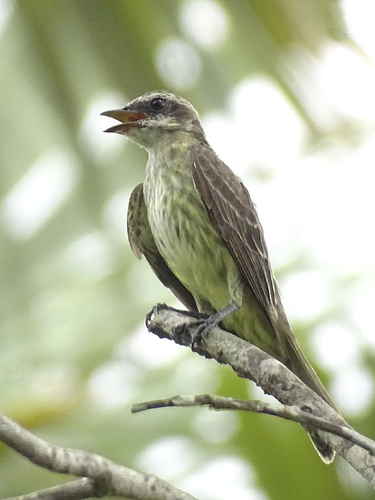
The sulphury flycatcher is about 19 to 20 cm (7.5 to 7.9 in) long and weighs 48 to 61 g (1.7 to 2.2 oz). The sexes have the same plumage. Adults have a mostly dusky head with a mostly hidden orange-yellow patch in the center of the crown, an indistinct whitish supercilium, and a blackish band from the lores to the ear coverts. Their upperparts and tail are dull olive brown. Their wings are dark brownish dusky. Their throat is whitish with blurry dark gray streaks on its sides. Their upper breast is white and the rest of their underparts bright yellow. Their breast has an olive gray wash and olive gray streaks on its sides and their flanks have an... Wikipedia →

Sounds

Call0:11

Brazil · 2026

© JAYRSON ARAUJO DE OLIVEIRA · XC1162326 · CC BY-NC-SA 4.0

Song0:20

Colombia · 2021

© Mauricio Cuellar Ramirez (@Birding.travel) · XC695123 · CC BY-NC-SA 4.0

Chamado0:22

Brazil · 2018

© Caio Brito · XC556659 · CC BY-NC-SA 4.0

Global Distribution

Parks Where Found

# Park Country Daily sighting probability
1 Yasuní National Park 🇪🇨 Ecuador
~10%
2 Amacayacu National Natural Park 🇨🇴 Colombia
~10%
3 Anavilhanas National Park 🇧🇷 Brazil
<5%
4 Manu National Park 🇵🇪 Peru
<5%
5 Tambopata National Reserve 🇵🇪 Peru
<5%
6 Cuyabeno Wildlife Reserve 🇪🇨 Ecuador
<5%
7 Chapada dos Guimarães National Park 🇧🇷 Brazil
<5%

Cities Where Found

# City Country Daily sighting probability
1 Belém 🇧🇷 Brazil
~30%
2 Manaus 🇧🇷 Brazil
~10%
3 Campo Grande 🇧🇷 Brazil
<5%
4 Goiânia 🇧🇷 Brazil
<5%

Before you go

What are the chances of seeing a Sulphury Flycatcher in Amacayacu National Natural Park?

With luck

About 10% of wildlife watchers report a Sulphury Flycatcher sighting in Amacayacu National Natural Park on a given day, based on 39 verified sightings from GBIF citizen-science data from 2019 to 2026. It is the 233rd most-seen of the 436 birds we can rate there. Over three days the chance rises to about 20%, and over a week to about 30%, if each day is a fresh chance.

When is the best time to see a Sulphury Flycatcher in Amacayacu National Natural Park?

June and August

In those months about 20% of wildlife watchers report a Sulphury Flycatcher in Amacayacu National Natural Park on a given day, against under 5% in September and November–May, the lowest months.

What time of day is best to see a Sulphury Flycatcher?

Between 6 and 9 am

Across all the parks we cover, that three-hour window holds the most Sulphury Flycatcher sightings with a recorded time, and about 9 in 10 of them come between 6 am and 6 pm: it is a daytime animal.

Is Amacayacu National Natural Park the best place to see a Sulphury Flycatcher?

Among the best

Of the 7 parks where we can rate Sulphury Flycatcher sightings, Amacayacu National Natural Park ranks 2nd at about 10%, level with the leaders once rounded. The best odds are in Yasuní National Park (Ecuador, about 10%).

Which relatives of the Sulphury Flycatcher live in Amacayacu National Natural Park?

Same family: Tyrannidae

The closest relatives of the Sulphury Flycatcher that you can see in Amacayacu National Natural Park (family Tyrannidae, Tyrant Flycatchers) are Tropical Kingbird (about 40%), Great Kiskadee (about 40%) and Yellow-crowned Tyrannulet (about 30%), with each one's daily chance of a sighting.

Where does the Sulphury Flycatcher sighting chance come from?

GBIF citizen-science records

It is estimated from how often the Sulphury Flycatcher is recorded against all the birds logged in Amacayacu National Natural Park (39 verified sightings from 2019 to 2026), calibrated against known sighting rates. Figures are rounded to the nearest 10% because citizen-science data supports honest approximations, not decimals, and months with records from fewer than five people show "—". How it works.

← Back to Amacayacu National Natural Park