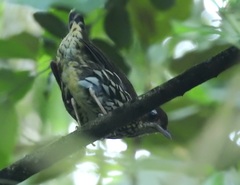
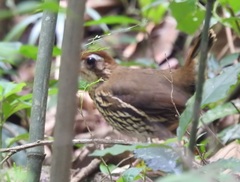
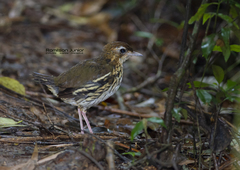

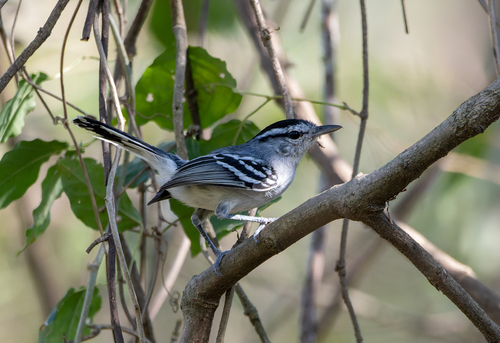
Short-tailed Antthrush

Short-tailed Antthrush

Chamaeza campanisona

Silhouette: Abraão B. Leite · PhyloPic

LCLeast ConcernNTVUENCR
Daily sighting probability ~50% · Likely
at Amboró National Park

In 3 days ~80% in a week >90%

240 Verified sightings at Amboró National Park From 2019 to 2026
1,112 In all 7 parks
January Best month
☀️ Diurnal When it's spotted

About the Short-tailed Antthrush

The short-tailed antthrush (Chamaeza campanisona) is a species of bird in the family Formicariidae. It is found in every mainland South American country except Chile, French Guiana, and Uruguay. The short-tailed antthrush was first formally described by Vieillot in 1818 as Turdus brevicaudus. However, because that binomial had previously applied to another species, by the principle of priority Lichtenstein's 1823 description as Myiothera campanisona is recognized as the original. The species was later moved to its current genus Chamaeza. Its specific epithet comes from the Latin "campana" (bell) and "sonus" (sound) and refers to the species' bell-like song.

The International Ornithological Congress (IOC) assigns the short-tailed antthrush these 11 subspecies: The authors also suggest that the short-tailed antthrush as currently known may include as many as four species. The Clements taxonomy and BirdLife International's Handbook of the Birds of the World recognize C. c. tshororo; the IOC includes... Wikipedia →

Sounds

Alarm call0:07

Argentina · 2026

© Faustino Hollmann · XC1176781 · CC BY-NC-SA 4.0

Call0:27

Argentina · 2026

© Marcos E. Sosa · XC1135510 · CC BY-NC-SA 4.0

Song1:02

Brazil · 2025

© Joost van Bruggen · XC1050592 · CC BY-NC-ND 4.0

Global Distribution

Parks Where Found

# Park Country Daily sighting probability
1 Amboró National Park 🇧🇴 Bolivia
~50%
2 Henri Pittier National Park 🇻🇪 Venezuela
~20%
3 Iguaçu National Park 🇧🇷 Brazil
~10%
4 Iguazú National Park 🇦🇷 Argentina
~10%
5 Podocarpus National Park 🇪🇨 Ecuador
<5%
6 Chingaza National Natural Park 🇨🇴 Colombia
<5%
7 Itatiaia National Park 🇧🇷 Brazil
<5%

Cities Where Found

# City Country Daily sighting probability
1 Caracas 🇻🇪 Venezuela
<5%

Before you go

What are the chances of seeing a Short-tailed Antthrush in Amboró National Park?

Likely

About 50% of wildlife watchers report a Short-tailed Antthrush sighting in Amboró National Park on a given day, based on 240 verified sightings from GBIF citizen-science data from 2019 to 2026. It is the 18th most-seen of the 273 birds we can rate there. Over three days the chance rises to about 80%, and over a week to over 90%, if each day is a fresh chance.

When is the best time to see a Short-tailed Antthrush in Amboró National Park?

January and October

In those months about 60% of wildlife watchers report a Short-tailed Antthrush in Amboró National Park on a given day, against about 30% in February and August, the lowest months. June has too few records to rate.

What time of day is best to see a Short-tailed Antthrush?

Between 7 and 10 am

Across all the parks we cover, that three-hour window holds the most Short-tailed Antthrush sightings with a recorded time, and about 8 in 10 of them come between 6 am and 6 pm: it is a daytime animal.

Is Amboró National Park the best place to see a Short-tailed Antthrush?

Yes

Of the 7 parks where we can rate Short-tailed Antthrush sightings, Amboró National Park has the highest daily chance: about 50%. Next come Henri Pittier National Park (Venezuela, about 20%) and Iguaçu National Park (Brazil, about 10%).

Which relatives of the Short-tailed Antthrush live in Amboró National Park?

Same order: Passeriformes

The closest relatives of the Short-tailed Antthrush that you can see in Amboró National Park (order Passeriformes, Perching Birds) are Purplish Jay (about 80%), Plush-crested Jay (about 80%) and Crested Oropendola (about 80%), with each one's daily chance of a sighting.

Where does the Short-tailed Antthrush sighting chance come from?

GBIF citizen-science records

It is estimated from how often the Short-tailed Antthrush is recorded against all the birds logged in Amboró National Park (240 verified sightings from 2019 to 2026), calibrated against known sighting rates. Figures are rounded to the nearest 10% because citizen-science data supports honest approximations, not decimals, and months with records from fewer than five people show "—". How it works.

← Back to Amboró National Park