
Barred Hawk

Barred Hawk

Leucopternis princeps

Silhouette: Sheatherius · PhyloPic

LCLeast ConcernNTVUENCR
Daily sighting probability <5% · Rare
at Arenal Volcano National Park

In 3 days ~10% in a week ~20%

391 Verified sightings at Arenal Volcano National Park From 2019 to 2026
1,901 In all 13 parks
May Best month
☀️ Diurnal When it's spotted

About the Barred Hawk

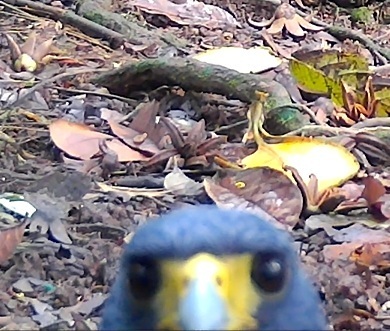
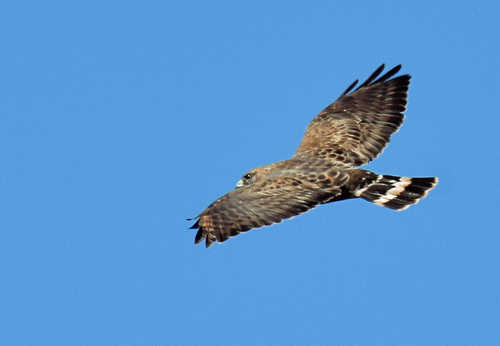
The barred hawk (Morphnarchus princeps) is a species of bird of prey in the family Accipitridae. It has also been known as the black-chested hawk. It is found in Colombia, Costa Rica, Ecuador, Panama, and Peru. Its natural habitats are subtropical or tropical moist lowland forest and subtropical or tropical moist montane forest. 10,000 to 100,000 barred hawks are thought to exist throughout Central and South America. Barred hawks mainly live in the dense forests of the lowland and mountainous areas.

Philip Sclater first classified the barred hawk in 1865. Barred hawks are in the family Accipitridae that contains all the hawks, eagles, and old world vultures. Recent research-using mtDNA to analyze the phylogeny of this genus has been done. What researchers found was that the black and white plumage of genus Leucopternis has evolved at least twice, and the widespread occurrence of this plumage pattern may result from plumage convergence in forested habitats. In classical taxonomy, the black and white plumage pattern was overemphasized in the grouping of Leucopternis and plumage patterns alone may not be reliable taxonomic markers in this family. Studies... Wikipedia →

Sounds

Call0:40

Ecuador · 2024

© Manuel Sánchez-Nivicela · XC1142971 · CC BY-NC-ND 4.0

Song0:23

Ecuador · 1991

© Paul Coopmans · XC264369 · CC BY-NC-SA 4.0

Flight call0:04

Ecuador · 1991

© Niels Krabbe · XC238647 · CC BY-NC-SA 3.0

Global Distribution

Parks Where Found

# Park Country Daily sighting probability
1 Farallones de Cali National Natural Park 🇨🇴 Colombia
~20%
2 Poás Volcano National Park 🇨🇷 Costa Rica
~10%
3 Tapantí-Macizo de la Muerte National Park 🇨🇷 Costa Rica
<5%
4 Darién National Park 🇵🇦 Panama
<5%
5 Chirripó National Park 🇨🇷 Costa Rica
<5%
6 Arenal Volcano National Park 🇨🇷 Costa Rica
<5%
7 Braulio Carrillo National Park 🇨🇷 Costa Rica
<5%
8 Tenorio Volcano National Park 🇨🇷 Costa Rica
<5%
9 La Amistad International Park (Panama) 🇵🇦 Panama
<5%
10 Rincón de la Vieja National Park 🇨🇷 Costa Rica
<5%
11 Monteverde Cloud Forest Reserve 🇨🇷 Costa Rica
<5%
12 Volcán Barú National Park 🇵🇦 Panama
<5%
13 Los Quetzales National Park 🇨🇷 Costa Rica
<5%

Cities Where Found

# City Country Daily sighting probability
1 San José 🇨🇷 Costa Rica
<5%

Zoos & Centres Where Found

# Zoo / Centre Country
1 Aviario Nacional de Colombia 🇨🇴 Colombia In captivity
2 Parque Cóndor 🇪🇨 Ecuador In captivity

Before you go

What are the chances of seeing a Barred Hawk in Arenal Volcano National Park?

Rare

Under 5% of wildlife watchers report a Barred Hawk sighting in Arenal Volcano National Park on a given day, based on 391 verified sightings from GBIF citizen-science data from 2019 to 2026. It is the 247th most-seen of the 503 birds we can rate there. Over three days the chance rises to about 10%, and over a week to about 20%, if each day is a fresh chance.

When is the best time to see a Barred Hawk in Arenal Volcano National Park?

May

In that month about 10% of wildlife watchers report a Barred Hawk in Arenal Volcano National Park on a given day, against under 5% in June to April, the lowest months.

What time of day is best to see a Barred Hawk?

Between 9 am and noon

Across all the parks we cover, that three-hour window holds the most Barred Hawk sightings with a recorded time, and nearly all of them come between 6 am and 6 pm: it is a daytime animal.

Where does the Barred Hawk sighting chance come from?

GBIF citizen-science records

It is estimated from how often the Barred Hawk is recorded against all the birds logged in Arenal Volcano National Park (391 verified sightings from 2019 to 2026), calibrated against known sighting rates. Figures are rounded to the nearest 10% because citizen-science data supports honest approximations, not decimals, and months with records from fewer than five people show "—". How it works.

← Back to Arenal Volcano National Park