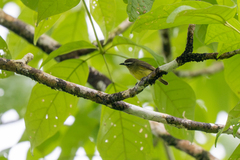
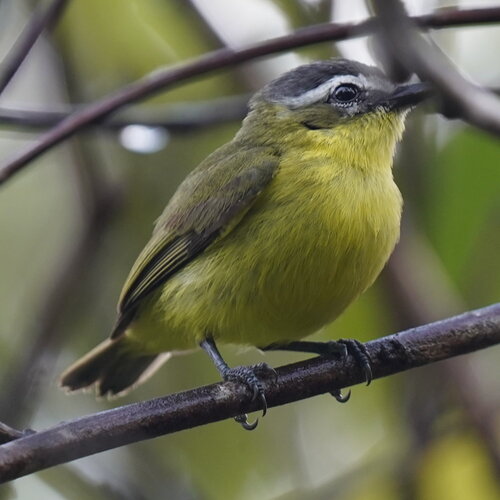
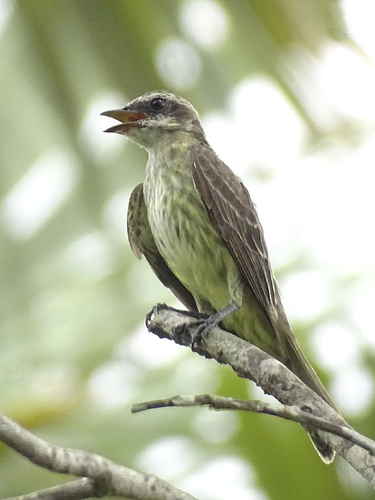
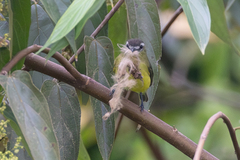
Brown-capped Tyrannulet

Brown-capped Tyrannulet

Ornithion brunneicapillus

Silhouette: Emily Willoughby · PhyloPic

LCLeast ConcernNTVUENCR
Daily sighting probability <5% · Rare
at Arenal Volcano National Park

In 3 days <5%

20 Verified sightings at Arenal Volcano National Park From 2019 to 2026
4,621 In all 15 parks
May Best month
☀️ Diurnal When it's spotted

About the Brown-capped Tyrannulet

The brown-capped tyrannulet (Ornithion brunneicapillus) is a species of bird in subfamily Elaeniinae of family Tyrannidae, the tyrant flycatchers. It is found in Colombia, Costa Rica, Ecuador, Panama, and Venezuela and reported for the first time in Nicaragua in 2011.

The brown-capped tyrannulet and the yellow-bellied tyrannulet (O. semiflavum) were for a time considered to be conspecific and now are deemed a superspecies. Both are now monotypic. The brown-capped tyrannulet is about 8 cm (3.1 in) long and weighs about 7 to 8 g (0.25 to 0.28 oz). It is a small flycatcher with a pointed bill. The sexes have the same plumage. Adults have a brownish olive to dark brown crown with a white forehead, lores, and supercilium on an otherwise olive face. Their upperparts are olive. Their wings and tail are dusky olive. Their underparts are bright yellow with faint olive streaks on the breast and flanks. Both sexes have a brown iris, a black bill with an arched maxilla, and dark gray legs and feet. Juveniles have a more olive crown, a less distinct supercilium, paler tips on the wing coverts, and paler yellow underparts than adults. Wikipedia →

Sounds

Call1:09

Ecuador · 2020

© Manuel Sánchez-Nivicela · XC1154941 · CC BY-NC-ND 4.0

Song0:05

Panama · 2019

© Kent Livezey · XC457166 · CC BY-NC-SA 4.0

Call?0:52

Colombia · 2007

© Bradley Davis · XC13946 · CC BY-NC-ND 2.5

Global Distribution

Parks Where Found

# Park Country Daily sighting probability
1 Soberanía National Park 🇵🇦 Panama
~30%
2 San Lorenzo Protected Forest 🇵🇦 Panama
~20%
3 Tayrona National Natural Park 🇨🇴 Colombia
~20%
4 Utría National Natural Park 🇨🇴 Colombia
~10%
5 Tortuguero National Park 🇨🇷 Costa Rica
~10%
6 Darién National Park 🇵🇦 Panama
~10%
7 Chagres National Park 🇵🇦 Panama
~10%
8 Cahuita National Park 🇨🇷 Costa Rica
~10%
9 Parque Natural Metropolitano 🇵🇦 Panama
~10%
10 Gandoca-Manzanillo Wildlife Refuge 🇨🇷 Costa Rica
~10%
11 Bastimentos Island National Marine Park 🇵🇦 Panama
<5%
12 La Amistad International Park (Panama) 🇵🇦 Panama
<5%
13 Braulio Carrillo National Park 🇨🇷 Costa Rica
<5%
14 Farallones de Cali National Natural Park 🇨🇴 Colombia
<5%
15 Arenal Volcano National Park 🇨🇷 Costa Rica
<5%

Cities Where Found

# City Country Daily sighting probability
1 Panama City 🇵🇦 Panama
<5%

Before you go

What are the chances of seeing a Brown-capped Tyrannulet in Arenal Volcano National Park?

Rare

Under 5% of wildlife watchers report a Brown-capped Tyrannulet sighting in Arenal Volcano National Park on a given day, based on 20 verified sightings from GBIF citizen-science data from 2019 to 2026. It is the 448th most-seen of the 503 birds we can rate there. Over three days the chance rises to under 5%, if each day is a fresh chance.

When is the best time to see a Brown-capped Tyrannulet in Arenal Volcano National Park?

Any time of year

In every month with enough records, under 5% of wildlife watchers report a Brown-capped Tyrannulet in Arenal Volcano National Park on a given day, so our monthly data shows no clear season.

What time of day is best to see a Brown-capped Tyrannulet?

Between 7 and 10 am

Across all the parks we cover, that three-hour window holds the most Brown-capped Tyrannulet sightings with a recorded time, and about 9 in 10 of them come between 6 am and 6 pm: it is a daytime animal.

Where does the Brown-capped Tyrannulet sighting chance come from?

GBIF citizen-science records

It is estimated from how often the Brown-capped Tyrannulet is recorded against all the birds logged in Arenal Volcano National Park (20 verified sightings from 2019 to 2026), calibrated against known sighting rates. Figures are rounded to the nearest 10% because citizen-science data supports honest approximations, not decimals, and months with records from fewer than five people show "—". How it works.

← Back to Arenal Volcano National Park