
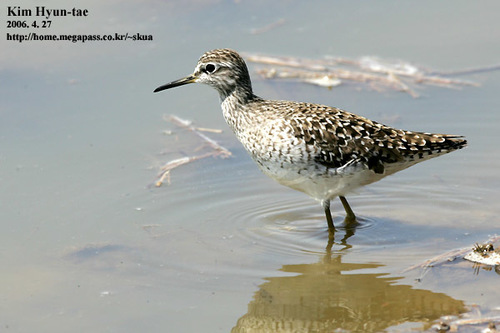
Eurasian Woodcock

Eurasian Woodcock

Scolopax rusticola

Silhouette: Craig Nash · PhyloPic

LCLeast ConcernNTVUENCR
Daily sighting probability <5% · Rare
at Bavarian Forest National Park

In 3 days ~10% in a week ~20%

33 Verified sightings at Bavarian Forest National Park From 2019 to 2026
691 In all 12 parks
March Best month
☀️ Diurnal When it's spotted

About the Eurasian Woodcock

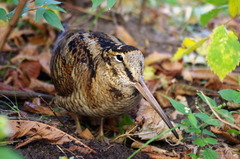
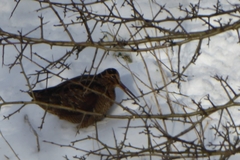
The Eurasian woodcock (Scolopax rusticola) is a medium-small wading bird found in temperate and subarctic Eurasia. It has cryptic camouflage to suit its woodland habitat, with reddish-brown upperparts and buff-coloured underparts. Its eyes are set far back on its head to give it 360-degree vision and it probes in the ground for food with its long, sensitive bill, making it vulnerable to cold weather when the ground remains frozen.

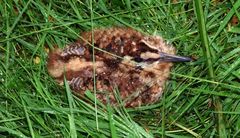
The male performs a courtship flight known as "roding" at dusk in spring. It is widely believed that the female will sometimes carry chicks between her legs whilst flying, though evidence of this is purely anecdotal. The world population is estimated to be 14 million to 16 million birds.

The Eurasian woodcock was formally described by the Swedish naturalist Carl Linnaeus in 1758 in the tenth edition of his Systema Naturae under the current binomial name Scolopax rusticola. The genus name is Latin for a snipe or woodcock. The specific epithet rusticola is the Latin name of a gamebird mentioned by Pliny the Elder and Marcus Valerius Martialis. It was possibly a grouse. The species is monotypic: no subspecies are recognised. Its closest relatives... Wikipedia →

Sounds

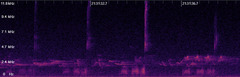
Song0:49

Finland · 2026

© Eetu Paljakka · XC1105406 · CC BY-NC-SA 4.0

Duet0:20

Sweden · 2024

© Lars Edenius · XC919448 · CC BY-NC-SA 4.0

Flight call0:37

Sweden · 2024

© Ulf Elman · XC910192 · CC BY-NC-ND 4.0

Global Distribution

Parks Where Found

# Park Country Daily sighting probability
1 Biebrza National Park 🇵🇱 Poland
~10%
2 Białowieża National Park 🇵🇱 Poland
~10%
3 Cuc Phuong National Park 🇻🇳 Vietnam
<5%
4 Cairngorms National Park 🇬🇧 United Kingdom
<5%
5 Bavarian Forest National Park 🇩🇪 Germany
<5%
6 Gobi Gurvansaikhan National Park 🇲🇳 Mongolia
<5%
7 Wadden Sea National Park 🇩🇪 Germany
<5%
8 Vatnajokull National Park 🇮🇸 Iceland
<5%
9 Gauja National Park 🇱🇻 Latvia
<5%
10 Doi Inthanon National Park 🇹🇭 Thailand
<5%
11 Monfragüe National Park 🇪🇸 Spain
<5%
12 Pyrénées National Park 🇫🇷 France
<5%

Cities Where Found

# City Country Daily sighting probability
1 Novosibirsk 🇷🇺 Russia
~10%
2 Kazan 🇷🇺 Russia
~10%
3 Moscow 🇷🇺 Russia
<5%
4 Dehradun 🇮🇳 India
<5%
5 Suzhou 🇨🇳 China
<5%
6 Helsinki 🇫🇮 Finland
<5%
7 Manchester 🇬🇧 United Kingdom
<5%
8 Minsk 🇧🇾 Belarus
<5%
9 Saint Petersburg 🇷🇺 Russia
<5%
10 Tuen Mun 🇨🇳 China
<5%

Before you go

What are the chances of seeing a Eurasian Woodcock in Bavarian Forest National Park?

Rare

Under 5% of wildlife watchers report a Eurasian Woodcock sighting in Bavarian Forest National Park on a given day, based on 33 verified sightings from GBIF citizen-science data from 2019 to 2026. It is the 127th most-seen of the 170 birds we can rate there. Over three days the chance rises to about 10%, and over a week to about 20%, if each day is a fresh chance.

When is the best time to see a Eurasian Woodcock in Bavarian Forest National Park?

March

In that month about 10% of wildlife watchers report a Eurasian Woodcock in Bavarian Forest National Park on a given day, against under 5% in April to February, the lowest months.

What time of day is best to see a Eurasian Woodcock?

Between 10 am and 1 pm

Across all the parks we cover, that three-hour window holds the most Eurasian Woodcock sightings with a recorded time, and about 7 in 10 of them come between 6 am and 6 pm: it is a daytime animal.

Is Bavarian Forest National Park the best place to see a Eurasian Woodcock?

5th of 12

Of the 12 parks where we can rate Eurasian Woodcock sightings, Bavarian Forest National Park ranks 5th at under 5%. The best odds are in Biebrza National Park (Poland, about 10%), Białowieża National Park (Poland, about 10%) and Cuc Phuong National Park (Vietnam, under 5%).

Which relatives of the Eurasian Woodcock live in Bavarian Forest National Park?

Same family: Scolopacidae

The closest relatives of the Eurasian Woodcock that you can see in Bavarian Forest National Park (family Scolopacidae, Sandpipers and Allies) are Eurasian Curlew (about 10%), Common Greenshank (about 10%) and Ruff (about 10%), with each one's daily chance of a sighting.

Where does the Eurasian Woodcock sighting chance come from?

GBIF citizen-science records

It is estimated from how often the Eurasian Woodcock is recorded against all the birds logged in Bavarian Forest National Park (33 verified sightings from 2019 to 2026), calibrated against known sighting rates. Figures are rounded to the nearest 10% because citizen-science data supports honest approximations, not decimals, and months with records from fewer than five people show "—". How it works.

← Back to Bavarian Forest National Park