22-Spot Ladybird

22-Spot Ladybird

Psyllobora vigintiduopunctata

Daily sighting probability ~10% · With luck
at Białowieża National Park

In 3 days ~30% in a week ~50%

5 Verified sightings at Białowieża National Park From 2019 to 2026
179 In all 7 parks
September Best month
☀️ Diurnal When it's spotted

About the 22-Spot Ladybird

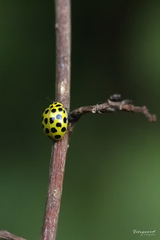
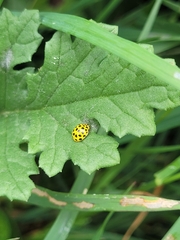
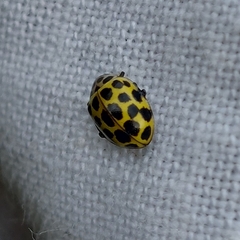
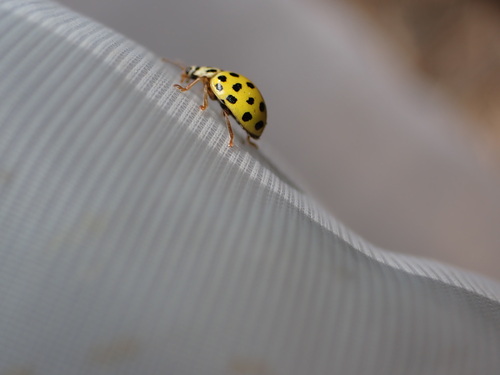
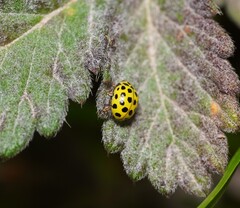
Psyllobora vigintiduopunctata (often abbreviated to Psyllobora 22-punctata), the 22-spot ladybird, (earlier known as Thea vigintiduopunctata) is a common, 3–5 mm long ladybird native to Europe. This species was originally discovered in Germany in 1874 on the leaves of Astragalus, consuming the hyphae of Erysiphe holosericea. The elytra are yellow in colour with 22 black spots. The pronotum is yellow or white with 5 black spots.

This is the only ladybird species in Britain and Ireland where the three life stages have very similar coloring and pattern; the pupa and larva look similar to the adult form, making them conspicuous and easier to identify. Unlike most other ladybirds which feed on aphids, P. 22-punctata eats mildew — especially from umbellifers and low-growing shrubs.

The 22-spot ladybird is best looked for amongst low vegetation. It has occasionally been found in woodlands, on lower branches of young trees and in some coastal areas. In a survey conducted between 1960 and 1965 by G.I. Savoiskaya in South-Eastern Kazakhstan, up to 500 individuals were found overwintering together in the leaf litter at the bases of birches, hawthorns and wild apple trees. These instances were noted as being found between 1000 meters and 2000 meters above sea level.

The Royal Botanic Gardens, Kew officially recorded their first 22-spot lady bird in 1969, publishing this finding along with many other additions to their wild flora and fauna records. The hemolymph of the 22-spot ladybird beetle contains a dimeric alkaloid, psylloborine A, which has unique structural features, highlighting the species' complex chemical defenses and evolutionary adaptations. Wikipedia →
Global Distribution

Parks Where Found

# Park Country Daily sighting probability
1 Fertő-Hanság National Park 🇭🇺 Hungary
~10%
2 Bavarian Forest National Park 🇩🇪 Germany
~10%
3 Białowieża National Park 🇵🇱 Poland
~10%
4 Wadden Sea National Park 🇩🇪 Germany
~10%
5 Cévennes National Park 🇫🇷 France
~10%
6 Pyrénées National Park 🇫🇷 France
~10%
7 Sierra de Guadarrama National Park 🇪🇸 Spain
<5%

Cities Where Found

# City Country Daily sighting probability
1 Kharkiv 🇺🇦 Ukraine
~20%
2 Sofia 🇧🇬 Bulgaria
~20%
3 Kyiv 🇺🇦 Ukraine
~20%
4 London 🇬🇧 United Kingdom
~20%
5 Budapest 🇭🇺 Hungary
~20%
6 Brussels 🇧🇪 Belgium
~10%
7 Berlin 🇩🇪 Germany
~10%
8 Vienna 🇦🇹 Austria
~10%
9 Birmingham 🇬🇧 United Kingdom
~10%
10 Lyon 🇫🇷 France
~10%

Before you go

What are the chances of seeing a 22-Spot Ladybird in Białowieża National Park?

With luck

About 10% of wildlife watchers report a 22-Spot Ladybird sighting in Białowieża National Park on a given day, based on 5 verified sightings from GBIF citizen-science data from 2019 to 2026. It is the 131st most-seen of the 158 insects we can rate there. Over three days the chance rises to about 30%, and over a week to about 50%, if each day is a fresh chance.

When is the best time to see a 22-Spot Ladybird in Białowieża National Park?

August and September

In those months about 20% of wildlife watchers report a 22-Spot Ladybird in Białowieża National Park on a given day, against under 5% in October to May, the lowest months.

What time of day is best to see a 22-Spot Ladybird?

Between 3 and 6 pm

Across all the parks we cover, that three-hour window holds the most 22-Spot Ladybird sightings with a recorded time, and about 8 in 10 of them come between 6 am and 6 pm: it is a daytime animal.

Is Białowieża National Park the best place to see a 22-Spot Ladybird?

Among the best

Of the 7 parks where we can rate 22-Spot Ladybird sightings, Białowieża National Park ranks 3rd at about 10%, level with the leaders once rounded. The best odds are in Fertő-Hanság National Park (Hungary, about 10%) and Bavarian Forest National Park (Germany, about 10%).

Which relatives of the 22-Spot Ladybird live in Białowieża National Park?

Same family: Coccinellidae

The closest relatives of the 22-Spot Ladybird that you can see in Białowieża National Park (family Coccinellidae, Lady Beetles) are Seven-Spotted Lady Beetle (about 30%) and Asian Lady Beetle (about 30%), with each one's daily chance of a sighting.

Where does the 22-Spot Ladybird sighting chance come from?

GBIF citizen-science records

It is estimated from how often the 22-Spot Ladybird is recorded against all the insects logged in Białowieża National Park (5 verified sightings from 2019 to 2026), calibrated against known sighting rates. Figures are rounded to the nearest 10% because citizen-science data supports honest approximations, not decimals, and months with records from fewer than five people show "—". How it works.

← Back to Białowieża National Park