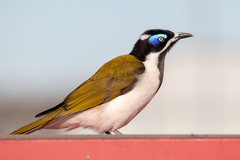
Blue-faced Honeyeater

Blue-faced Honeyeater

Entomyzon cyanotis

Silhouette: Kai Caspar · PhyloPic

LCLeast ConcernNTVUENCR
Daily sighting probability <5% · Rare
at Blue Mountains National Park

In 3 days <5%

33 Verified sightings at Blue Mountains National Park From 2019 to 2026
1,458 In all 9 parks
December Best month
☀️ Diurnal When it's spotted

About the Blue-faced Honeyeater

The blue-faced honeyeater (Entomyzon cyanotis), also colloquially known as the bananabird, is a passerine bird of the honeyeater family, Meliphagidae. It is the only member of its genus, and it is most closely related to honeyeaters of the genus Melithreptus. Three subspecies are recognised. At around 29.5 cm (11.6 in) in length, the blue-faced species is large for a honeyeater. Its plumage is distinctive, with olive upperparts, white underparts, and a black head and throat with white nape and cheeks. Males and females are similar in external appearance. Adults have a blue area of bare skin on each side of the face readily distinguishing them from juveniles, which have yellow or green patches of bare skin.

Found in open woodland, parks and gardens, the blue-faced honeyeater is common in northern and eastern Australia, and southern New Guinea. It appears to be sedentary in parts of its range, and locally nomadic in other parts; however, the species has been little studied. Its diet is mostly composed of invertebrates, supplemented with nectar and fruit. They often take over and renovate old babbler nests, in which the female lays and incubates two or rarely three eggs. Wikipedia →

Sounds

Dawn song0:20

Australia · 2025

© Étienne Leroy · XC1074096 · CC BY-NC-SA 4.0

Call0:39

Australia · 2025

© Peter Boesman · XC1066552 · CC BY-NC-ND 4.0

Begging call1:08

Australia · 2022

© Richard Boon · XC772291 · CC BY-NC-SA 4.0

Global Distribution

Parks Where Found

# Park Country Daily sighting probability
1 Nitmiluk National Park 🇦🇺 Australia
~50%
2 Noosa National Park 🇦🇺 Australia
~40%
3 Litchfield National Park 🇦🇺 Australia
~40%
4 Kakadu National Park 🇦🇺 Australia
~30%
5 Springbrook National Park 🇦🇺 Australia
~10%
6 Hattah-Kulkyne National Park 🇦🇺 Australia
~10%
7 Lamington National Park 🇦🇺 Australia
<5%
8 Daintree National Park 🇦🇺 Australia
<5%
9 Blue Mountains National Park 🇦🇺 Australia
<5%

Cities Where Found

# City Country Daily sighting probability
1 Brisbane 🇦🇺 Australia
~50%
2 Sydney 🇦🇺 Australia
<5%
3 Melbourne 🇦🇺 Australia
<5%

Zoos & Centres Where Found

# Zoo / Centre Country
1 San Diego Zoo 🇺🇸 United States In captivity
2 Cincinnati Zoo and Botanical Garden 🇺🇸 United States In captivity
3 Antwerp Zoo 🇧🇪 Belgium In captivity
4 Barcelona Zoo 🇪🇸 Spain In captivity
5 North Carolina Zoo 🇺🇸 United States In captivity
6 Living Desert Zoo and Gardens 🇺🇸 United States In captivity
7 Columbus Zoo and Aquarium 🇺🇸 United States In captivity
8 Bronx Zoo 🇺🇸 United States In captivity
9 Brookfield Zoo 🇺🇸 United States In captivity
10 Cotswold Wildlife Park 🇬🇧 United Kingdom In captivity
11 Marwell Zoo 🇬🇧 United Kingdom In captivity
12 Warsaw Zoo 🇵🇱 Poland In captivity
13 Healesville Sanctuary 🇦🇺 Australia In captivity
14 Berlin Zoological Garden 🇩🇪 Germany In captivity
15 Woodland Park Zoo 🇺🇸 United States In captivity
16 Moody Gardens 🇺🇸 United States In captivity
17 ZooTampa 🇺🇸 United States In captivity
18 Fort Worth Zoo 🇺🇸 United States In captivity
19 Taronga Zoo 🇦🇺 Australia In captivity
20 Wilhelma 🇩🇪 Germany In captivity
21 Blank Park Zoo 🇺🇸 United States In captivity
22 Fort Wayne Children's Zoo 🇺🇸 United States In captivity
23 Melbourne Zoo 🇦🇺 Australia In captivity
24 ABQ BioPark Zoo 🇺🇸 United States In captivity
25 Bird Paradise 🇸🇬 Singapore In captivity
26 Aquarama Barcelona 🇪🇸 Spain In captivity
27 Lincoln Park Zoo 🇺🇸 United States In captivity
28 Rainforest Wild Asia 🇸🇬 Singapore In captivity
29 Vogelpark Avifauna 🇳🇱 Netherlands In captivity
30 Loro Parque 🇪🇸 Spain In captivity
31 Featherdale Sydney Wildlife Park 🇦🇺 Australia In captivity
32 Tracy Aviary 🇺🇸 United States In captivity
33 Zoo Lagos 🇵🇹 Portugal In captivity
34 National Aviary 🇺🇸 United States In captivity
35 Aquarium Berlin 🇩🇪 Germany In captivity
36 National Aquarium 🇺🇸 United States In captivity
37 herpetarium warszawskiego ZOO 🇵🇱 Poland In captivity
38 akwarium warszawskiego ZOO 🇵🇱 Poland In captivity
39 Aquatopia 🇧🇪 Belgium In captivity
40 hipopotamiarnia i akwarium morskie warszawskiego ZOO 🇵🇱 Poland In captivity
41 Ranger Red’s Zoo & Conservation Park 🇦🇺 Australia In captivity

Before you go

What are the chances of seeing a Blue-faced Honeyeater in Blue Mountains National Park?

Rare

Under 5% of wildlife watchers report a Blue-faced Honeyeater sighting in Blue Mountains National Park on a given day, based on 33 verified sightings from GBIF citizen-science data from 2019 to 2026. It is the 168th most-seen of the 196 birds we can rate there. Over three days the chance rises to under 5%, if each day is a fresh chance.

When is the best time to see a Blue-faced Honeyeater in Blue Mountains National Park?

Any time of year

In every month with enough records, under 5% of wildlife watchers report a Blue-faced Honeyeater in Blue Mountains National Park on a given day, so our monthly data shows no clear season.

What time of day is best to see a Blue-faced Honeyeater?

Between 1 and 4 pm

Across all the parks we cover, that three-hour window holds the most Blue-faced Honeyeater sightings with a recorded time, and nearly all of them come between 6 am and 6 pm: it is a daytime animal.

Which relatives of the Blue-faced Honeyeater live in Blue Mountains National Park?

Same family: Meliphagidae

The closest relatives of the Blue-faced Honeyeater that you can see in Blue Mountains National Park (family Meliphagidae, Honeyeaters) are Eastern Spinebill (about 70%), Red Wattlebird (about 60%) and Yellow-faced Honeyeater (about 50%), with each one's daily chance of a sighting.

Where does the Blue-faced Honeyeater sighting chance come from?

GBIF citizen-science records

It is estimated from how often the Blue-faced Honeyeater is recorded against all the birds logged in Blue Mountains National Park (33 verified sightings from 2019 to 2026), calibrated against known sighting rates. Figures are rounded to the nearest 10% because citizen-science data supports honest approximations, not decimals, and months with records from fewer than five people show "—". How it works.

← Back to Blue Mountains National Park