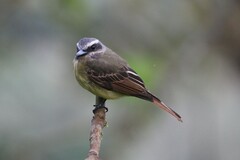
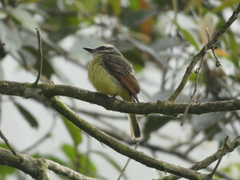
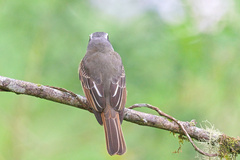
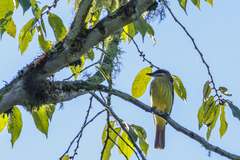

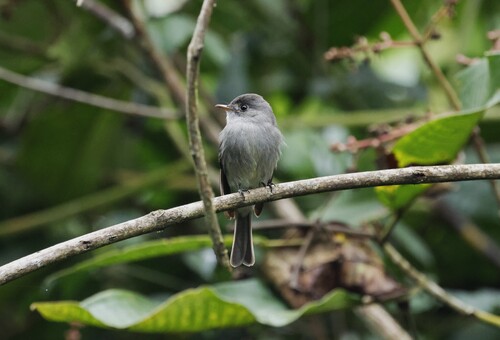
Golden-bellied Flycatcher

Golden-bellied Flycatcher

Myiodynastes hemichrysus

Silhouette: Emily Willoughby · PhyloPic

LCLeast ConcernNTVUENCR
Daily sighting probability <5% · Rare
at Braulio Carrillo National Park

In 3 days ~10% in a week ~30%

208 Verified sightings at Braulio Carrillo National Park From 2019 to 2026
4,206 In all 14 parks
May Best month
☀️ Diurnal When it's spotted

About the Golden-bellied Flycatcher

The golden-bellied flycatcher (Myiodynastes hemichrysus) is a passerine bird in the family Tyrannidae, the tyrant flycatchers. It is found in Colombia, Costa Rica, Ecuador, Panama, Peru, and Venezuela. The golden-bellied flycatcher has a complicated taxonomic history. It was originally described as Hypermitres hemichrysus. By the early 1900s it had been reassigned to genus Myiodynastes, which had been erected in 1847. A 1927 publication treated it as a subspecies of the golden-crowned flycatcher (M. chrysocephalus).

By at least 1979 it was again being treated as a full species. At that time it was considered monotypic. A 2016 publication detailed the vocal differences and similarities between the golden-bellied flycatcher and the three subspecies of the golden-crowned flycatcher. Based on that study, by 2020 BirdLife International's Handbook of the Birds of the World moved two subspecies from the golden-crowned to the golden-bellied. The Clements taxonomy followed suit in 2022 and the IOC and both subcommittees of the American Ornithological Society in 2023. The golden-bellied and golden-crowned flycatchers are sister species.

The golden-bellied flycatcher... Wikipedia →

Sounds

Dawn song0:34

Ecuador · 2024

© Manuel Sánchez-Nivicela · XC1154969 · CC BY-NC-ND 4.0

Call0:30

Ecuador · 2026

© Daan van der Hoeven · XC1105460 · CC BY-NC-SA 4.0

Uncertain0:25

Colombia · 2024

© Andrés Mauricio López · XC902726 · CC BY-NC-SA 4.0

Global Distribution

Parks Where Found

# Park Country Daily sighting probability
1 Farallones de Cali National Natural Park 🇨🇴 Colombia
~20%
2 Henri Pittier National Park 🇻🇪 Venezuela
~10%
3 Chirripó National Park 🇨🇷 Costa Rica
~10%
4 Volcán Barú National Park 🇵🇦 Panama
~10%
5 Los Nevados National Natural Park 🇨🇴 Colombia
~10%
6 La Amistad International Park (Panama) 🇵🇦 Panama
~10%
7 Braulio Carrillo National Park 🇨🇷 Costa Rica
<5%
8 Podocarpus National Park 🇪🇨 Ecuador
<5%
9 Arenal Volcano National Park 🇨🇷 Costa Rica
<5%
10 Los Quetzales National Park 🇨🇷 Costa Rica
<5%
11 Monteverde Cloud Forest Reserve 🇨🇷 Costa Rica
<5%
12 Tapantí-Macizo de la Muerte National Park 🇨🇷 Costa Rica
<5%
13 Poás Volcano National Park 🇨🇷 Costa Rica
<5%
14 Sierra de la Macarena National Park 🇨🇴 Colombia
<5%

Cities Where Found

# City Country Daily sighting probability
1 Cali 🇨🇴 Colombia
<5%
2 Medellín 🇨🇴 Colombia
<5%
3 San José 🇨🇷 Costa Rica
<5%

Before you go

What are the chances of seeing a Golden-bellied Flycatcher in Braulio Carrillo National Park?

Rare

Under 5% of wildlife watchers report a Golden-bellied Flycatcher sighting in Braulio Carrillo National Park on a given day, based on 208 verified sightings from GBIF citizen-science data from 2019 to 2026. It is the 238th most-seen of the 505 birds we can rate there. Over three days the chance rises to about 10%, and over a week to about 30%, if each day is a fresh chance.

When is the best time to see a Golden-bellied Flycatcher in Braulio Carrillo National Park?

April–July and October–December

In those months about 10% of wildlife watchers report a Golden-bellied Flycatcher in Braulio Carrillo National Park on a given day, against under 5% in January–March and August–September, the lowest months.

What time of day is best to see a Golden-bellied Flycatcher?

Between 6 and 9 am

Across all the parks we cover, that three-hour window holds the most Golden-bellied Flycatcher sightings with a recorded time, and about 9 in 10 of them come between 6 am and 6 pm: it is a daytime animal.

Where does the Golden-bellied Flycatcher sighting chance come from?

GBIF citizen-science records

It is estimated from how often the Golden-bellied Flycatcher is recorded against all the birds logged in Braulio Carrillo National Park (208 verified sightings from 2019 to 2026), calibrated against known sighting rates. Figures are rounded to the nearest 10% because citizen-science data supports honest approximations, not decimals, and months with records from fewer than five people show "—". How it works.

← Back to Braulio Carrillo National Park