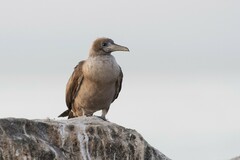
Red-footed Booby

Red-footed Booby

Sula sula

Silhouette: T. Michael Keesey (vectorization) and Larry Loos (photography) · PhyloPic

LCLeast ConcernNTVUENCR
Daily sighting probability <5% · Rare
at Cabo Blanco Absolute Nature Reserve

In 3 days ~10% in a week ~30%

37 Verified sightings at Cabo Blanco Absolute Nature Reserve From 2019 to 2026
3,239 In all 12 parks
July Best month
☀️ Diurnal When it's spotted

About the Red-footed Booby

The red-footed booby (Sula sula) is a large seabird of the booby family, Sulidae. Adults always have red feet, but the colour of the plumage varies. They are powerful and agile fliers, harnessing the wind to fly efficiently, but they are clumsy in takeoffs and landings. They forage by catching flying fish from above the ocean's surface and by performing shallow dives. They are found widely in the tropics, and breed colonially in coastal regions, especially isolated islands such as St. Brandon, Mauritius (Cargados Carajos shoals), and the Chagos Archipelago. Although its population is declining, it is considered to be a least-concern species by the International Union for Conservation of Nature (IUCN). It faces threats from climate change, competition with fisheries, human disturbance, and invasive species.

The red-footed booby was formally described by the Swedish naturalist Carl Linnaeus in 1766, in the twelfth edition of his Systema Naturae. He gave it the binomial name Pelecanus sula and described it based on a specimen from Barbados. The present genus Sula was introduced by the French scientist Mathurin Jacques Brisson in 1760. The word Sula is Norwegian for a gannet... Wikipedia →

Sounds

Call0:39

Ecuador · 2023

© Barry Edmonston · XC815569 · CC BY-NC-SA 4.0

Alarm call0:21

France · 2021

© AUDEVARD Aurélien · XC619248 · CC BY-NC-SA 4.0

Song1:01

Brazil · 2018

© JAYRSON ARAUJO DE OLIVEIRA · XC431272 · CC BY-NC-SA 4.0

Global Distribution

Parks Where Found

# Park Country Daily sighting probability
1 Isla del Coco National Park 🇨🇷 Costa Rica
>90%
2 Machalilla National Park 🇪🇨 Ecuador
~20%
3 Galápagos Islands 🇪🇨 Ecuador
~10%
4 Main Ridge Forest Reserve 🇹🇹 Trinidad and Tobago
~10%
5 Bastimentos Island National Marine Park 🇵🇦 Panama
~10%
6 Cabo Blanco Absolute Nature Reserve 🇨🇷 Costa Rica
<5%
7 La Amistad International Park (Panama) 🇵🇦 Panama
<5%
8 Channel Islands National Park 🇺🇸 United States
<5%
9 Corcovado National Park 🇨🇷 Costa Rica
<5%
10 Raja Ampat 🇮🇩 Indonesia
<5%
11 Manuel Antonio National Park 🇨🇷 Costa Rica
<5%
12 Tortuguero National Park 🇨🇷 Costa Rica
<5%

Cities Where Found

# City Country Daily sighting probability
1 Singapore 🇸🇬 Singapore
<5%
2 San Diego 🇺🇸 United States
<5%

Zoos & Centres Where Found

# Zoo / Centre Country
1 Honolulu Zoo 🇺🇸 United States In captivity

Before you go

What are the chances of seeing a Red-footed Booby in Cabo Blanco Absolute Nature Reserve?

Rare

Under 5% of wildlife watchers report a Red-footed Booby sighting in Cabo Blanco Absolute Nature Reserve on a given day, based on 37 verified sightings from GBIF citizen-science data from 2019 to 2026. It is the 135th most-seen of the 241 birds we can rate there. Over three days the chance rises to about 10%, and over a week to about 30%, if each day is a fresh chance.

When is the best time to see a Red-footed Booby in Cabo Blanco Absolute Nature Reserve?

July

In that month about 30% of wildlife watchers report a Red-footed Booby in Cabo Blanco Absolute Nature Reserve on a given day, against under 5% in February–May and August–December, the lowest months. That is one of Cabo Blanco Absolute Nature Reserve's wettest months, with about 470 mm of rain against 15 mm in February.

What time of day is best to see a Red-footed Booby?

Between 10 am and 1 pm

Across all the parks we cover, that three-hour window holds the most Red-footed Booby sightings with a recorded time, and about 9 in 10 of them come between 6 am and 6 pm: it is a daytime animal.

Is Cabo Blanco Absolute Nature Reserve the best place to see a Red-footed Booby?

6th of 12

Of the 12 parks where we can rate Red-footed Booby sightings, Cabo Blanco Absolute Nature Reserve ranks 6th at under 5%. The best odds are in Isla del Coco National Park (Costa Rica, over 90%), Machalilla National Park (Ecuador, about 20%) and Galápagos Islands (Ecuador, about 10%).

Where does the Red-footed Booby sighting chance come from?

GBIF citizen-science records

It is estimated from how often the Red-footed Booby is recorded against all the birds logged in Cabo Blanco Absolute Nature Reserve (37 verified sightings from 2019 to 2026), calibrated against known sighting rates. Figures are rounded to the nearest 10% because citizen-science data supports honest approximations, not decimals, and months with records from fewer than five people show "—". How it works.

← Back to Cabo Blanco Absolute Nature Reserve