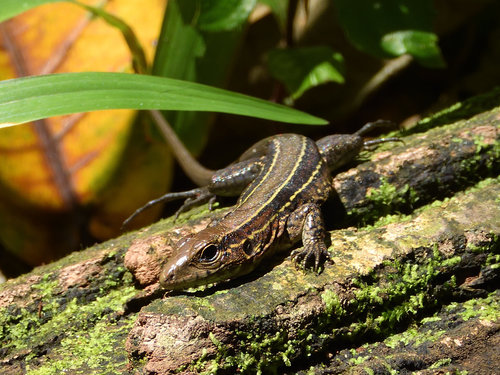
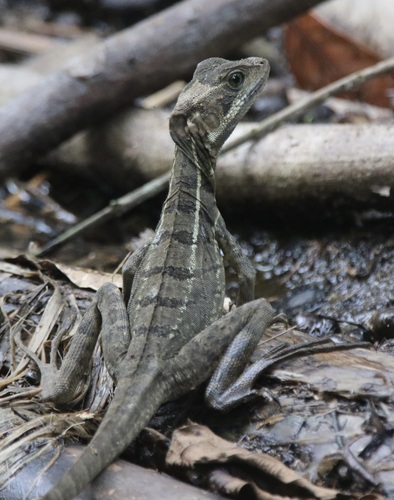
Rainbow Ameiva

Rainbow Ameiva

Holcosus undulatus

Silhouette: SeismicShrimp · PhyloPic

LCLeast ConcernNTVUENCR
Daily sighting probability ~10% · With luck
at Carara National Park

In 3 days ~40% in a week ~60%

15 Verified sightings at Carara National Park From 2019 to 2026
154 In all 10 parks
August Best month
☀️ Diurnal When it's spotted

About the Rainbow Ameiva

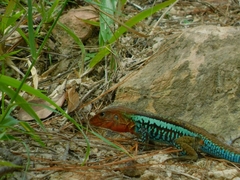
Holcosus undulatus, also known commonly as the barred whiptail, the metallic ameiva, and the rainbow ameiva, is a species of lizard in the family Teiidae. The species occurs in Central America from South Mexico to Costa Rica. There are three recognized subspecies.

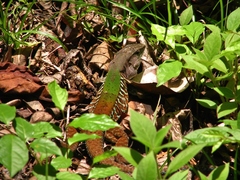
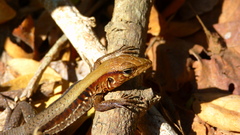
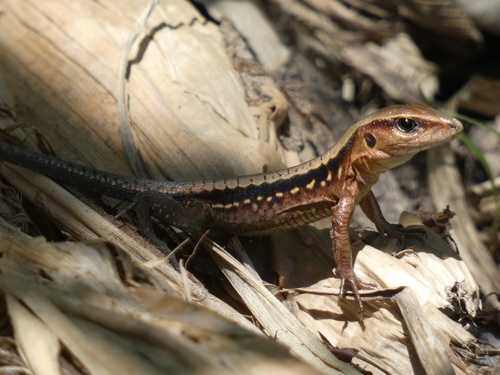
H. undulatus is brown-coloured, with a series of darker zig-zag bars running down the sides, often with light blue and green markings along the sides and underside. It is similar to the Middle American ameiva (H. festivus).

H. undulatus lives in litter in open habitats. The following three subspecies, including the nominotypical subspecies, are recognized as being valid. Holcosus undulatus dexter (H.M. Smith & Laufe, 1946) Holcosus undulatus miadis (Barbour & Loveridge, 1929)

Holcosus undulatus undulatus (Wiegmann, 1834) Nota bene: A trinomial authority in parentheses indicates that the subspecies was originally described in a genus other than Holcosus. Wiegmann AFA (1834). Herpetologia Mexicana, seu descriptio amphibiorum Novae Hispaniae quae itineribus comitis Sack, Ferdinandi Deppe et Chr. Guil. Schiede in Museum Zoologicum Berolinense... Wikipedia →

Global Distribution

Parks Where Found

# Park Country Daily sighting probability
1 Rincón de la Vieja National Park 🇨🇷 Costa Rica
~50%
2 Calakmul Biosphere Reserve 🇲🇽 Mexico
~20%
3 Sian Ka'an Biosphere Reserve 🇲🇽 Mexico
~20%
4 Ría Lagartos Biosphere Reserve 🇲🇽 Mexico
~20%
5 Cabo Blanco Absolute Nature Reserve 🇨🇷 Costa Rica
~20%
6 Tikal National Park 🇬🇹 Guatemala
~20%
7 Santa Rosa National Park 🇨🇷 Costa Rica
~20%
8 Carara National Park 🇨🇷 Costa Rica
~10%
9 Palo Verde National Park 🇨🇷 Costa Rica
~10%
10 Monteverde Cloud Forest Reserve 🇨🇷 Costa Rica
~10%

Cities Where Found

# City Country Daily sighting probability
1 Guatemala City 🇬🇹 Guatemala
~10%

Zoos & Centres Where Found

# Zoo / Centre Country
1 Newport Aquarium 🇺🇸 United States In captivity

Before you go

What are the chances of seeing a Rainbow Ameiva in Carara National Park?

With luck

About 10% of wildlife watchers report a Rainbow Ameiva sighting in Carara National Park on a given day, based on 15 verified sightings from GBIF citizen-science data from 2019 to 2026. It is the 18th most-seen of the 29 reptiles we can rate there. Over three days the chance rises to about 40%, and over a week to about 60%, if each day is a fresh chance.

When is the best time to see a Rainbow Ameiva in Carara National Park?

August

In that month about 30% of wildlife watchers report a Rainbow Ameiva in Carara National Park on a given day, against under 5% in September–October and December, the lowest months. That is one of Carara National Park's wettest months, with about 600 mm of rain against 35 mm in February.

What time of day is best to see a Rainbow Ameiva?

Between 10 am and 1 pm

Across all the parks we cover, that three-hour window holds the most Rainbow Ameiva sightings with a recorded time, and about 9 in 10 of them come between 6 am and 6 pm: it is a daytime animal.

Which relatives of the Rainbow Ameiva live in Carara National Park?

Same genus: Holcosus

The closest relatives of the Rainbow Ameiva that you can see in Carara National Park (genus Holcosus, Northwestern Ameivas) are Delicate Ameiva (about 50%) and Four-lined Ameiva (about 10%), with each one's daily chance of a sighting.

Where does the Rainbow Ameiva sighting chance come from?

GBIF citizen-science records

It is estimated from how often the Rainbow Ameiva is recorded against all the reptiles logged in Carara National Park (15 verified sightings from 2019 to 2026), calibrated against known sighting rates. Figures are rounded to the nearest 10% because citizen-science data supports honest approximations, not decimals, and months with records from fewer than five people show "—". How it works.

← Back to Carara National Park