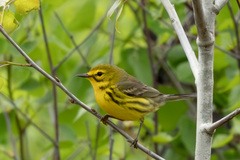
Prairie Warbler

Prairie Warbler

Setophaga discolor

Silhouette: Dylan GE Gomes · PhyloPic

LCLeast ConcernNTVUENCR
Daily sighting probability <5% · Rare
at Celestún Biosphere Reserve

In 3 days <5%

12 Verified sightings at Celestún Biosphere Reserve From 2019 to 2026
5,219 In all 14 parks
January Best month
☀️ Diurnal When it's spotted

About the Prairie Warbler

The prairie warbler (Setophaga discolor) is a small songbird of the New World warbler family. The prairie warbler belongs to the genus Setophaga. The species was described by the French ornithologist Louis Pierre Vieillot in a work published in 1807 documenting North American birds, where he called the bird Sylvia discolor, although the genus designation Sylvia was not later retained. It was also previously assigned to the genus Dendroica before that genus was merged into Setophaga.

The vernacular name "prairie warbler" is attributed to the Scottish-American naturalist Alexander Wilson who saw the species in 1810 in prairie country in southwestern Kentucky. This name is arguably misleading, since the bird generally prefers shrubbery and small trees rather than true open prairie habitats.

The first, S. d. discolor, is the migratory form which breeds throughout the full range and spends winters in Florida and the West Indies. The second, S. d. paludicola, is the sedentary form which permanently inhabits the coasts of Florida. American zoologist Arthur H. Howell is credited with describing S. d. paludicola... Wikipedia →

Sounds

Aberrant0:39

United States · 2023

© Brian Henderson · XC893266 · CC BY-NC-SA 4.0

Recording0:47

United States · 2022

© Jorge de Leon Cardozo · XC729713 · CC BY-NC-SA 4.0

Song0:51

United States · 2021

© Christopher McPherson · XC691783 · CC BY-NC-SA 4.0

Global Distribution

Parks Where Found

# Park Country Daily sighting probability
1 Ciénaga de Zapata 🇨🇺 Cuba
~30%
2 Everglades National Park 🇺🇸 United States
~30%
3 Blue and John Crow Mountains National Park 🇯🇲 Jamaica
~30%
4 Big Cypress National Preserve 🇺🇸 United States
~10%
5 Great Smoky Mountains National Park 🇺🇸 United States
~10%
6 Merritt Island National Wildlife Refuge 🇺🇸 United States
<5%
7 Arrecifes de Cozumel National Park 🇲🇽 Mexico
<5%
8 Point Pelee National Park 🇨🇦 Canada
<5%
9 Congaree National Park 🇺🇸 United States
<5%
10 El Vizcaíno Biosphere Reserve 🇲🇽 Mexico
<5%
11 Shenandoah National Park 🇺🇸 United States
<5%
12 Celestún Biosphere Reserve 🇲🇽 Mexico
<5%
13 Ría Lagartos Biosphere Reserve 🇲🇽 Mexico
<5%
14 Soberanía National Park 🇵🇦 Panama
<5%

Cities Where Found

# City Country Daily sighting probability
1 Miami 🇺🇸 United States
~20%
2 Havana 🇨🇺 Cuba
~20%
3 Santo Domingo 🇩🇴 Dominican Republic
~20%
4 Orlando 🇺🇸 United States
~10%
5 New York City 🇺🇸 United States
<5%
6 San Diego 🇺🇸 United States
<5%
7 Baltimore 🇺🇸 United States
<5%
8 Philadelphia 🇺🇸 United States
<5%
9 Boston 🇺🇸 United States
<5%
10 Washington 🇺🇸 United States
<5%

Before you go

What are the chances of seeing a Prairie Warbler in Celestún Biosphere Reserve?

Rare

Under 5% of wildlife watchers report a Prairie Warbler sighting in Celestún Biosphere Reserve on a given day, based on 12 verified sightings from GBIF citizen-science data from 2019 to 2026. It is the 249th most-seen of the 297 birds we can rate there. Over three days the chance rises to under 5%, if each day is a fresh chance.

When is the best time to see a Prairie Warbler in Celestún Biosphere Reserve?

Any time of year

In every month with enough records, under 5% of wildlife watchers report a Prairie Warbler in Celestún Biosphere Reserve on a given day, so our monthly data shows no clear season.

What time of day is best to see a Prairie Warbler?

Between 8 and 11 am

Across all the parks we cover, that three-hour window holds the most Prairie Warbler sightings with a recorded time, and about 9 in 10 of them come between 6 am and 6 pm: it is a daytime animal.

Which relatives of the Prairie Warbler live in Celestún Biosphere Reserve?

Same genus: Setophaga

The closest relatives of the Prairie Warbler that you can see in Celestún Biosphere Reserve (genus Setophaga, Setophaga Warblers) are Yellow Warbler (about 60%), Northern Parula (about 20%) and American Redstart (about 20%), with each one's daily chance of a sighting.

Where does the Prairie Warbler sighting chance come from?

GBIF citizen-science records

It is estimated from how often the Prairie Warbler is recorded against all the birds logged in Celestún Biosphere Reserve (12 verified sightings from 2019 to 2026), calibrated against known sighting rates. Figures are rounded to the nearest 10% because citizen-science data supports honest approximations, not decimals, and months with records from fewer than five people show "—". How it works.

← Back to Celestún Biosphere Reserve