
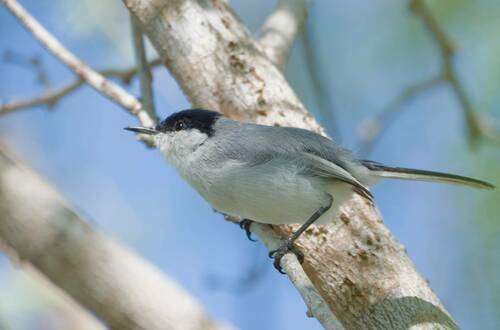
Yucatán Jay

Yucatán Jay

Cyanocorax yucatanicus

Silhouette: Sheatherius · PhyloPic

LCLeast ConcernNTVUENCR
Daily sighting probability <5% · Rare
at Celestún Biosphere Reserve

In 3 days ~10% in a week ~30%

73 Verified sightings at Celestún Biosphere Reserve From 2019 to 2026
1,790 In all 5 parks
July Best month
☀️ Diurnal When it's spotted

About the Yucatán Jay

The Yucatan jay (Cyanocorax yucatanicus) is a species of bird in the family Corvidae, the crows and their allies. It is native to the Yucatán Peninsula where its habitats are subtropical or tropical dry forest, plantations and cleared areas at altitudes up to 250 m (820 ft). Adults are about 30 cm (12 in) long, black, with blue wings, mantle, and tail, black bills, yellow eye rings and legs. Immature birds have yellow bills. This is a common species of jay with a wide range and the International Union for Conservation of Nature has rated its conservation status as being of "least concern".

The Yucatan jay was first described by the naturalist Alphonse Dubois in 1875. It originally places in the genus Cyanocitta, and was given the scientific name Cyanocitta yucatanica. It is now placed by the genus Cyanocorax, which was introduced by the German zoologist Friedrich Boie in 1826, as Cyanocorax yucatanicus. In 1934, ornithologist Carl Eduard Hellmayr reorganized the genus Cyanocorax and split it into four subgenera. The Yucatan jay was placed into the subgenus Cissilopha as Cissilopha yucatanica. This is now considered a synonym for the Yucatan jay.

When Hellmayr created... Wikipedia →

Sounds

Call1:06

Mexico · 2023

© Enrique Varela · XC824008 · CC BY-NC-SA 4.0

Song0:28

Mexico · 2018

© Manuel Grosselet · XC444838 · CC BY-NC-SA 4.0

Chatter1:04

Mexico · 2005

© Meena Haribal · XC5496 · CC BY-NC-ND 2.5

Global Distribution

Parks Where Found

# Park Country Daily sighting probability
1 Sian Ka'an Biosphere Reserve 🇲🇽 Mexico
~60%
2 Calakmul Biosphere Reserve 🇲🇽 Mexico
~20%
3 Ría Lagartos Biosphere Reserve 🇲🇽 Mexico
~10%
4 Celestún Biosphere Reserve 🇲🇽 Mexico
<5%
5 Tikal National Park 🇬🇹 Guatemala
<5%

Zoos & Centres Where Found

# Zoo / Centre Country
1 Kansas City Zoo 🇺🇸 United States In captivity
2 Papiliorama 🇨🇭 Switzerland In captivity
3 Sobela Ocean Aquarium 🇺🇸 United States In captivity

Before you go

What are the chances of seeing a Yucatán Jay in Celestún Biosphere Reserve?

Rare

Under 5% of wildlife watchers report a Yucatán Jay sighting in Celestún Biosphere Reserve on a given day, based on 73 verified sightings from GBIF citizen-science data from 2019 to 2026. It is the 153rd most-seen of the 297 birds we can rate there. Over three days the chance rises to about 10%, and over a week to about 30%, if each day is a fresh chance.

When is the best time to see a Yucatán Jay in Celestún Biosphere Reserve?

May, July and November

In those months about 10% of wildlife watchers report a Yucatán Jay in Celestún Biosphere Reserve on a given day, against under 5% in June, August–October and December–April, the lowest months.

What time of day is best to see a Yucatán Jay?

Between 7 and 10 am

Across all the parks we cover, that three-hour window holds the most Yucatán Jay sightings with a recorded time, and about 9 in 10 of them come between 6 am and 6 pm: it is a daytime animal.

Where does the Yucatán Jay sighting chance come from?

GBIF citizen-science records

It is estimated from how often the Yucatán Jay is recorded against all the birds logged in Celestún Biosphere Reserve (73 verified sightings from 2019 to 2026), calibrated against known sighting rates. Figures are rounded to the nearest 10% because citizen-science data supports honest approximations, not decimals, and months with records from fewer than five people show "—". How it works.

← Back to Celestún Biosphere Reserve