
Stub-tailed Spadebill

Stub-tailed Spadebill

Platyrinchus cancrominus

Silhouette: Emily Willoughby · PhyloPic

LCLeast ConcernNTVUENCR
Daily sighting probability <5% · Rare
at Biotopo Cerro Cahuí

In 3 days ~10% in a week ~30%

17 Verified sightings at Biotopo Cerro Cahuí From 2019 to 2026
1,994 In all 15 parks
December Best month
☀️ Diurnal When it's spotted

About the Stub-tailed Spadebill

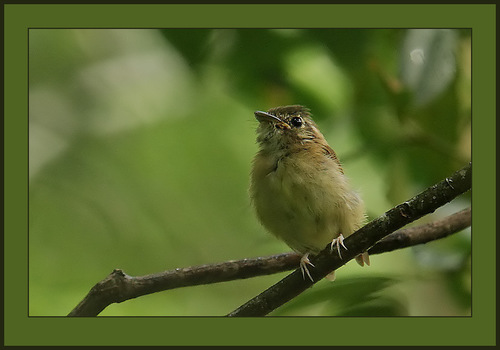
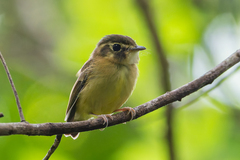
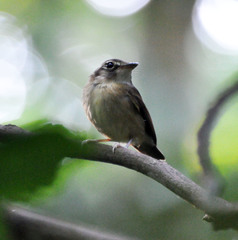
The stub-tailed spadebill (Platyrinchus cancrominus) is a passerine bird in the Tyrannidae family. It is commonly found in tropical dry rainforests or tropical moist lowlands throughout Central America. First scientifically described in 1860, it was originally thought to be the same as Platyrinchus mystaceus but was later reclassified as a sympatric species. The stub-tailed spadebill may grow up to 9.5 cm (3.74 in) long and may weigh up to 12 g (0.42 oz). It has a white throat, yellow breast, and brown mantle and wings. The stub-tailed spadebill is most easily recognizable due to its stubby tail, broad bill, and its distinctive bird song. Some morphological differences like its greatly reduced crown differentiate it from other related species.

The stub-tailed spadebill is found in elevation ranges up to 500 m (1,640 ft) above sea level. As an omnivore it feeds on both arthropods such as spiders, beetles, and ants as well as low hanging berries and fruits in the lower strata of the rainforests. While many individuals may live in solitude, pairs that live together often nest in deep cone-shaped nests made with scavenged fibres. Stub-tailed spadebills also engage in mixed-species foraging flocks with other species commonly found in the same habitat. Engaging in this flocking behaviour is still not fully understood and is believed to be done for protection from predation. It is categorized as a species of least concern by the International Union for Conservation of Nature Wikipedia →

Sounds

Call0:20

Mexico · 2022

© Joren van Schie · XC1080708 · CC BY-NC-SA 4.0

Song0:13

Mexico · 2012

© Ian Davies · XC118754 · CC BY-NC-SA 3.0

Song?0:15

Belize · 2011

© Mary Beth Stowe · XC77734 · CC BY-NC-ND 2.5

Global Distribution

Parks Where Found

# Park Country Daily sighting probability
1 Tikal National Park 🇬🇹 Guatemala
~30%
2 Cockscomb Basin Wildlife Sanctuary 🇧🇿 Belize
~20%
3 Calakmul Biosphere Reserve 🇲🇽 Mexico
~20%
4 Rincón de la Vieja National Park 🇨🇷 Costa Rica
~10%
5 Santa Rosa National Park 🇨🇷 Costa Rica
~10%
6 Bastimentos Island National Marine Park 🇵🇦 Panama
~10%
7 Biotopo Cerro Cahuí 🇬🇹 Guatemala
<5%
8 El Triunfo 🇲🇽 Mexico
<5%
9 Cabo Blanco Absolute Nature Reserve 🇨🇷 Costa Rica
<5%
10 Sian Ka'an Biosphere Reserve 🇲🇽 Mexico
<5%
11 Montes Azules Biosphere Reserve 🇲🇽 Mexico
<5%
12 Carara National Park 🇨🇷 Costa Rica
<5%
13 La Amistad International Park (Panama) 🇵🇦 Panama
<5%
14 Tenorio Volcano National Park 🇨🇷 Costa Rica
<5%
15 Pico Bonito National Park 🇭🇳 Honduras
<5%

Before you go

What are the chances of seeing a Stub-tailed Spadebill in Biotopo Cerro Cahuí?

Rare

Under 5% of wildlife watchers report a Stub-tailed Spadebill sighting in Biotopo Cerro Cahuí on a given day, based on 17 verified sightings from GBIF citizen-science data from 2019 to 2026. It is the 123rd most-seen of the 191 birds we can rate there. Over three days the chance rises to about 10%, and over a week to about 30%, if each day is a fresh chance.

When is the best time to see a Stub-tailed Spadebill in Biotopo Cerro Cahuí?

December

In that month about 20% of wildlife watchers report a Stub-tailed Spadebill in Biotopo Cerro Cahuí on a given day, against under 5% in February–September and November, the lowest months.

What time of day is best to see a Stub-tailed Spadebill?

Between 8 and 11 am

Across all the parks we cover, that three-hour window holds the most Stub-tailed Spadebill sightings with a recorded time, and about 9 in 10 of them come between 6 am and 6 pm: it is a daytime animal.

Which relatives of the Stub-tailed Spadebill live in Biotopo Cerro Cahuí?

Same family: Tyrannidae

The closest relatives of the Stub-tailed Spadebill that you can see in Biotopo Cerro Cahuí (family Tyrannidae, Tyrant Flycatchers) are Social Flycatcher (about 50%), Great Kiskadee (about 30%) and Tropical Kingbird (about 30%), with each one's daily chance of a sighting.

Where does the Stub-tailed Spadebill sighting chance come from?

GBIF citizen-science records

It is estimated from how often the Stub-tailed Spadebill is recorded against all the birds logged in Biotopo Cerro Cahuí (17 verified sightings from 2019 to 2026), calibrated against known sighting rates. Figures are rounded to the nearest 10% because citizen-science data supports honest approximations, not decimals, and months with records from fewer than five people show "—". How it works.

← Back to Biotopo Cerro Cahuí