Plum-headed Parakeet

Plum-headed Parakeet

Psittacula cyanocephala

Silhouette: Farelli (photo), John E. McCormack, Michael G. Harvey, Brant C. Faircloth, Nicholas G. Crawford, Travis C. Glenn, Robb T. Brumfield & T. Michael Keesey · PhyloPic

Daily sighting probability ~50% · Likely
at Chitwan National Park

In 3 days ~90% in a week >90%

922 Verified sightings at Chitwan National Park From 2019 to 2026
17,028 In all 17 parks
January Best month
☀️ Diurnal When it's spotted

About the Plum-headed Parakeet

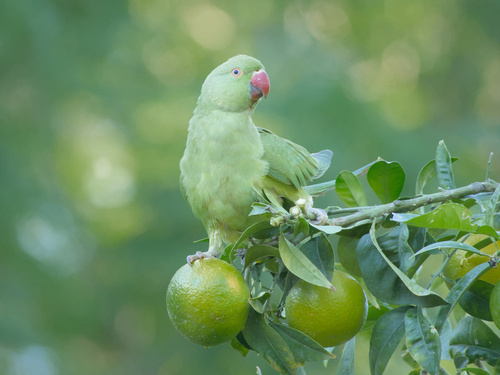
The plum-headed parakeet (Psittacula cyanocephala) is a species of parakeet in the family Psittacidae. It is endemic to the Indian subcontinent and was once thought to be conspecific with the blossom-headed parakeet (P. roseata) before being elevated to a full species. Plum-headed parakeets are found in flocks, the males having a pinkish purple head and the females, a grey head. They fly swiftly with twists and turns accompanied by their distinctive calls.

In 1760 the French zoologist Mathurin Jacques Brisson included a description of the plum-headed parakeet in his Ornithologie based on a specimen collected in India. He used the French name Le perruche a teste bleu and the Latin name Psittaca cyanocephalos. Although Brisson coined Latin names, these do not conform to the binomial system and are not recognised by the International Commission on Zoological Nomenclature. When in 1766 the Swedish naturalist Carl Linnaeus updated his Systema Naturae for the twelfth edition he added 240 species that had been previously described by Brisson. One of these was the plum-headed parakeet. Linnaeus included a terse description, coined the binomial name Psittacus cyanocephalus and... Wikipedia →

Sounds

Call0:29

India · 2012

© Conrad Pinto · XC161248 · CC BY-NC-ND 3.0

Song0:17

India · 2022

© JISHNU KIZHAKKILLAM · XC777495 · CC BY-NC-SA 4.0

Flight call0:08

India · 2020

© Mandar Bhagat · XC590315 · CC BY-NC-SA 4.0

Global Distribution

Parks Where Found

# Park Country Daily sighting probability
1 Bandhavgarh National Park 🇮🇳 India
~70%
2 Mudumalai National Park 🇮🇳 India
~60%
3 Satpura National Park 🇮🇳 India
~60%
4 Jim Corbett National Park 🇮🇳 India
~60%
5 Nagarhole National Park 🇮🇳 India
~60%
6 Kanha National Park 🇮🇳 India
~50%
7 Ranthambore National Park 🇮🇳 India
~50%
8 Royal Bardia National Park 🇳🇵 Nepal
~50%
9 Chitwan National Park 🇳🇵 Nepal
~50%
10 Gir National Park 🇮🇳 India
~50%
11 Bandipur National Park 🇮🇳 India
~50%
12 Periyar National Park 🇮🇳 India
~30%
13 Udawalawe National Park 🇱🇰 Sri Lanka
~20%
14 Sinharaja Forest Reserve 🇱🇰 Sri Lanka
~10%
15 Eravikulam National Park 🇮🇳 India
~10%
16 Yala National Park 🇱🇰 Sri Lanka
~10%
17 Keoladeo National Park 🇮🇳 India
<5%

Cities Where Found

# City Country Daily sighting probability
1 Dehradun 🇮🇳 India
~40%
2 Thrissur 🇮🇳 India
~30%
3 Indore 🇮🇳 India
~20%
4 Jabalpur 🇮🇳 India
~20%
5 Nagpur 🇮🇳 India
~20%
6 Pune 🇮🇳 India
~10%
7 Gwalior 🇮🇳 India
~10%
8 Prayagraj 🇮🇳 India
~10%
9 Tamluk 🇮🇳 India
~10%
10 Kozhikode 🇮🇳 India
~10%

Zoos & Centres Where Found

# Zoo / Centre Country
1 Disney's Animal Kingdom 🇺🇸 United States In captivity
2 Islamabad Zoo 🇵🇰 Pakistan In captivity
3 Wildlife World Zoo 🇺🇸 United States In captivity
4 Paignton Zoo 🇬🇧 United Kingdom In captivity
5 Kamla Nehru Prani Sangrahalay 🇮🇳 India In captivity
6 Budapest Zoo & Botanical Garden 🇭🇺 Hungary In captivity
7 Paphos Zoo 🇨🇾 Cyprus In captivity
8 Loro Parque 🇪🇸 Spain In captivity
9 Adelaide Zoo 🇦🇺 Australia In captivity
10 Kuala Lumpur Bird Park 🇲🇾 Malaysia In captivity
11 Ranger Red’s Zoo & Conservation Park 🇦🇺 Australia In captivity

Before you go

What are the chances of seeing a Plum-headed Parakeet in Chitwan National Park?

Likely

About 50% of wildlife watchers report a Plum-headed Parakeet sighting in Chitwan National Park on a given day, based on 922 verified sightings from GBIF citizen-science data from 2019 to 2026. It is the 21st most-seen of the 367 birds we can rate there. Over three days the chance rises to about 90%, and over a week to over 90%, if each day is a fresh chance.

When is the best time to see a Plum-headed Parakeet in Chitwan National Park?

January–February and June

In those months about 60% of wildlife watchers report a Plum-headed Parakeet in Chitwan National Park on a given day, against about 40% in July–September and December, the lowest months.

What time of day is best to see a Plum-headed Parakeet?

Between 7 and 10 am

Across all the parks we cover, that three-hour window holds the most Plum-headed Parakeet sightings with a recorded time, and about 9 in 10 of them come between 6 am and 6 pm: it is a daytime animal.

Which relatives of the Plum-headed Parakeet live in Chitwan National Park?

Same genus: Psittacula

The closest relatives of the Plum-headed Parakeet that you can see in Chitwan National Park (genus Psittacula, Old World Parakeets) are Rose-ringed Parakeet (about 50%), Alexandrine Parakeet (about 50%) and Red-breasted Parakeet (about 20%), with each one's daily chance of a sighting.

Where does the Plum-headed Parakeet sighting chance come from?

GBIF citizen-science records

It is estimated from how often the Plum-headed Parakeet is recorded against all the birds logged in Chitwan National Park (922 verified sightings from 2019 to 2026), calibrated against known sighting rates. Figures are rounded to the nearest 10% because citizen-science data supports honest approximations, not decimals, and months with records from fewer than five people show "—". How it works.

← Back to Chitwan National Park