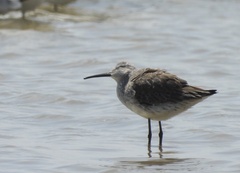
Stilt Sandpiper

Stilt Sandpiper

Calidris himantopus

Silhouette: Edwin Price · PhyloPic

LCNTNear ThreatenedVUENCR
Daily sighting probability <5% · Rare
at Ciénaga de Zapata

In 3 days ~10% in a week ~20%

49 Verified sightings at Ciénaga de Zapata From 2019 to 2026
869 In all 17 parks
March Best month
☀️ Diurnal When it's spotted

About the Stilt Sandpiper

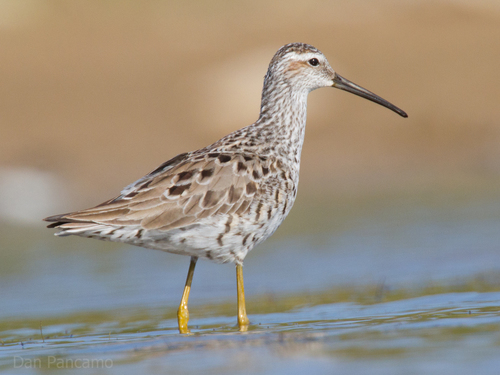
The stilt sandpiper (Calidris himantopus) is a small shorebird. The scientific name is from Ancient Greek; the genus name kalidris or skalidris is a term used by Aristotle for a gray-colored waterside bird. The specific himantopus means "strap foot" or "thong foot", and also refers to the stilt.

Formerly placed in its own monotypic genus Micropalama, DNA evidence has now shown that it is deeply embedded in the genus Calidris, where its closest relative is the curlew sandpiper, and next closest to a group of four Eurasian species, red-necked stint, spoon-billed sandpiper, Temminck's stint, and long-toed stint. Within the genus Calidris the stilt sandpiper is most closely related to the curlew sandpiper (Calidris ferruginea).

The stilt sandpiper resembles the curlew sandpiper in its long bill, long neck, pale supercilium and white rump. It is readily distinguished from that species by its straighter bill (only slightly curved, not obviously so), its longer and greenish-yellow (not black) legs, and in flight, by the lack of a wingbar. It also lacks an obvious wing bar in flight. Breeding adults are distinctive, heavily barred with blackish bars on a white... Wikipedia →
Sounds

Call0:51

French Guiana · 2024

© Tristan Guillebot de Nerville · XC1139147 · CC BY-NC-SA 4.0

Flight call0:09

United States · 2013

© Paul Marvin · XC145926 · CC BY-NC-SA 3.0

Song0:53

Canada · 2010

© Doug Hynes · XC76188 · CC BY-NC-ND 2.5

Global Distribution

Parks Where Found

# Park Country Daily sighting probability
1 Isla del Coco National Park 🇨🇷 Costa Rica
~10%
2 Caroni Swamp 🇹🇹 Trinidad and Tobago
~10%
3 Merritt Island National Wildlife Refuge 🇺🇸 United States
<5%
4 Ría Lagartos Biosphere Reserve 🇲🇽 Mexico
<5%
5 Ciénaga de Zapata 🇨🇺 Cuba
<5%
6 Celestún Biosphere Reserve 🇲🇽 Mexico
<5%
7 Palo Verde National Park 🇨🇷 Costa Rica
<5%
8 Padre Island National Seashore 🇺🇸 United States
<5%
9 El Vizcaíno Biosphere Reserve 🇲🇽 Mexico
<5%
10 Arrecifes de Cozumel National Park 🇲🇽 Mexico
<5%
11 Everglades National Park 🇺🇸 United States
<5%
12 Parque Estadual Encontro das Águas 🇧🇷 Brazil
<5%
13 La Amistad International Park (Panama) 🇵🇦 Panama
<5%
14 Carara National Park 🇨🇷 Costa Rica
<5%
15 Tortuguero National Park 🇨🇷 Costa Rica
<5%
16 Tambopata National Reserve 🇵🇪 Peru
<5%
17 Point Pelee National Park 🇨🇦 Canada
<5%

Cities Where Found

# City Country Daily sighting probability
1 León 🇲🇽 México
~20%
2 Lima 🇵🇪 Peru
<5%
3 Santa Cruz de la Sierra 🇧🇴 Bolivia
<5%
4 Seattle 🇺🇸 United States
<5%
5 Panama City 🇵🇦 Panama
<5%
6 Cochabamba 🇧🇴 Bolivia
<5%
7 Havana 🇨🇺 Cuba
<5%
8 Valencia 🇻🇪 Venezuela
<5%
9 New York City 🇺🇸 United States
<5%
10 Mexico City 🇲🇽 México
<5%

Before you go

What are the chances of seeing a Stilt Sandpiper in Ciénaga de Zapata?

Rare

Under 5% of wildlife watchers report a Stilt Sandpiper sighting in Ciénaga de Zapata on a given day, based on 49 verified sightings from GBIF citizen-science data from 2019 to 2026. It is the 126th most-seen of the 177 birds we can rate there. Over three days the chance rises to about 10%, and over a week to about 20%, if each day is a fresh chance.

When is the best time to see a Stilt Sandpiper in Ciénaga de Zapata?

February and March

In those months about 10% of wildlife watchers report a Stilt Sandpiper in Ciénaga de Zapata on a given day, against under 5% in April–August and October–January, the lowest months. Those are among Ciénaga de Zapata's driest months, with about 20 mm of rain a month against 150 mm in June. September has too few records to rate.

What time of day is best to see a Stilt Sandpiper?

Between 10 am and 1 pm

Across all the parks we cover, that three-hour window holds the most Stilt Sandpiper sightings with a recorded time, and about 9 in 10 of them come between 6 am and 6 pm: it is a daytime animal.

Which relatives of the Stilt Sandpiper live in Ciénaga de Zapata?

Same genus: Calidris

The closest relatives of the Stilt Sandpiper that you can see in Ciénaga de Zapata (genus Calidris, Calidris Sandpipers) are Least Sandpiper (about 20%), Dunlin (about 10%) and Red Knot (about 10%), with each one's daily chance of a sighting.

Where does the Stilt Sandpiper sighting chance come from?

GBIF citizen-science records

It is estimated from how often the Stilt Sandpiper is recorded against all the birds logged in Ciénaga de Zapata (49 verified sightings from 2019 to 2026), calibrated against known sighting rates. Figures are rounded to the nearest 10% because citizen-science data supports honest approximations, not decimals, and months with records from fewer than five people show "—". How it works.

← Back to Ciénaga de Zapata