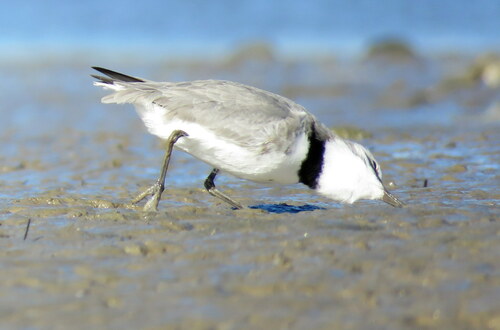
Black-Fronted Dotterel

Black-Fronted Dotterel

Elseyornis melanops

LCLeast ConcernNTVUENCR
Daily sighting probability <5% · Rare
at Auckland

In 3 days <5%

5 Verified sightings at Auckland
775 In all 6 parks From 2019 to 2026
March Best month
☀️ Diurnal When it's spotted

About the Black-Fronted Dotterel

The black-fronted dotterel (Thinornis melanops) is a small plover in the family Charadriidae that is found throughout much of Australia and New Zealand. The black-fronted dotterel was formally described in 1818 by the French ornithologist Louis Pierre Vieillot under the binomial name Charadrius melanops. The type locality was subsequently designated as New South Wales. The specific epithet combines the Ancient Greek melops meaning "black" with ōps meaning "face". This species was previously placed in the monotypic genus Elseyornis but a molecular phylogenetic study published in 2022 found that it was embedded in a clade containing members of the genus Thinornis. The black-fronted dotterel was therefore moved to Thinornis. The species is monotypic: no subspecies are recognised.

As an adult, this small shorebird has an overall length of 16–18 cm (6.3–7.1 in), a wingspan of 33–35 cm (13–14 in) and a weight of 30–35 g (1.1–1.2 oz). The sexes are similar in appearance. It has a distinct black face mask, forehead and v-shaped band across the chest. Dorsally it is a mottled brown colour with the wings and crown of the head the same colour. This colouration...

Wikipedia →

Sounds

2 birds interacting0:26

Australia · 2024

© Mike FitzGerald · XC947054 · CC BY-NC-SA 4.0

Call0:56

Australia · 2022

© James Lambert · XC731827 · CC BY-NC-ND 4.0

Call0:22

Australia · 2020

© Marc Anderson · XC634714 · CC BY-NC-ND 4.0

Global Distribution

Parks Where Found

# Park Country Daily sighting probability
1 Flinders Ranges National Park 🇦🇺 Australia
~30%
2 Kakadu National Park 🇦🇺 Australia
~20%
3 Hattah-Kulkyne National Park 🇦🇺 Australia
~20%
4 Daintree National Park 🇦🇺 Australia
~10%
5 Great Otway National Park 🇦🇺 Australia
~10%
6 Phillip Island Nature Park 🇦🇺 Australia
~10%

Cities Where Found

# City Country Daily sighting probability
1 Perth 🇦🇺 Australia
~10%
2 Brisbane 🇦🇺 Australia
<5%
3 Melbourne 🇦🇺 Australia
<5%
4 Sydney 🇦🇺 Australia
<5%
5 Auckland 🇳🇿 New Zealand
<5%

Before you go

What are the chances of seeing a Black-Fronted Dotterel in Auckland?

Rare

Under 5% of wildlife watchers report a Black-Fronted Dotterel sighting in Auckland on a given day, based on 5 verified sightings from GBIF citizen-science data. It is the 93rd most-seen of the 98 birds we can rate there. Over three days the chance rises to under 5%, if each day is a fresh chance.

When is the best time to see a Black-Fronted Dotterel in Auckland?

Any time of year

In every month with enough records, under 5% of wildlife watchers report a Black-Fronted Dotterel in Auckland on a given day, so our monthly data shows no clear season.

What time of day is best to see a Black-Fronted Dotterel?

Between noon and 3 pm

Across all the parks we cover, that three-hour window holds the most Black-Fronted Dotterel sightings with a recorded time, and about 9 in 10 of them come between 6 am and 6 pm: it is a daytime animal.

Is Auckland the best place to see a Black-Fronted Dotterel?

5th of 5

Of the 5 cities where we can rate Black-Fronted Dotterel sightings, Auckland ranks 5th at under 5%. The best odds are in Perth (Australia, about 10%), Brisbane (Australia, under 5%) and Melbourne (Australia, under 5%).

Which relatives of the Black-Fronted Dotterel live in Auckland?

Same family: Charadriidae

The closest relatives of the Black-Fronted Dotterel that you can see in Auckland (family Charadriidae, Plovers and Lapwings) are Masked Lapwing (about 50%), Red-Breasted Dotterel (about 20%) and Wrybill (about 10%), with each one's daily chance of a sighting.

Where does the Black-Fronted Dotterel sighting chance come from?

GBIF citizen-science records

It is estimated from how often the Black-Fronted Dotterel is recorded against all the birds logged in Auckland (5 verified sightings), calibrated against known sighting rates. Figures are rounded to the nearest 10% because citizen-science data supports honest approximations, not decimals, and months with records from fewer than five people show "—". How it works.

← Back to Auckland