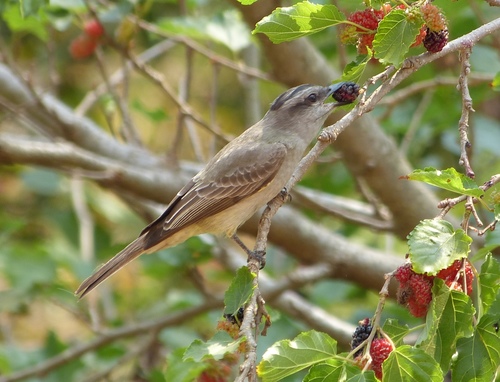
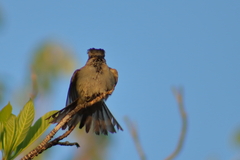
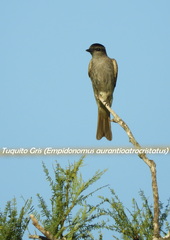

Crowned Slaty Flycatcher

Crowned Slaty Flycatcher

Empidonomus aurantioatrocristatus

Silhouette: Emily Willoughby · PhyloPic

Daily sighting probability <5% · Rare
at Bogota

In 3 days <5%

7 Verified sightings at Bogota
1,026 In all 10 parks From 2019 to 2026
April Best month
☀️ Diurnal When it's spotted

About the Crowned Slaty Flycatcher

The crowned slaty flycatcher (Empidonomus aurantioatrocristatus) is a species of bird in the family Tyrannidae, the tyrant flycatchers. It is found in every mainland South American country except Suriname though only as a vagrant to Chile, French Guiana, and Venezuela. There are also single records of it in Panama and the U.S. state of Louisiana.

The crowned slaty flycatcher was formerly described in 1837 as Tyrannus aurantio-atro cristatus by the French naturalists Alcide d'Orbigny and Frédéric de Lafresnaye based on a specimen collected in the Vallegrande Province, Santa Cruz Department, Bolivia. The specific epithet aurantioatrocristatus combines the late Medieval Latin aurantius meaning "orange-coloured" with Latin ater, atri meaning "black" and cristatus meaning "crested". The species was for long placed together with the variegated flycatcher in the genus Empidonomus that had been introduced in 1860 by the German ornithologists Jean Cabanis and Ferdinand Heine. In 1984 the American ornithologist Wesley E. Lanyon proposed that the crowned slaty flycatcher should be moved to its own genus Griseotyrannus based on the distinctive syringeal morphology. The two species... Wikipedia →

Sounds

Recording0:29

Argentina · 2022

© Leonardo Adrián LEIVA · iNaturalist · CC BY-NC 4.0

Recording0:17

Brazil · 2016

© Luciano Bernardes · iNaturalist · CC BY-NC 4.0

Global Distribution

Parks Where Found

# Park Country Daily sighting probability
1 El Impenetrable National Park 🇦🇷 Argentina
~20%
2 Yasuní National Park 🇪🇨 Ecuador
~10%
3 Iberá National Park 🇦🇷 Argentina
~10%
4 Manu National Park 🇵🇪 Peru
~10%
5 Tambopata National Reserve 🇵🇪 Peru
<5%
6 El Palmar National Park 🇦🇷 Argentina
<5%
7 Cuyabeno Wildlife Reserve 🇪🇨 Ecuador
<5%
8 Amboró National Park 🇧🇴 Bolivia
<5%
9 Península Valdés 🇦🇷 Argentina
<5%
10 Parque Estadual Encontro das Águas 🇧🇷 Brazil
<5%

Cities Where Found

# City Country Daily sighting probability
1 Santa Cruz de la Sierra 🇧🇴 Bolivia
~10%
2 Brasilia 🇧🇷 Brazil
~10%
3 Cordoba 🇦🇷 Argentina
~10%
4 Campo Grande 🇧🇷 Brazil
<5%
5 Belo Horizonte 🇧🇷 Brazil
<5%
6 Asuncion 🇵🇾 Paraguay
<5%
7 Montevideo 🇺🇾 Uruguay
<5%
8 Buenos Aires 🇦🇷 Argentina
<5%
9 Bogota 🇨🇴 Colombia
<5%

Before you go

What are the chances of seeing a Crowned Slaty Flycatcher in Bogota?

Rare

Under 5% of wildlife watchers report a Crowned Slaty Flycatcher sighting in Bogota on a given day, based on 7 verified sightings from GBIF citizen-science data. It is the 211th most-seen of the 231 birds we can rate there. Over three days the chance rises to under 5%, if each day is a fresh chance.

When is the best time to see a Crowned Slaty Flycatcher in Bogota?

Any time of year

In every month with enough records, under 5% of wildlife watchers report a Crowned Slaty Flycatcher in Bogota on a given day, so our monthly data shows no clear season.

What time of day is best to see a Crowned Slaty Flycatcher?

Between 9 am and noon

Across all the parks we cover, that three-hour window holds the most Crowned Slaty Flycatcher sightings with a recorded time, and about 8 in 10 of them come between 6 am and 6 pm: it is a daytime animal.

Is Bogota the best place to see a Crowned Slaty Flycatcher?

9th of 9

Of the 9 cities where we can rate Crowned Slaty Flycatcher sightings, Bogota ranks 9th at under 5%. The best odds are in Santa Cruz de la Sierra (Bolivia, about 10%), Brasilia (Brazil, about 10%) and Cordoba (Argentina, about 10%).

Where does the Crowned Slaty Flycatcher sighting chance come from?

GBIF citizen-science records

It is estimated from how often the Crowned Slaty Flycatcher is recorded against all the birds logged in Bogota (7 verified sightings), calibrated against known sighting rates. Figures are rounded to the nearest 10% because citizen-science data supports honest approximations, not decimals, and months with records from fewer than five people show "—". How it works.

← Back to Bogota