Pacific Baza

Pacific Baza

Aviceda subcristata

Silhouette: Sheatherius · PhyloPic

LCLeast ConcernNTVUENCR
Daily sighting probability <5% · Rare
at Brisbane

In 3 days ~10% in a week ~20%

547 Verified sightings at Brisbane
432 In all 9 parks From 2019 to 2026
July Best month
☀️ Diurnal When it's spotted

About the Pacific Baza

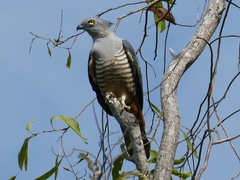
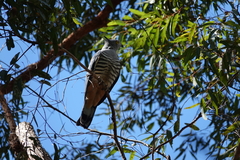
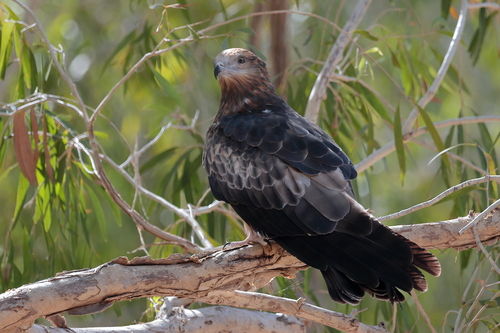
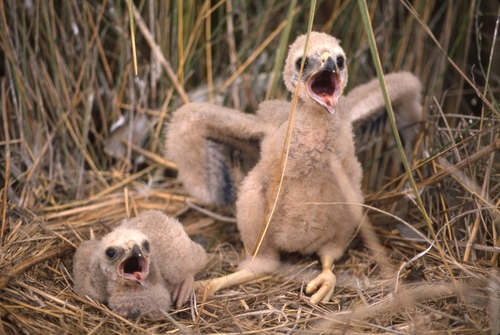
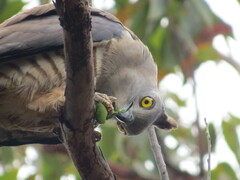
The Pacific baza (Aviceda subcristata), also known as the crested hawk, crested baza, and Pacific cuckoo-falcon, is a slender, medium-sized species of hawk in the family Accipitridae. It is mostly grey, brown, and white coloured and grows to a length of 35–46 centimetres (14–18 in). It is an omnivore and usually does not migrate. The breeding season for the species lasts from September to at least February, during which time specimens commonly fly and vocalise for display. It lives in Australia, Indonesia, Papua New Guinea, Solomon Islands, and East Timor, in forests, savannas, and freshwater bodies. The International Union for Conservation of Nature lists it as a least concern species.

The name would be formally published in April of the next year, in part 3 of Gould's A synopsis of the birds of Australia, and the adjacent islands, which reproduced the paper read the previous... Wikipedia →

Sounds

Song0:15

Solomon Islands · 2026

© Marc Anderson · XC1146265 · CC BY-NC-ND 4.0

Begging call1:04

Australia · 2021

© Mike FitzGerald · XC612922 · CC BY-NC-SA 4.0

Flight call0:06

Australia · 2009

© Simon Elliott · XC592656 · CC BY-NC-ND 4.0

Global Distribution

Parks Where Found

# Park Country Daily sighting probability
1 Raja Ampat 🇮🇩 Indonesia
~10%
2 Springbrook National Park 🇦🇺 Australia
~10%
3 Daintree National Park 🇦🇺 Australia
<5%
4 Litchfield National Park 🇦🇺 Australia
<5%
5 Nitmiluk National Park 🇦🇺 Australia
<5%
6 Kakadu National Park 🇦🇺 Australia
<5%
7 Royal National Park 🇦🇺 Australia
<5%
8 Blue Mountains National Park 🇦🇺 Australia
<5%
9 Lamington National Park 🇦🇺 Australia
<5%

Cities Where Found

# City Country Daily sighting probability
1 Brisbane 🇦🇺 Australia
<5%
2 Sydney 🇦🇺 Australia
<5%

Zoos & Centres Where Found

# Zoo / Centre Country
1 Territory Wildlife Park 🇦🇺 Australia In captivity
2 Melbourne Zoo 🇦🇺 Australia In captivity

Before you go

What are the chances of seeing a Pacific Baza in Brisbane?

Rare

Under 5% of wildlife watchers report a Pacific Baza sighting in Brisbane on a given day, based on 547 verified sightings from GBIF citizen-science data. It is the 120th most-seen of the 237 birds we can rate there. Over three days the chance rises to about 10%, and over a week to about 20%, if each day is a fresh chance.

When is the best time to see a Pacific Baza in Brisbane?

July

In that month about 10% of wildlife watchers report a Pacific Baza in Brisbane on a given day, against under 5% in August to June, the lowest months. That is one of Brisbane's driest months, with about 40 mm of rain against 160 mm in February.

What time of day is best to see a Pacific Baza?

Between 9 am and noon

Across all the parks we cover, that three-hour window holds the most Pacific Baza sightings with a recorded time, and nearly all of them come between 6 am and 6 pm: it is a daytime animal.

Is Brisbane the best place to see a Pacific Baza?

Yes

Of the 2 cities where we can rate Pacific Baza sightings, Brisbane has the highest daily chance: under 5%. Next come Sydney (Australia, under 5%).

Which relatives of the Pacific Baza live in Brisbane?

Same family: Accipitridae

The closest relatives of the Pacific Baza that you can see in Brisbane (family Accipitridae, Hawks, Eagles, and Kites) are White-Bellied Sea-Eagle (about 10%) and Black-shouldered Kite (about 10%), with each one's daily chance of a sighting.

Where does the Pacific Baza sighting chance come from?

GBIF citizen-science records

It is estimated from how often the Pacific Baza is recorded against all the birds logged in Brisbane (547 verified sightings), calibrated against known sighting rates. Figures are rounded to the nearest 10% because citizen-science data supports honest approximations, not decimals, and months with records from fewer than five people show "—". How it works.

← Back to Brisbane