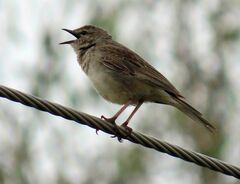
Rufous Songlark

Rufous Songlark

Megalurus mathewsi

Silhouette: Sheatherius · PhyloPic

Daily sighting probability <5% · Rare
at Brisbane

In 3 days <5%

6 Verified sightings at Brisbane
422 In all 9 parks From 2019 to 2026
November Best month
☀️ Diurnal When it's spotted

About the Rufous Songlark

The rufous songlark (Cincloramphus mathewsi) is a species in the family Locustellidae endemic to Australia. It is a species of Locustellidae, which includes the grass warblers and grassbirds. The rufous songlark was described by English ornithologist Tom Iredale in 1911. An alternative generic name Cincloramphus is derived from Greek words cinclus/κιγκλος "wagtail" and ramphos/ραμφος "beak", while the specific epithet honours Gregory Mathews.

As well as rufous songlark, other common names include red-rumped songlark, rufous singing lark, and skylark. The rufous songlark is a medium brown passerine songbird with a pattern of streaks on its feathers. Encyclopædia Britannica describes this bird as "drab and vaguely larklike". It has a dark line through its eye, a pale eyebrow and pale underparts, and a rufous upper tail and rump. A little larger than a house sparrow, the male grows to about 19 cm (7.5 in) in length and is larger than the female which reaches only about 16 cm (6.3 in).

This species is similar to the brown songlark but males of that species are much larger than those of the rufous songlark. Brown songlark females also lack the rufous rump... Wikipedia →

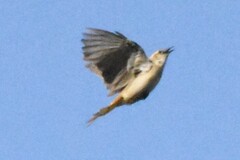
Sounds

Recording0:34

Australia · 2026

© amck98 · iNaturalist · CC BY-NC 4.0

Recording0:11

Australia · 2025

© deborod · iNaturalist · CC BY-NC 4.0

Recording0:03

Australia · 2024

© JEM88789 · iNaturalist · CC BY-NC 4.0

Global Distribution

Parks Where Found

# Park Country Daily sighting probability
1 Uluru-Kata Tjuta National Park 🇦🇺 Australia
~40%
2 Hattah-Kulkyne National Park 🇦🇺 Australia
~10%
3 Flinders Ranges National Park 🇦🇺 Australia
<5%
4 Ningaloo Marine Park 🇦🇺 Australia
<5%
5 Cape Range 🇦🇺 Australia
<5%
6 Kosciuszko National Park 🇦🇺 Australia
<5%
7 Grampians National Park 🇦🇺 Australia
<5%
8 Kakadu National Park 🇦🇺 Australia
<5%
9 Blue Mountains National Park 🇦🇺 Australia
<5%

Cities Where Found

# City Country Daily sighting probability
1 Melbourne 🇦🇺 Australia
<5%
2 Brisbane 🇦🇺 Australia
<5%

Before you go

What are the chances of seeing a Rufous Songlark in Brisbane?

Rare

Under 5% of wildlife watchers report a Rufous Songlark sighting in Brisbane on a given day, based on 6 verified sightings from GBIF citizen-science data. It is the 234th most-seen of the 237 birds we can rate there. Over three days the chance rises to under 5%, if each day is a fresh chance.

When is the best time to see a Rufous Songlark in Brisbane?

Any time of year

In every month with enough records, under 5% of wildlife watchers report a Rufous Songlark in Brisbane on a given day, so our monthly data shows no clear season.

What time of day is best to see a Rufous Songlark?

Between 8 and 11 am

Across all the parks we cover, that three-hour window holds the most Rufous Songlark sightings with a recorded time, and about 9 in 10 of them come between 6 am and 6 pm: it is a daytime animal.

Is Brisbane the best place to see a Rufous Songlark?

Among the best

Of the 2 cities where we can rate Rufous Songlark sightings, Brisbane ranks 2nd at under 5%, level with the leaders once rounded. The best odds are in Melbourne (Australia, under 5%).

Where does the Rufous Songlark sighting chance come from?

GBIF citizen-science records

It is estimated from how often the Rufous Songlark is recorded against all the birds logged in Brisbane (6 verified sightings), calibrated against known sighting rates. Figures are rounded to the nearest 10% because citizen-science data supports honest approximations, not decimals, and months with records from fewer than five people show "—". How it works.

← Back to Brisbane