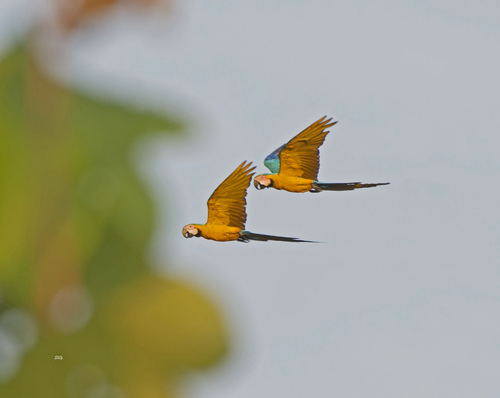
Blue-crowned Trogon

Blue-crowned Trogon

Trogon curucui

Silhouette: Edwin Price · PhyloPic

LCLeast ConcernNTVUENCR
Daily sighting probability ~20% · Possible
at Campo Grande

In 3 days ~50% in a week ~80%

191 Verified sightings at Campo Grande
2,480 In all 9 parks From 2019 to 2026
August Best month
☀️ Diurnal When it's spotted

About the Blue-crowned Trogon

The blue-crowned trogon (Trogon curucui) is a species of bird in the family Trogonidae, the quetzals and trogons. It is found in Brazil, Argentina, Bolivia, Colombia, Ecuador, Paraguay, and Peru. As with all trogons, this species is sexually dimorphic. The male has a blue head with an orange orbital ring, a red belly with a narrow white breastband and a green back. The female differs in having a grey head, a grey back and a broken white eye-ring.

The blue-crowned trogon was formally described by the Swedish naturalist Carl Linnaeus in 1766 in the twelfth edition of his Systema Naturae. He placed it with the other trogons in the genus Trogon and coined the binomial name Trogon curucui. Linnaeus based his description on the "Curucui" that had been described and illustrated in 1648 by the German naturalist Georg Marcgrave in his book Historia Naturalis Brasiliae. The name "Curucui" and the specific epithet are derived from Surucui, a word from the extinct Brazilian Tupi language for a small bird. A 2008 molecular phylogenetic study of the genus Trogon found that the blue-crowned trogon was sister to the yellow-bellied Guianan trogon (T. violaceus).

Three subspecies are recognised... Wikipedia →

Sounds

Duet0:44

Brazil · 2026

© JAYRSON ARAUJO DE OLIVEIRA · XC1186197 · CC BY-NC-SA 4.0

Song0:45

Brazil · 2023

© Franciel da Silva Lima · XC1137707 · CC BY-NC-ND 4.0

Call0:35

Ecuador · 2019

© Jerome Fischer · XC475313 · CC BY-NC-SA 4.0

Global Distribution

Parks Where Found

# Park Country Daily sighting probability
1 Amboró National Park 🇧🇴 Bolivia
~40%
2 Manu National Park 🇵🇪 Peru
~20%
3 Tambopata National Reserve 🇵🇪 Peru
~20%
4 Chapada dos Guimarães National Park 🇧🇷 Brazil
~20%
5 Cuyabeno Wildlife Reserve 🇪🇨 Ecuador
~10%
6 Amacayacu National Natural Park 🇨🇴 Colombia
~10%
7 Yasuní National Park 🇪🇨 Ecuador
~10%
8 Anavilhanas National Park 🇧🇷 Brazil
~10%
9 Parque Estadual Encontro das Águas 🇧🇷 Brazil
<5%

Cities Where Found

# City Country Daily sighting probability
1 Campo Grande 🇧🇷 Brazil
~20%
2 Fortaleza 🇧🇷 Brazil
~10%
3 Asuncion 🇵🇾 Paraguay
<5%
4 Santa Cruz de la Sierra 🇧🇴 Bolivia
<5%

Zoos & Centres Where Found

# Zoo / Centre Country
1 Dallas World Aquarium 🇺🇸 United States In captivity

Before you go

What are the chances of seeing a Blue-crowned Trogon in Campo Grande?

Possible

About 20% of wildlife watchers report a Blue-crowned Trogon sighting in Campo Grande on a given day, based on 191 verified sightings from GBIF citizen-science data. It is the 54th most-seen of the 221 birds we can rate there. Over three days the chance rises to about 50%, and over a week to about 80%, if each day is a fresh chance.

When is the best time to see a Blue-crowned Trogon in Campo Grande?

January–February and August

In those months about 30% of wildlife watchers report a Blue-crowned Trogon in Campo Grande on a given day, against about 10% in April and June–July, the lowest months.

What time of day is best to see a Blue-crowned Trogon?

Between 8 and 11 am

Across all the parks we cover, that three-hour window holds the most Blue-crowned Trogon sightings with a recorded time, and about 8 in 10 of them come between 6 am and 6 pm: it is a daytime animal.

Is Campo Grande the best place to see a Blue-crowned Trogon?

Yes

Of the 4 cities where we can rate Blue-crowned Trogon sightings, Campo Grande has the highest daily chance: about 20%. Next come Fortaleza (Brazil, about 10%) and Asuncion (Paraguay, under 5%).

Where does the Blue-crowned Trogon sighting chance come from?

GBIF citizen-science records

It is estimated from how often the Blue-crowned Trogon is recorded against all the birds logged in Campo Grande (191 verified sightings), calibrated against known sighting rates. Figures are rounded to the nearest 10% because citizen-science data supports honest approximations, not decimals, and months with records from fewer than five people show "—". How it works.

← Back to Campo Grande