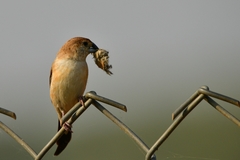
Indian Silverbill

Indian Silverbill

Euodice malabarica

Silhouette: Sheatherius · PhyloPic

LCLeast ConcernNTVUENCR
Daily sighting probability ~10% · With luck
at Chattogram

In 3 days ~30% in a week ~50%

7 Verified sightings at Chattogram
1,613 In all 12 parks From 2019 to 2026
October Best month
🌅 Crepuscular When it's spotted

About the Indian Silverbill

The Indian silverbill or white-throated munia (Euodice malabarica) is a small passerine bird found in the Indian subcontinent and adjoining regions that was formerly considered to include the closely related African silverbill (Euodice cantans). This estrildid finch is a common resident breeding bird in the drier regions of the Middle East and the Indian subcontinent. It has also been introduced into many other parts of the world and has become established in some areas. They forage in small flocks in grassland and scrub habitats.

The Indian silverbill was formally described by the Swedish naturalist Carl Linnaeus in 1758 in the tenth edition of his Systema Naturae. He placed the species with the crossbills in the genus Loxia and coined the binomial name Loxia malabarica.

The specific epithet is from the Malabar region on the southwestern coast of India. Linnaeus specified the locality as India but this was restricted to the Malabar region by E. C. Stuart Baker in 1926. The Indian silverbill is now placed with the African silverbill in the genus Euodice that was introduced by Ludwig Reichenbach in 1862. The species is monotypic: no subspecies are recognised.

The Indian... Wikipedia →

Sounds

Call0:35

India · 2025

© Peter Boesman · XC1030572 · CC BY-NC-ND 4.0

Alarm call0:45

France · 2019

© Stanislas Wroza · XC471528 · CC BY-NC-SA 4.0

Call0:07

France · 2023

© Piqué Simon · XC838993 · CC BY-NC-SA 4.0

Global Distribution

Parks Where Found

# Park Country Daily sighting probability
1 Keoladeo National Park 🇮🇳 India
~30%
2 Gir National Park 🇮🇳 India
~20%
3 Ranthambore National Park 🇮🇳 India
~20%
4 Yala National Park 🇱🇰 Sri Lanka
~10%
5 Satpura National Park 🇮🇳 India
~10%
6 Bandipur National Park 🇮🇳 India
~10%
7 Mudumalai National Park 🇮🇳 India
~10%
8 Bandhavgarh National Park 🇮🇳 India
~10%
9 Kanha National Park 🇮🇳 India
<5%
10 Jim Corbett National Park 🇮🇳 India
<5%
11 Udawalawe National Park 🇱🇰 Sri Lanka
<5%
12 Sundarbans National Park 🇮🇳 India
<5%

Cities Where Found

# City Country Daily sighting probability
1 Doha 🇶🇦 Qatar
~90%
2 Dubai 🇦🇪 United Arab Emirates
~60%
3 Abu Dhabi 🇦🇪 United Arab Emirates
~60%
4 Raipur 🇮🇳 India
~50%
5 Jodhpur 🇮🇳 India
~40%
6 Rajkot 🇮🇳 India
~40%
7 Bhopal 🇮🇳 India
~40%
8 Jaipur 🇮🇳 India
~30%
9 Lucknow 🇮🇳 India
~30%
10 Indore 🇮🇳 India
~30%

Zoos & Centres Where Found

# Zoo / Centre Country
1 Butterfly World 🇺🇸 United States In captivity
2 The Lost Chambers aquarium 🇦🇪 United Arab Emirates In captivity

Before you go

What are the chances of seeing an Indian Silverbill in Chattogram?

With luck

About 10% of wildlife watchers report an Indian Silverbill sighting in Chattogram on a given day, based on 7 verified sightings from GBIF citizen-science data. It is the 55th most-seen of the 76 birds we can rate there. Over three days the chance rises to about 30%, and over a week to about 50%, if each day is a fresh chance.

When is the best time to see an Indian Silverbill in Chattogram?

October

In that month about 20% of wildlife watchers report an Indian Silverbill in Chattogram on a given day, against about 10% in May–June, September and November–March, the lowest months. April and July–August have too few records to rate.

What time of day is best to see an Indian Silverbill?

Between 3 and 6 am

Across all the parks we cover, that three-hour window holds the most Indian Silverbill sightings with a recorded time, and about 6 in 10 of them come between 6 am and 6 pm: it is most active around dawn and dusk.

Is Chattogram the best place to see an Indian Silverbill?

31st of 70

Of the 70 cities where we can rate Indian Silverbill sightings, Chattogram ranks 31st at about 10%. The best odds are in Doha (Qatar, about 90%), Dubai (United Arab Emirates, about 60%) and Abu Dhabi (United Arab Emirates, about 60%).

Which relatives of the Indian Silverbill live in Chattogram?

Same family: Estrildidae

The closest relatives of the Indian Silverbill that you can see in Chattogram (family Estrildidae, Waxbills and Allies) are Chestnut Munia (about 50%), Nutmeg Mannikin (about 20%) and Tricolored Munia (about 10%), with each one's daily chance of a sighting.

Where does the Indian Silverbill sighting chance come from?

GBIF citizen-science records

It is estimated from how often the Indian Silverbill is recorded against all the birds logged in Chattogram (7 verified sightings), calibrated against known sighting rates. Figures are rounded to the nearest 10% because citizen-science data supports honest approximations, not decimals, and months with records from fewer than five people show "—". How it works.

← Back to Chattogram