Nutmeg Mannikin

Nutmeg Mannikin

Lonchura punctulata

Silhouette: Andy Wilson · PhyloPic

LCLeast ConcernNTVUENCR
Daily sighting probability ~20% · Possible
at Chattogram

In 3 days ~60% in a week ~90%

14 Verified sightings at Chattogram
6,748 In all 46 parks From 2019 to 2026
November Best month
☀️ Diurnal When it's spotted

About the Nutmeg Mannikin

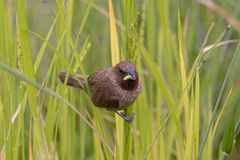
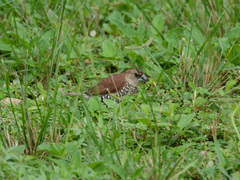
The scaly-breasted munia or spotted munia (Lonchura punctulata), known in the pet trade as nutmeg mannikin or spice finch, is a sparrow-sized estrildid finch native to tropical Asia. A species of the genus Lonchura, it was formally described and named by Carl Linnaeus in 1758. Its name is based on the distinct scale-like feather markings on the breast and belly. The adult is brown above and has a dark conical bill. The species has 11 subspecies across its range, which differ slightly in size and colour.

This munia eats mainly grass seeds apart from berries and small insects. They forage in flocks and communicate with soft calls and whistles. The species is highly social and may sometimes roost with other species of munias. This species is found in tropical plains and grasslands. Breeding pairs construct dome-shaped nests using grass or bamboo leaves.

The species is endemic to Asia and occurs from India and Sri Lanka east to Indonesia and the Philippines (where it is called mayang pakíng). It has been introduced into many other parts of the world, and feral populations have established in Puerto Rico and Hispaniola, as well as parts of Australia, and the United States of America, with sightings in California. The bird is listed as of least concern by the International Union for Conservation of Nature (IUCN). Wikipedia →

Sounds

Call0:27

China · 2025

© Bo Shunqi 薄顺奇 · XC1180719 · CC BY-NC-SA 4.0

Begging call0:20

Malaysia · 2024

© Lim Ying Hien · XC862882 · CC BY-NC-ND 4.0

Call0:55

China · 2019

© Geoff Carey · XC900678 · CC BY-NC-SA 4.0

Global Distribution

Parks Where Found

# Park Country Daily sighting probability
1 Udawalawe National Park 🇱🇰 Sri Lanka
~50%
2 Yala National Park 🇱🇰 Sri Lanka
~40%
3 Bali Barat National Park 🇮🇩 Indonesia
~40%
4 Chitwan National Park 🇳🇵 Nepal
~40%
5 Wilpattu National Park 🇱🇰 Sri Lanka
~30%
6 Royal Bardia National Park 🇳🇵 Nepal
~30%
7 Minneriya National Park 🇱🇰 Sri Lanka
~20%
8 Way Kambas National Park 🇮🇩 Indonesia
~20%
9 Gir National Park 🇮🇳 India
~20%
10 Kanha National Park 🇮🇳 India
~20%
11 Tangkoko Nature Reserve 🇮🇩 Indonesia
~20%
12 Los Haitises National Park 🇩🇴 Dominican Republic
~10%
13 Doi Inthanon National Park 🇹🇭 Thailand
~10%
14 Manas National Park 🇮🇳 India
~10%
15 Bandipur National Park 🇮🇳 India
~10%
16 Sinharaja Forest Reserve 🇱🇰 Sri Lanka
~10%
17 Gunung Leuser National Park 🇮🇩 Indonesia
~10%
18 Mudumalai National Park 🇮🇳 India
~10%
19 Satpura National Park 🇮🇳 India
~10%
20 Kaeng Krachan National Park 🇹🇭 Thailand
~10%
21 Jim Corbett National Park 🇮🇳 India
~10%
22 Sepilok 🇲🇾 Malaysia
~10%
23 Keoladeo National Park 🇮🇳 India
~10%
24 Khao Yai National Park 🇹🇭 Thailand
~10%
25 Nagarhole National Park 🇮🇳 India
~10%
26 Horton Plains National Park 🇱🇰 Sri Lanka
~10%
27 Bandhavgarh National Park 🇮🇳 India
~10%
28 Kerinci Seblat National Park 🇮🇩 Indonesia
~10%
29 Cat Tien National Park 🇻🇳 Vietnam
<5%
30 Taman Negara National Park 🇲🇾 Malaysia
<5%
31 Arrecifes de Cozumel National Park 🇲🇽 Mexico
<5%
32 Khao Luang National Park 🇹🇭 Thailand
<5%
33 Kaziranga National Park 🇮🇳 India
<5%
34 Periyar National Park 🇮🇳 India
<5%
35 Khao Sok National Park 🇹🇭 Thailand
<5%
36 Ranthambore National Park 🇮🇳 India
<5%
37 Royal Manas National Park 🇧🇹 Bhutan
<5%
38 Sundarbans National Park 🇮🇳 India
<5%
39 Kinabalu Park 🇲🇾 Malaysia
<5%
40 Namdapha National Park 🇮🇳 India
<5%
41 Daintree National Park 🇦🇺 Australia
<5%
42 Taroko National Park 🇹🇼 Taiwan
<5%
43 Kinabatangan Wildlife Sanctuary 🇲🇾 Malaysia
<5%
44 Channel Islands National Park 🇺🇸 United States
<5%
45 Everglades National Park 🇺🇸 United States
<5%
46 Merritt Island National Wildlife Refuge 🇺🇸 United States
<5%

Cities Where Found

# City Country Daily sighting probability
1 Raipur 🇮🇳 India
~70%
2 Vasai-Virar 🇮🇳 India
~60%
3 Phnom Penh 🇰🇭 Cambodia
~60%
4 Taichung 🇹🇼 Taiwan
~60%
5 Bangkok 🇹🇭 Thailand
~50%
6 Kalyan-Dombivli 🇮🇳 India
~50%
7 Jakarta 🇮🇩 Indonesia
~50%
8 Yogyakarta 🇮🇩 Indonesia
~50%
9 Ho Chi Minh City 🇻🇳 Vietnam
~40%
10 Nashik 🇮🇳 India
~40%

Zoos & Centres Where Found

# Zoo / Centre Country
1 Aquarium of Genoa 🇮🇹 Italy In captivity
2 Kyiv Zoo 🇺🇦 Ukraine In captivity
3 Taronga Zoo 🇦🇺 Australia In captivity
4 Vogelpark Avifauna 🇳🇱 Netherlands In captivity
5 Taman Indonesia 🇳🇱 Netherlands In captivity

Before you go

What are the chances of seeing a Nutmeg Mannikin in Chattogram?

Possible

About 20% of wildlife watchers report a Nutmeg Mannikin sighting in Chattogram on a given day, based on 14 verified sightings from GBIF citizen-science data. It is the 30th most-seen of the 76 birds we can rate there. Over three days the chance rises to about 60%, and over a week to about 90%, if each day is a fresh chance.

When is the best time to see a Nutmeg Mannikin in Chattogram?

January and November

In those months about 40% of wildlife watchers report a Nutmeg Mannikin in Chattogram on a given day, against about 10% in September, the lowest month. Those are among Chattogram's driest months, with about 35 mm of rain a month against 780 mm in July. April and July–August have too few records to rate.

What time of day is best to see a Nutmeg Mannikin?

Between 8 and 11 am

Across all the parks we cover, that three-hour window holds the most Nutmeg Mannikin sightings with a recorded time, and about 9 in 10 of them come between 6 am and 6 pm: it is a daytime animal.

Is Chattogram the best place to see a Nutmeg Mannikin?

31st of 118

Of the 118 cities where we can rate Nutmeg Mannikin sightings, Chattogram ranks 31st at about 20%. The best odds are in Raipur (India, about 70%), Vasai-Virar (India, about 60%) and Phnom Penh (Cambodia, about 60%).

Which relatives of the Nutmeg Mannikin live in Chattogram?

Same genus: Lonchura

The closest relatives of the Nutmeg Mannikin that you can see in Chattogram (genus Lonchura, Typical Munias and Mannikins) are Chestnut Munia (about 50%) and Tricolored Munia (about 10%), with each one's daily chance of a sighting.

Where does the Nutmeg Mannikin sighting chance come from?

GBIF citizen-science records

It is estimated from how often the Nutmeg Mannikin is recorded against all the birds logged in Chattogram (14 verified sightings), calibrated against known sighting rates. Figures are rounded to the nearest 10% because citizen-science data supports honest approximations, not decimals, and months with records from fewer than five people show "—". How it works.

← Back to Chattogram