Black-necked Stork

Black-necked Stork

Ephippiorhynchus asiaticus

Silhouette: Mike Keesey (vectorization) and Vaibhavcho (photography) · PhyloPic

LCLeast ConcernNTVUENCR
Daily sighting probability <5% · Rare
at Colombo [Sri Jayawardenepura Kotte]

In 3 days <5%

7 Verified sightings at Colombo [Sri Jayawardenepura Kotte]
4,284 In all 8 parks From 2019 to 2026
December Best month
☀️ Diurnal When it's spotted

About the Black-necked Stork

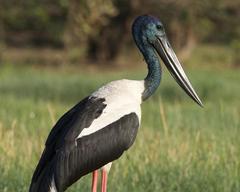
The black-necked stork (Ephippiorhynchus asiaticus) is a tall, long-necked wading bird in the stork family. It is a resident species across the Indian subcontinent and Southeast Asia with a disjunct population in Australia. It lives in wetland habitats and near fields of certain crops such as rice and wheat where it forages for a wide range of animal prey. Adult birds of both sexes have a heavy bill and are patterned in white and irridescent blacks, but the sexes differ in the colour of the iris with females sporting yellow irises and males having dark-coloured irises. In Australia, it is known as a jabiru, although that name also refers to a stork species found in the Americas. It is one of the few storks that are strongly territorial when feeding and breeding.

First described by John Latham as Mycteria asiatica, this species was later placed in the now-defunct genus Xenorhynchus based on morphology. Based on behavioural similarities, M. Philip Kahl suggested the placement of the species in the genus Ephippiorhynchus, which then included a single species, the saddle-billed stork. This placement of both the black-necked stork and saddle-billed stork in... Wikipedia →

Global Distribution

Parks Where Found

# Park Country Daily sighting probability
1 Kaziranga National Park 🇮🇳 India
~70%
2 Keoladeo National Park 🇮🇳 India
~40%
3 Kakadu National Park 🇦🇺 Australia
~40%
4 Yala National Park 🇱🇰 Sri Lanka
~30%
5 Daintree National Park 🇦🇺 Australia
~10%
6 Jim Corbett National Park 🇮🇳 India
~10%
7 Manas National Park 🇮🇳 India
<5%
8 Ranthambore National Park 🇮🇳 India
<5%

Cities Where Found

# City Country Daily sighting probability
1 Brisbane 🇦🇺 Australia
<5%
2 New Delhi 🇮🇳 India
<5%
3 Colombo [Sri Jayawardenepura Kotte] 🇱🇰 Sri Lanka
<5%

Zoos & Centres Where Found

# Zoo / Centre Country
1 Australia Zoo 🇦🇺 Australia In captivity
2 Territory Wildlife Park 🇦🇺 Australia In captivity
3 Nehru Zoological Park 🇮🇳 India In captivity
4 Healesville Sanctuary 🇦🇺 Australia In captivity
5 National Zoo of Malaysia 🇲🇾 Malaysia In captivity
6 Taronga Zoo 🇦🇺 Australia In captivity
7 Currumbin Wildlife Sanctuary 🇦🇺 Australia In captivity
8 Melbourne Zoo 🇦🇺 Australia In captivity
9 Perth Zoo 🇦🇺 Australia In captivity
10 Hartley’s Crocodile Adventures 🇦🇺 Australia In captivity
11 Adelaide Zoo 🇦🇺 Australia In captivity
12 Gorge Wildlife Park 🇦🇺 Australia In captivity
13 Hunter Valley Wildlife Park 🇦🇺 Australia In captivity
14 Featherdale Sydney Wildlife Park 🇦🇺 Australia In captivity
15 Johor Zoo 🇲🇾 Malaysia In captivity
16 Caversham Wildlife Park 🇦🇺 Australia In captivity
17 Nawab Wajid Ali Shah Prani Udyan 🇮🇳 India In captivity
18 Wildlife Habitat Port Douglas 🇦🇺 Australia In captivity

Before you go

What are the chances of seeing a Black-necked Stork in Colombo [Sri Jayawardenepura Kotte]?

Rare

Under 5% of wildlife watchers report a Black-necked Stork sighting in Colombo [Sri Jayawardenepura Kotte] on a given day, based on 7 verified sightings from GBIF citizen-science data. It is the 183rd most-seen of the 204 birds we can rate there. Over three days the chance rises to under 5%, if each day is a fresh chance.

When is the best time to see a Black-necked Stork in Colombo [Sri Jayawardenepura Kotte]?

Any time of year

In every month with enough records, under 5% of wildlife watchers report a Black-necked Stork in Colombo [Sri Jayawardenepura Kotte] on a given day, so our monthly data shows no clear season.

What time of day is best to see a Black-necked Stork?

Between 8 and 11 am

Across all the parks we cover, that three-hour window holds the most Black-necked Stork sightings with a recorded time, and about 9 in 10 of them come between 6 am and 6 pm: it is a daytime animal.

Is Colombo [Sri Jayawardenepura Kotte] the best place to see a Black-necked Stork?

Among the best

Of the 3 cities where we can rate Black-necked Stork sightings, Colombo [Sri Jayawardenepura Kotte] ranks 3rd at under 5%, level with the leaders once rounded. The best odds are in Brisbane (Australia, under 5%) and New Delhi (India, under 5%).

Which relatives of the Black-necked Stork live in Colombo [Sri Jayawardenepura Kotte]?

Same family: Ciconiidae

The closest relatives of the Black-necked Stork that you can see in Colombo [Sri Jayawardenepura Kotte] (family Ciconiidae, Storks) are Asian Openbill Stork (about 20%) and Painted Stork (about 10%), with each one's daily chance of a sighting.

Where does the Black-necked Stork sighting chance come from?

GBIF citizen-science records

It is estimated from how often the Black-necked Stork is recorded against all the birds logged in Colombo [Sri Jayawardenepura Kotte] (7 verified sightings), calibrated against known sighting rates. Figures are rounded to the nearest 10% because citizen-science data supports honest approximations, not decimals, and months with records from fewer than five people show "—". How it works.

← Back to Colombo [Sri Jayawardenepura Kotte]

