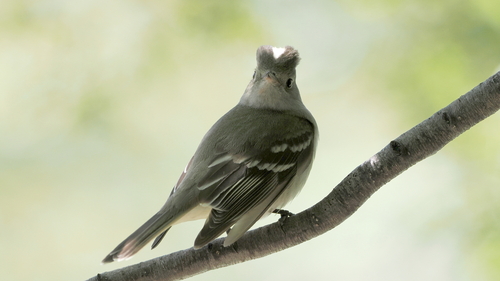
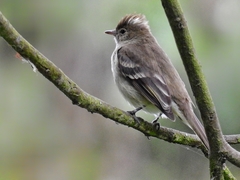
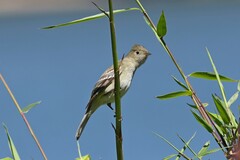
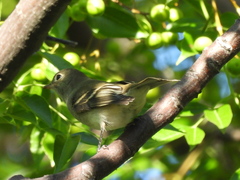
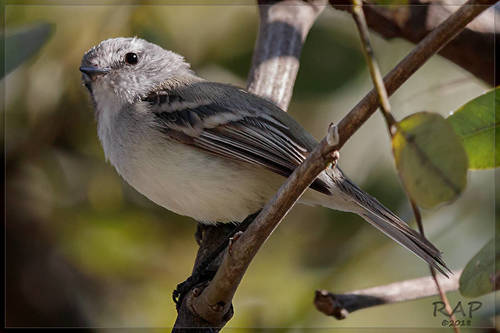
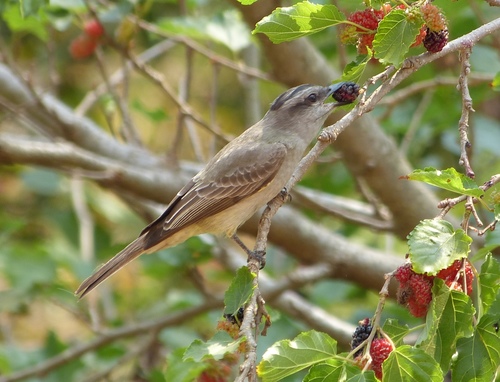
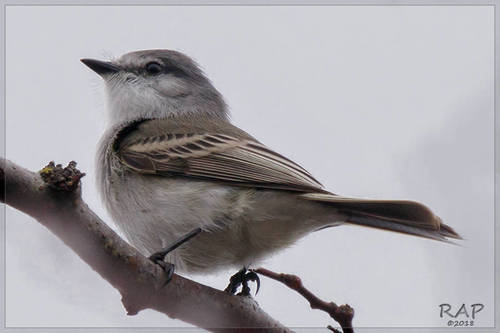
White-crested Elaenia

White-crested Elaenia

Elaenia albiceps

Silhouette: Edwin Price · PhyloPic

LCLeast ConcernNTVUENCR
Daily sighting probability <5% · Rare
at Cordoba

In 3 days ~10% in a week ~20%

77 Verified sightings at Cordoba
3,406 In all 10 parks From 2019 to 2026
October Best month
☀️ Diurnal When it's spotted

About the White-crested Elaenia

The white-crested elaenia (Elaenia albiceps) is a species of bird in subfamily Elaeniinae of family Tyrannidae, the tyrant flycatchers. It is found in Bolivia, Chile, Colombia, Ecuador, and Peru. The white-crested elaenia was formally described in 1837 as Muscipeta albiceps by the French naturalists Alcide d'Orbigny and Frédéric de Lafresnaye. They noted that the species occurred in Rio de Janeiro in Brazil, the Yungas region in Bolivia and the Tacna region of Peru. In 1925 the Austrian ornithologist Carl Eduard Hellmayr restricted the type locality to the Yungas region in Bolivia based on the provenance of the type species. The specific epithet albiceps combines the Latin albus meaning "white" with -ceps meaning "-headed". The white-crested elaenia is now placed in the genus Elaenia that was introduced in 1836 by the Swedish zoologist Carl Jakob Sundevall.

Six subspecies are recognised: Wikipedia →

Sounds

Call1:30

Ecuador · 2026

© Dušan M. Brinkhuizen · XC1163497 · CC BY-NC-ND 4.0

Duet0:59

Chile · 2022

© Esteban Martinez Fredes · XC771840 · CC BY-NC-SA 4.0

Dawn song0:33

Chile · 2022

© Jorge Martini · XC771764 · CC BY-NC-SA 4.0

Global Distribution

Parks Where Found

# Park Country Daily sighting probability
1 Tierra del Fuego National Park 🇦🇷 Argentina
~70%
2 Vicente Pérez Rosales National Park 🇨🇱 Chile
~60%
3 Nahuel Huapi National Park 🇦🇷 Argentina
~50%
4 Torres del Paine National Park 🇨🇱 Chile
~50%
5 Chapada dos Guimarães National Park 🇧🇷 Brazil
~10%
6 Podocarpus National Park 🇪🇨 Ecuador
<5%
7 Amboró National Park 🇧🇴 Bolivia
<5%
8 Chapada Diamantina National Park 🇧🇷 Brazil
<5%
9 Lauca National Park 🇨🇱 Chile
<5%
10 Manu National Park 🇵🇪 Peru
<5%

Cities Where Found

# City Country Daily sighting probability
1 Santiago 🇨🇱 Chile
~30%
2 Quito 🇪🇨 Ecuador
~20%
3 Mendoza 🇦🇷 Argentina
~10%
4 Cordoba 🇦🇷 Argentina
<5%
5 Arequipa 🇵🇪 Peru
<5%
6 Cochabamba 🇧🇴 Bolivia
<5%
7 Buenos Aires 🇦🇷 Argentina
<5%
8 Montevideo 🇺🇾 Uruguay
<5%
9 São Paulo 🇧🇷 Brazil
<5%
10 Lima 🇵🇪 Peru
<5%

Before you go

What are the chances of seeing a White-crested Elaenia in Cordoba?

Rare

Under 5% of wildlife watchers report a White-crested Elaenia sighting in Cordoba on a given day, based on 77 verified sightings from GBIF citizen-science data. It is the 103rd most-seen of the 176 birds we can rate there. Over three days the chance rises to about 10%, and over a week to about 20%, if each day is a fresh chance.

When is the best time to see a White-crested Elaenia in Cordoba?

March and October–November

In those months about 10% of wildlife watchers report a White-crested Elaenia in Cordoba on a given day, against under 5% in April–September and December–February, the lowest months. Those are among Cordoba's wettest months, with about 95 mm of rain a month against 5 mm in August.

What time of day is best to see a White-crested Elaenia?

Between 10 am and 1 pm

Across all the parks we cover, that three-hour window holds the most White-crested Elaenia sightings with a recorded time, and about 9 in 10 of them come between 6 am and 6 pm: it is a daytime animal.

Is Cordoba the best place to see a White-crested Elaenia?

4th of 10

Of the 10 cities where we can rate White-crested Elaenia sightings, Cordoba ranks 4th at under 5%. The best odds are in Santiago (Chile, about 30%), Quito (Ecuador, about 20%) and Mendoza (Argentina, about 10%).

Where does the White-crested Elaenia sighting chance come from?

GBIF citizen-science records

It is estimated from how often the White-crested Elaenia is recorded against all the birds logged in Cordoba (77 verified sightings), calibrated against known sighting rates. Figures are rounded to the nearest 10% because citizen-science data supports honest approximations, not decimals, and months with records from fewer than five people show "—". How it works.

← Back to Cordoba