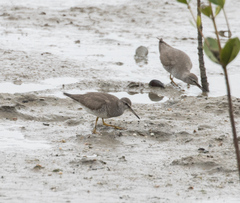
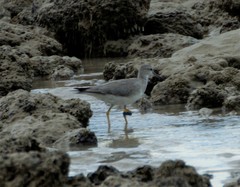
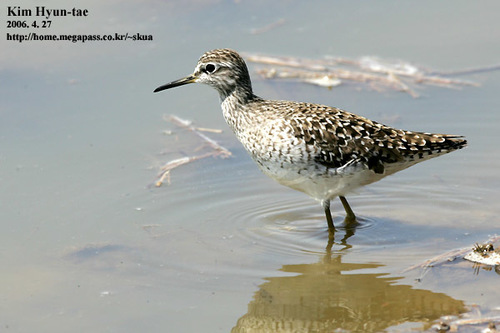
Grey-tailed Tattler

Grey-tailed Tattler

Tringa brevipes

Silhouette: Cristian Gutierrez-Ibanez · PhyloPic

LCLeast ConcernNTVUENCR
Daily sighting probability <5% · Rare
at Denpasar

In 3 days ~10% in a week ~20%

18 Verified sightings at Denpasar
521 In all 9 parks From 2019 to 2026
November Best month
☀️ Diurnal When it's spotted

About the Grey-tailed Tattler

The grey-tailed tattler (Tringa brevipes), also known as the Siberian tattler or Polynesian tattler, is a small shorebird in the genus Tringa. The English name for the tattlers refers to their noisy call. The genus name Tringa is the Neo-Latin name given to the green sandpiper by Aldrovandus in 1599 based on Ancient Greek trungas, a thrush-sized, white-rumped, tail-bobbing wading bird mentioned by Aristotle. The specific brevipes is from Latin brevis, "short", and pes, "foot".

This tattler breeds in northeast Siberia. After breeding, they migrate to an area from southeast Asia to Australia. The grey-tailed tattler is closely related to its North American counterpart, the wandering tattler (T. incana) and is difficult to distinguish from that species. Both tattlers are unique among the species of Tringa for having unpatterned, greyish wings and back, and a scaly breast pattern extending more or less onto the belly in breeding plumage, in which both also have a rather prominent supercilium.

These birds resemble common redshanks in shape and size. The upper parts, underwings, face and neck are grey, and the belly is white. They have short yellowish legs and a bill with... Wikipedia →

Sounds

Call0:12

China · 2025

© 雪鼬 · XC1001654 · CC BY-NC-SA 4.0

Alarm call0:12

Russian Federation · 2021

© Albert Lastukhin · XC675904 · CC BY-NC-ND 4.0

Flight call0:07

Japan · 2014

© Ross Gallardy · XC192308 · CC BY-NC-SA 4.0

Global Distribution

Parks Where Found

# Park Country Daily sighting probability
1 Cape Range 🇦🇺 Australia
~30%
2 Ningaloo Marine Park 🇦🇺 Australia
~20%
3 Bali Barat National Park 🇮🇩 Indonesia
~20%
4 Everglades National Park 🇺🇸 United States
~10%
5 Raja Ampat 🇮🇩 Indonesia
~10%
6 Tangkoko Nature Reserve 🇮🇩 Indonesia
<5%
7 Daintree National Park 🇦🇺 Australia
<5%
8 Rottnest Island 🇦🇺 Australia
<5%
9 Noosa National Park 🇦🇺 Australia
<5%

Cities Where Found

# City Country Daily sighting probability
1 Naha 🇯🇵 Japan
~20%
2 Davao City 🇵🇭 Philippines
~10%
3 Makassar 🇮🇩 Indonesia
~10%
4 Tokyo 🇯🇵 Japan
~10%
5 Cebu City 🇵🇭 Philippines
<5%
6 Manila 🇵🇭 Philippines
<5%
7 Sydney 🇦🇺 Australia
<5%
8 Osaka 🇯🇵 Japan
<5%
9 Nagoya 🇯🇵 Japan
<5%
10 Denpasar 🇮🇩 Indonesia
<5%

Zoos & Centres Where Found

# Zoo / Centre Country
1 Seattle Aquarium 🇺🇸 United States In captivity
2 Seattle Marine Aquarium 🇺🇸 United States In captivity

Before you go

What are the chances of seeing a Grey-tailed Tattler in Denpasar?

Rare

Under 5% of wildlife watchers report a Grey-tailed Tattler sighting in Denpasar on a given day, based on 18 verified sightings from GBIF citizen-science data. It is the 76th most-seen of the 109 birds we can rate there. Over three days the chance rises to about 10%, and over a week to about 20%, if each day is a fresh chance.

When is the best time to see a Grey-tailed Tattler in Denpasar?

November

In that month about 10% of wildlife watchers report a Grey-tailed Tattler in Denpasar on a given day, against under 5% in December to October, the lowest months.

What time of day is best to see a Grey-tailed Tattler?

Between noon and 3 pm

Across all the parks we cover, that three-hour window holds the most Grey-tailed Tattler sightings with a recorded time, and about 8 in 10 of them come between 6 am and 6 pm: it is a daytime animal.

Is Denpasar the best place to see a Grey-tailed Tattler?

10th of 19

Of the 19 cities where we can rate Grey-tailed Tattler sightings, Denpasar ranks 10th at under 5%. The best odds are in Naha (Japan, about 20%), Davao City (Philippines, about 10%) and Makassar (Indonesia, about 10%).

Where does the Grey-tailed Tattler sighting chance come from?

GBIF citizen-science records

It is estimated from how often the Grey-tailed Tattler is recorded against all the birds logged in Denpasar (18 verified sightings), calibrated against known sighting rates. Figures are rounded to the nearest 10% because citizen-science data supports honest approximations, not decimals, and months with records from fewer than five people show "—". How it works.

← Back to Denpasar