Common Tiger Butterfly

Common Tiger Butterfly

Danaus genutia

Daily sighting probability ~20% · Possible
at Dhaka

In 3 days ~50% in a week ~80%

13 Verified sightings at Dhaka
171 In all 13 parks From 2019 to 2026
June Best month
☀️ Diurnal When it's spotted

About the Common Tiger Butterfly

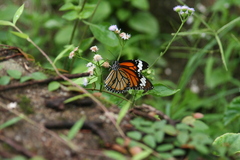
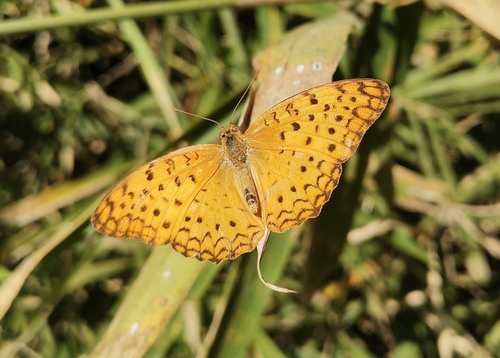
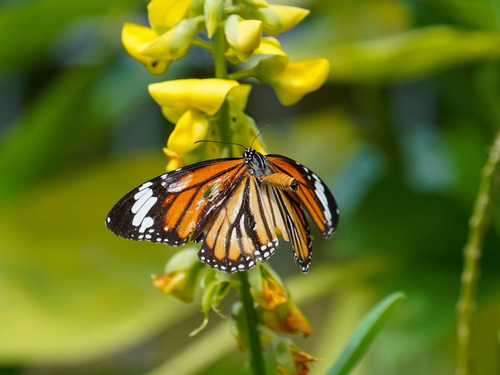
Danaus genutia, the common tiger, is one of the common butterflies of India. It belongs to the "crows and tigers", that is, the Danainae group of the brush-footed butterflies family. The butterfly is also called striped tiger in India to differentiate it from the equally common plain tiger, Danaus chrysippus. The species was first described by Pieter Cramer in 1779.

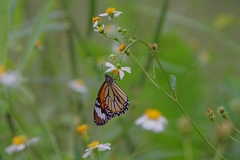
The butterfly closely resembles the monarch butterfly (Danaus plexippus) of the Americas. The wingspan is 70 to 95 millimetres (2.8 to 3.7 in). Both sexes of the butterfly have tawny wings with veins marked with broad black bands. The male has a pouch on the hindwing. The margins of the wings are black with two rows of white spots. The underside of the wings resembles the upperside but is paler in colouration. The male common tiger has a prominent black-and-white spot on the underside of the hindwing. In drier regions the tawny part of the hindwing pales and approaches white in colour making it very similar to the white tiger (D. melanippus).

D. genutia is distributed throughout India, Sri Lanka, Myanmar and extending to South-East Asia and Australia (except New Guinea). At... Wikipedia →
Global Distribution

Parks Where Found

# Park Country Daily sighting probability
1 Cuc Phuong National Park 🇻🇳 Vietnam
~40%
2 Keoladeo National Park 🇮🇳 India
~30%
3 Tangkoko Nature Reserve 🇮🇩 Indonesia
~30%
4 Cat Tien National Park 🇻🇳 Vietnam
~30%
5 Chitwan National Park 🇳🇵 Nepal
~30%
6 Wilpattu National Park 🇱🇰 Sri Lanka
~30%
7 Udawalawe National Park 🇱🇰 Sri Lanka
~20%
8 Minneriya National Park 🇱🇰 Sri Lanka
~20%
9 Kanha National Park 🇮🇳 India
~10%
10 Kinabalu Park 🇲🇾 Malaysia
~10%
11 Khao Yai National Park 🇹🇭 Thailand
~10%
12 Kaeng Krachan National Park 🇹🇭 Thailand
~10%
13 Doi Inthanon National Park 🇹🇭 Thailand
~10%

Cities Where Found

# City Country Daily sighting probability
1 Surat 🇮🇳 India
~40%
2 Jabalpur 🇮🇳 India
~30%
3 Xiuying District 🇨🇳 China
~30%
4 Guiyang 🇨🇳 China
~30%
5 Kolkata 🇮🇳 India
~30%
6 Mumbai 🇮🇳 India
~30%
7 Nashik 🇮🇳 India
~20%
8 Kalyan-Dombivli 🇮🇳 India
~20%
9 Salem 🇮🇳 India
~20%
10 Phnom Penh 🇰🇭 Cambodia
~20%

Before you go

What are the chances of seeing a Common Tiger Butterfly in Dhaka?

Possible

About 20% of wildlife watchers report a Common Tiger Butterfly sighting in Dhaka on a given day, based on 13 verified sightings from GBIF citizen-science data. It is the 40th most-seen of the 92 insects we can rate there. Over three days the chance rises to about 50%, and over a week to about 80%, if each day is a fresh chance.

When is the best time to see a Common Tiger Butterfly in Dhaka?

April and June

In those months about 40% of wildlife watchers report a Common Tiger Butterfly in Dhaka on a given day, against under 5% in July–August and October–March, the lowest months. Those are among Dhaka's wettest months, with about 270 mm of rain a month against 10 mm in January.

What time of day is best to see a Common Tiger Butterfly?

Between 10 am and 1 pm

Across all the parks we cover, that three-hour window holds the most Common Tiger Butterfly sightings with a recorded time, and about 8 in 10 of them come between 6 am and 6 pm: it is a daytime animal.

Is Dhaka the best place to see a Common Tiger Butterfly?

17th of 37

Of the 37 cities where we can rate Common Tiger Butterfly sightings, Dhaka ranks 17th at about 20%. The best odds are in Surat (India, about 40%), Jabalpur (India, about 30%) and Xiuying District (China, about 30%).

Where does the Common Tiger Butterfly sighting chance come from?

GBIF citizen-science records

It is estimated from how often the Common Tiger Butterfly is recorded against all the insects logged in Dhaka (13 verified sightings), calibrated against known sighting rates. Figures are rounded to the nearest 10% because citizen-science data supports honest approximations, not decimals, and months with records from fewer than five people show "—". How it works.

← Back to Dhaka