Indian Muntjac

Indian Muntjac

Muntiacus muntjak

Silhouette: Steven Traver · PhyloPic

LCLeast ConcernNTVUENCR
Daily sighting probability ~10% · With luck
at Guangzhou

In 3 days ~20% in a week ~30%

12 Verified sightings at Guangzhou
624 In all 17 parks From 2019 to 2026
January Best month
🌅 Crepuscular When it's spotted

About the Indian Muntjac

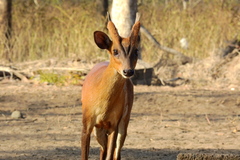
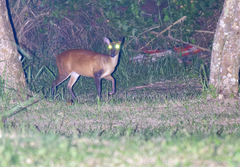
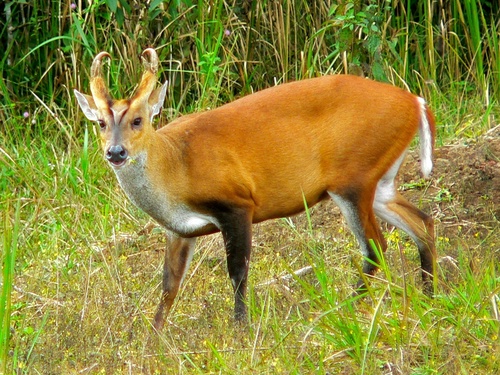
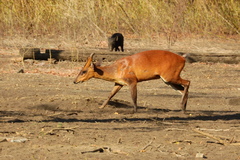
The southern red muntjac (Muntiacus muntjak) is a deer species native to Southeast Asia. It was formerly known as the Indian muntjac or the common muntjac before the species was taxonomically revised to represent only populations of Thailand, Sunda and perhaps Malaysia. The other populations being attributed to this species are now attributed to Muntiacus vaginalis (northern red muntjac). Muntjacs are also referred to as barking deer. It is listed as Least Concern on the IUCN Red List.

This muntjac has soft, short, brownish or grayish hair, sometimes with creamy markings. It is among the smallest deer species. It is an omnivore and eats grass, fruit, shoots, seeds, bird eggs, and small animals, and occasionally scavenges on carrion. Its calls sound like barking, often when frightened by a predator, hence the common name "barking deer". Males have canines, short antlers that usually branch just once near the base, and a large postorbital scent gland used to mark territories.

The southern red muntjac has a short but very soft, thick, dense coat that is more dense in cooler regions. Its face is darker and the limbs are dark to reddish brown and the coat color seasonally... Wikipedia →
Sounds

Recording0:26

Hong Kong SAR China · 2024

© johnallcock · iNaturalist · CC BY-NC 4.0

Recording0:15

India · 2026

© Kapish Garg · iNaturalist · CC BY-NC 4.0

Recording0:23

Nepal · 2025

© Natalya Andreyenkova · iNaturalist · CC BY-NC 4.0

Global Distribution

Parks Where Found

# Park Country Daily sighting probability
1 Khao Yai National Park 🇹🇭 Thailand
~70%
2 Kanha National Park 🇮🇳 India
~60%
3 Jim Corbett National Park 🇮🇳 India
~60%
4 Wilpattu National Park 🇱🇰 Sri Lanka
~50%
5 Bandhavgarh National Park 🇮🇳 India
~50%
6 Cat Tien National Park 🇻🇳 Vietnam
~40%
7 Way Kambas National Park 🇮🇩 Indonesia
~40%
8 Kaziranga National Park 🇮🇳 India
~40%
9 Royal Bardia National Park 🇳🇵 Nepal
~40%
10 Nagarhole National Park 🇮🇳 India
~40%
11 Bali Barat National Park 🇮🇩 Indonesia
~40%
12 Manas National Park 🇮🇳 India
~40%
13 Langtang National Park 🇳🇵 Nepal
~40%
14 Chitwan National Park 🇳🇵 Nepal
~40%
15 Royal Manas National Park 🇧🇹 Bhutan
~40%
16 Taman Negara National Park 🇲🇾 Malaysia
~40%
17 Kaeng Krachan National Park 🇹🇭 Thailand
~20%

Cities Where Found

# City Country Daily sighting probability
1 Guwahati 🇮🇳 India
~20%
2 Guangzhou 🇨🇳 China
~10%

Zoos & Centres Where Found

# Zoo / Centre Country
1 Barcelona Zoo 🇪🇸 Spain In captivity
2 Bali Zoo 🇮🇩 Indonesia In captivity
3 Taman Safari Indonesia 🇮🇩 Indonesia In captivity
4 Taman Safari Bogor 🇮🇩 Indonesia In captivity
5 Nehru Zoological Park 🇮🇳 India In captivity
6 Columbus Zoo and Aquarium 🇺🇸 United States In captivity
7 Kadoorie Farm and Botanic Garden 🇭🇰 Hong Kong SAR China In captivity
8 La Torbiera 🇮🇹 Italy In captivity
9 Bannerghatta Zoo 🇮🇳 India In captivity
10 Terra Natura Benidorm 🇪🇸 Spain In captivity
11 Night Safari 🇸🇬 Singapore In captivity
12 National Zoo of Malaysia 🇲🇾 Malaysia In captivity
13 Jijamata Udyaan 🇮🇳 India In captivity
14 Alipore Zoological Gardens 🇮🇳 India In captivity
15 Gembira Loka Zoo 🇮🇩 Indonesia In captivity
16 Saigon Zoo and Botanical Gardens 🇻🇳 Vietnam In captivity
17 Zoo Santo Inácio 🇵🇹 Portugal In captivity
18 Bandung Zoo 🇮🇩 Indonesia In captivity
19 Aquarama Barcelona 🇪🇸 Spain In captivity
20 Paphos Zoo 🇨🇾 Cyprus In captivity
21 Zoo de Córdoba 🇪🇸 Spain In captivity
22 Palmitos Park 🇪🇸 Spain In captivity
23 Faunistic Park Cappeller 🇮🇹 Italy In captivity
24 Sequoia Park Zoo 🇺🇸 United States In captivity
25 Zoo Koki (Parque zoológico y botánico) 🇪🇸 Spain In captivity
26 Vogelpark Heiligenkirchen 🇩🇪 Germany In captivity
27 Sea World Indonesia 🇮🇩 Indonesia In captivity

Before you go

What are the chances of seeing an Indian Muntjac in Guangzhou?

With luck

About 10% of wildlife watchers report an Indian Muntjac sighting in Guangzhou on a given day, based on 12 verified sightings from GBIF citizen-science data. It is the 7th most-seen of the 9 mammals we can rate there. Over three days the chance rises to about 20%, and over a week to about 30%, if each day is a fresh chance.

When is the best time to see an Indian Muntjac in Guangzhou?

January–February, April–May, July and November

In those months about 10% of wildlife watchers report an Indian Muntjac in Guangzhou on a given day, against under 5% in March, June, August–October and December, the lowest months.

What time of day is best to see an Indian Muntjac?

Between 2 and 5 am

Across all the parks we cover, that three-hour window holds the most Indian Muntjac sightings with a recorded time, and about half of them come between 6 pm and 6 am: it is most active around dawn and dusk.

Is Guangzhou the best place to see an Indian Muntjac?

2nd of 2

Of the 2 cities where we can rate Indian Muntjac sightings, Guangzhou ranks 2nd at about 10%. The best odds are in Guwahati (India, about 20%).

Where does the Indian Muntjac sighting chance come from?

GBIF citizen-science records

It is estimated from how often the Indian Muntjac is recorded against all the mammals logged in Guangzhou (12 verified sightings), calibrated against known sighting rates. Figures are rounded to the nearest 10% because citizen-science data supports honest approximations, not decimals, and months with records from fewer than five people show "—". How it works.

← Back to Guangzhou