Daurian Redstart

Daurian Redstart

Phoenicurus auroreus

Silhouette: Martin Bulla, based on François Desbordes' illustration · PhyloPic

LCLeast ConcernNTVUENCR
Daily sighting probability ~30% · Possible
at Gwangju

In 3 days ~60% in a week ~90%

48 Verified sightings at Gwangju
644 In all 9 parks From 2019 to 2026
November Best month
🌅 Crepuscular When it's spotted

About the Daurian Redstart

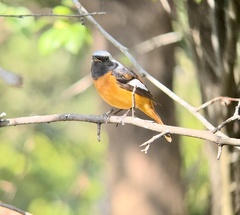
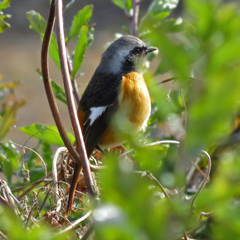
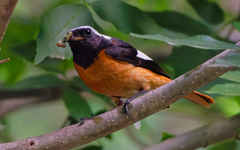
The Daurian redstart (Phoenicurus auroreus) is a small passerine bird from temperate Asia. The species was first described by Peter Simon Pallas in 1776. Its length is 14 to 15 cm and its weight is 11 to 20 g. Like all typical redstarts, they are strongly sexually dimorphic. Breeding males have a grey crown and nape with lighter forehead and crown-sides, a black face and chin, brownish mantle and wings and a large white wing patch; the chest, lower back and rump are orange, and the tail is black with orange sides. Juvenile males are similarly patterned but much duller and less clearly marked.

Females are warm brown above, paler below, have an orange rump and tail sides, and have a large white wing patch similar to the males. Bill, eye, legs and feet are black in both sexes. It was formerly classed as a member of the thrush family (Turdidae), but is now generally considered to be an Old World flycatcher (Muscicapidae).

It belongs to a close-knit Eurasian clade which also includes the black redstart (P. ochruros), Hodgson's redstart (P. hodgsoni... Wikipedia →

Sounds

Song1:00

China · 2026

© Peter Boesman · XC1147674 · CC BY-NC-ND 4.0

Call0:12

China · 2025

© Bo Shunqi 薄顺奇 · XC1048567 · CC BY-NC-SA 4.0

Begging call0:04

China · 2025

© Ding Li Yong · XC1006256 · CC BY-NC-ND 4.0

Global Distribution

Parks Where Found

# Park Country Daily sighting probability
1 Taroko National Park 🇹🇼 Taiwan
~20%
2 Jiuzhaigou National Park 🇨🇳 China
~10%
3 Gobi Gurvansaikhan National Park 🇲🇳 Mongolia
~10%
4 Kaziranga National Park 🇮🇳 India
<5%
5 Namdapha National Park 🇮🇳 India
<5%
6 Nikko National Park 🇯🇵 Japan
<5%
7 Doi Inthanon National Park 🇹🇭 Thailand
<5%
8 Cuc Phuong National Park 🇻🇳 Vietnam
<5%
9 Royal Manas National Park 🇧🇹 Bhutan
<5%

Cities Where Found

# City Country Daily sighting probability
1 Guiyang 🇨🇳 China
~50%
2 Fukuoka 🇯🇵 Japan
~50%
3 Busan 🇰🇷 South Korea
~50%
4 Daejeon 🇰🇷 South Korea
~50%
5 Seoul 🇰🇷 South Korea
~50%
6 Nanchang 🇨🇳 China
~50%
7 Xining 🇨🇳 China
~40%
8 Fuzhou 🇨🇳 China
~40%
9 Qingdao 🇨🇳 China
~40%
10 Jinhua 🇨🇳 China
~40%

Zoos & Centres Where Found

# Zoo / Centre Country
1 Leipzig Zoological Garden 🇩🇪 Germany In captivity
2 Zoologischer Garten Leipzig 🇩🇪 Germany In captivity
3 Inokashira Park Zoo 🇯🇵 Japan In captivity
4 Wolfgang-Köhler-Primaten-Forschungszentrum 🇩🇪 Germany In captivity

Before you go

What are the chances of seeing a Daurian Redstart in Gwangju?

Possible

About 30% of wildlife watchers report a Daurian Redstart sighting in Gwangju on a given day, based on 48 verified sightings from GBIF citizen-science data. It is the 21st most-seen of the 50 birds we can rate there. Over three days the chance rises to about 60%, and over a week to about 90%, if each day is a fresh chance.

When is the best time to see a Daurian Redstart in Gwangju?

November and December

In those months about 50% of wildlife watchers report a Daurian Redstart in Gwangju on a given day, against about 10% in April, June and September, the lowest months. Those are among Gwangju's driest months, with about 40 mm of rain a month against 290 mm in July. August has too few records to rate.

What time of day is best to see a Daurian Redstart?

Between 3 and 6 am

Across all the parks we cover, that three-hour window holds the most Daurian Redstart sightings with a recorded time, and about half of them come between 6 pm and 6 am: it is most active around dawn and dusk.

Is Gwangju the best place to see a Daurian Redstart?

18th of 52

Of the 52 cities where we can rate Daurian Redstart sightings, Gwangju ranks 18th at about 30%. The best odds are in Guiyang (China, about 50%), Fukuoka (Japan, about 50%) and Busan (South Korea, about 50%).

Which relatives of the Daurian Redstart live in Gwangju?

Same order: Passeriformes

The closest relatives of the Daurian Redstart that you can see in Gwangju (order Passeriformes, Perching Birds) are Brown-eared Bulbul (over 90%), Oriental Magpie (over 90%) and Eurasian Tree Sparrow (about 80%), with each one's daily chance of a sighting.

Where does the Daurian Redstart sighting chance come from?

GBIF citizen-science records

It is estimated from how often the Daurian Redstart is recorded against all the birds logged in Gwangju (48 verified sightings), calibrated against known sighting rates. Figures are rounded to the nearest 10% because citizen-science data supports honest approximations, not decimals, and months with records from fewer than five people show "—". How it works.

← Back to Gwangju